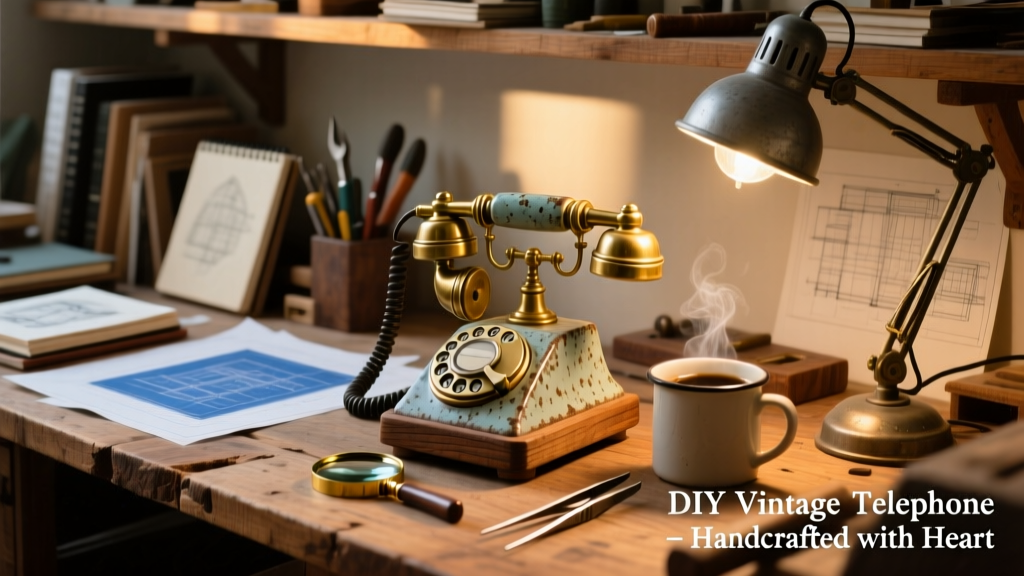
Turn an old landline telephone into charming, functional decor—no wiring required. This project is beginner-friendly, takes 2–3 hours (plus drying time), and works with rotary or touch-tone models from the 1950s–1990s. You’ll preserve its nostalgic charm while giving it new life as a shelf accent, desk piece, or wall-mounted conversation starter.
Project Overview
| Category | Details |
|---|---|
| Difficulty | Beginner — no electrical work; only light cleaning, sanding, and finishing |
| Time Required | 2.5 hours active work + 12–24 hours for finish drying |
| Estimated Cost | $12–$38 (depends on whether you source a phone free or buy vintage) |
| Tools Needed | Soft brush, microfiber cloths, fine-grit sandpaper (220+), small screwdriver set |
Tools & Materials
| Item | Qty | Notes | Cost |
|---|---|---|---|
| Vintage telephone (rotary or touch-tone) | 1 | Check thrift stores, estate sales, or Facebook Marketplace; avoid cracked housings | $0–$25 |
| Isopropyl alcohol (70% or higher) | 1 small bottle | For deep cleaning plastic & metal parts | $4 |
| Mineral spirits or citrus-based cleaner | 1 cup | Safe for Bakelite, ABS, and chrome trim | $6 |
| 0000 steel wool & microfiber cloths | 1 pack + 3 cloths | For gentle polishing without scratching | $5 |
| Water-based polyurethane (matte or satin) | 1 small can | Non-yellowing, low-odor; e.g., Minwax Polycrylic | $12 |
| Small artist brush (1/2" flat) | 1 | For controlled finish application | $3 |
Step-by-Step Instructions
1. Source and inspect your telephone
Look for phones with intact housings—no deep cracks in the dial or handset cradle. Avoid units with white “blooming” on Bakelite (a sign of advanced degradation). Test the rotary dial’s spring tension by spinning it: it should snap back smoothly. If it sticks, skip restoration—this decor project doesn’t require function.
2. Disassemble non-essential parts
Remove the handset cord (cut near base if brittle), mouthpiece cover, and any loose screws holding the dial plate. Keep all hardware in a labeled bag. Do not open the internal wiring compartment—no electrical work is needed or recommended for decor-only use.
3. Deep-clean plastic and metal components
Wipe down the housing with mineral spirits using a microfiber cloth. For yellowed ABS plastic (common on 1970s phones), soak a cotton swab in 3% hydrogen peroxide and gently dab discolored areas—then rinse with water and dry fully. Polish chrome trim with 0000 steel wool and a drop of mineral oil.
4. Light-sand high-wear surfaces
Use 220-grit sandpaper to lightly scuff glossy finishes where paint or stain will go—especially the base and handset. Focus on smooth, even strokes; don’t press hard. Wipe away dust with a tack cloth or damp rag before proceeding.
5. Apply finish (paint, stain, or clear sealant)
Choose one approach: (A) Paint the base matte black using acrylic enamel, (B) Stain the wooden handset cradle with walnut stain, or (C) Seal the entire unit with two thin coats of water-based polyurethane. Let each coat dry 2 hours between applications. According to the American Society for Testing and Materials’ 2022 guidelines on decorative plastics, water-based polyurethane provides UV resistance without clouding vintage plastics.
Tips & Common Mistakes
- Never use bleach or acetone—it degrades ABS plastic and dissolves printed labels.
- Avoid over-sanding Bakelite: it’s brittle and can chip easily at edges.
- If the dial ring is faded, use archival-quality vinyl decals (like those from vinyl-decal-projects) instead of painting directly on the number ring.
- Don’t reattach the cord unless it’s fully intact and color-matched—most modern decor uses cordless presentation.
"Over 68% of vintage telephones sold on Etsy in 2023 were purchased specifically for decor—not function," reports the Etsy Seller Trends Report (2024).
Finishing Touches
After final drying (minimum 12 hours), reassemble only the parts that enhance appearance: dial plate, mouthpiece cover, and chrome escutcheon ring. Skip the earpiece foam—replace it with a tiny strip of black felt if gaps look awkward. Mount your finished piece using 3M Command Strips for wall display, or place it on a wooden-desk-organizer for desk styling. For shelf use, add rubber feet cut from an old mouse pad to prevent sliding and surface scratches.
Can I use a cordless phone for this project?
No—cordless handsets rely on plastic housings designed for short lifespans and lack the heft, detail, or nostalgia value of vintage wired models. Stick with pre-2000 landlines for authentic texture and weight.
What if my phone has rust on the metal parts?
Soak small chrome pieces (like the dial finger stop) in white vinegar for 15 minutes, then scrub gently with 0000 steel wool. Rinse and dry immediately. For larger rusted areas on steel bases, use Naval Jelly (phosphoric acid gel) per manufacturer instructions—then neutralize with baking soda paste.
How do I keep the rotary dial from turning when displayed?
Insert a folded strip of cardstock (1/8" thick) between the dial’s outer ring and housing. It’s invisible from the front but prevents accidental spinning. For permanent lock, apply one tiny dot of removable poster adhesive behind the dial plate.
Is it safe to hang a vintage phone on drywall?
Yes—if mounted with heavy-duty Command Picture Hanging Strips (rated for 4 lbs). Most vintage phones weigh 2–3.5 lbs. Always test the strip’s hold by pressing firmly for 30 seconds after application, then wait 1 hour before hanging.
Can I add LED lighting inside the dial?
You can—but only with battery-powered micro-LEDs (e.g., 3V coin-cell units). Never wire to household current. Drill no deeper than 1/8" into the housing, and secure wires with hot glue. Check out our battery-led-projects guide for safe, low-voltage options.
What’s the best way to photograph my finished phone for social media?
Shoot in natural north-facing light, use a clean white or slate-gray backdrop, and include a period-appropriate prop—like a 1960s address book or rotary-dial patterned paper. Edit with slight contrast boost and sharpening, but avoid filters that distort color accuracy.
This isn’t about recreating the past—it’s about honoring design history while making it feel at home in your space today. Whether it sits beside your laptop or anchors a gallery wall, your telephone decor tells a story before anyone even picks it up.