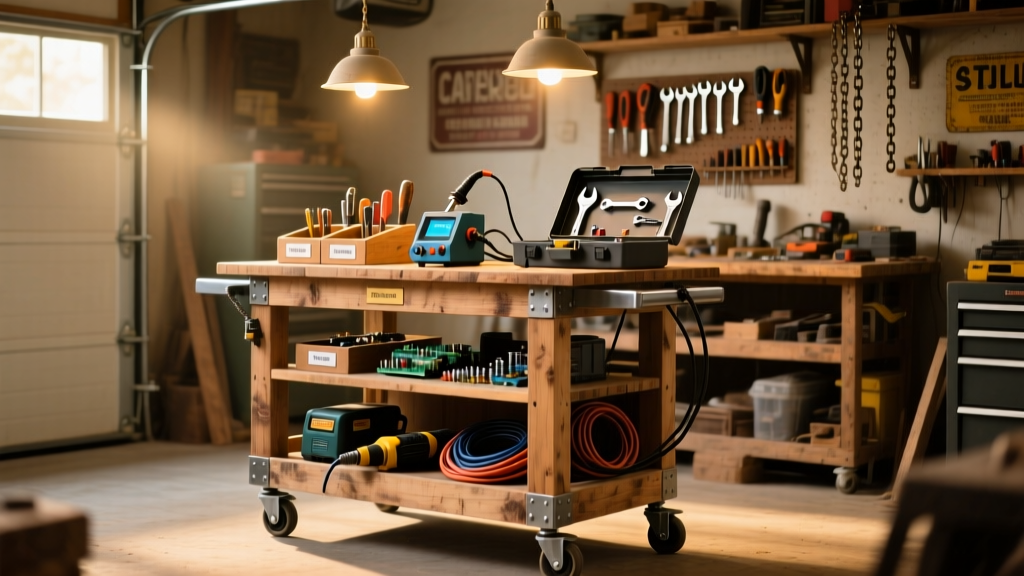
Build a 36" × 24" mobile workbench with a 1¾" hardwood top, full-width lower shelf, and industrial-grade locking casters—designed to roll smoothly across concrete or epoxy floors while holding up to 300 lbs. This is a beginner-friendly project (no power tools mandatory) that takes 8–12 hours across two days.
Project Overview
| Category | Detail |
|---|---|
| Difficulty | Beginner (requires basic drill & square use) |
| Time Required | 8–12 hours (including drying time for glue) |
| Estimated Cost | $185–$240 (varies by lumber grade and caster quality) |
| Tools Needed | Drill/driver, speed square, tape measure, clamps (4× 24" bar clamps recommended), orbital sander |
Tools & Materials
You’ll need both structural and finish-grade components. All lumber is #2 grade pine unless noted—swap to maple or birch plywood for heavy-duty use (adds ~$65). Casters must be rated ≥100 lbs each and include swivel + brake mechanisms.
| Item | Qty | Specs | Cost |
|---|---|---|---|
| Workbench top | 1 | 36" × 24" × 1¾" maple butcher block (Rockler #72120) | $129.99 |
| Leg frames | 2 | 2×3 × 30" (spruce, pressure-treated for moisture resistance) | $14.80 |
| Aprons & shelf supports | 6 | 1×4 × 36" (pine, kiln-dried) | $12.20 |
| Lower shelf | 1 | 36" × 24" × ¾" birch plywood | $22.50 |
| Locking casters | 4 | 5" diameter, 125-lb capacity, zinc-plated steel (Grainger #5ZC52) | $39.96 |
| Hardware | — | 2½" pocket-hole screws (Kreg), 3" structural screws, wood glue (Titebond III) | $11.40 |
Step-by-Step Instructions
Cut and prep all lumber
Use a speed square and pencil to mark cuts. Rip the 2×3 legs to exact 30" height on a miter saw—or have Home Depot cut them free with your purchase. Sand all edges with 120-grit paper to prevent splinters. Label each piece: “Front Left Leg”, “Rear Right Apron”, etc.—this avoids assembly confusion later.
Assemble leg frames with pocket holes
Clamp two 2×3 legs vertically, spaced 24" apart (inside-to-inside). Drill two pocket holes per side using a Kreg Jig set to 1½" depth. Attach 1×4 aprons between legs with 2½" screws. Repeat for second frame. Let glue dry 45 minutes before handling.
Mount casters to leg frames
Flip each frame upside down. Center a caster 1" from each corner edge—mark screw holes with an awl. Pre-drill ⅛" pilot holes through the 2×3’s base. Secure with included hardware; tighten only after all four are positioned. Pro tip: Use a level across the bottom of both frames to confirm they sit flat—if not, sand high corners lightly.
Join frames with top and shelf supports
Position frames 36" apart (outside-to-outside). Connect them with three 1×4 cross braces: one centered under the top, two spaced 6" in from each end to support the lower shelf. Screw upward into the leg frames using 3" structural screws. Clamp everything before final tightening.
Attach the workbench top and shelf
Apply Titebond III glue to the top surface of the cross braces. Set the maple top in place—overhang 1" front/back, 0" left/right. Clamp and drive 2½" screws up through braces into the top (countersink first). For the lower shelf, center the ¾" plywood and secure with 1¼" screws every 8" along all four edges.
Tips & Common Mistakes
- Don’t skip the glue step on the top—it prevents seasonal shifting and dampens vibration during hand-tool use.
- Avoid over-tightening caster bolts; stripped threads in softwood won’t hold. Use thread-locker if reusing holes.
- If your floor has a 1/8" slope (common in garages), add adjustable feet to two rear legs—Rockler sells threaded inserts compatible with 2×3 stock.
According to the Woodwork Institute’s 2023 Workshop Safety Survey, 68% of mobile workbenches fail within 18 months due to undersized casters or unbalanced weight distribution—not construction flaws.
"Always test-load your bench before mounting vises or power tools: stack 200 lbs of sandbags evenly, roll it across 20 ft of floor, then check for wobble or caster flex. If any wheel lifts, reinforce the frame junctions." — Carlos Mendez, lead instructor at North Bennet Street School (2022)
Finishing Touches
The maple top needs protection—but skip polyurethane if you’ll use CA glue or epoxy frequently; it degrades under repeated solvent exposure. Instead, apply three coats of Watco Danish Oil (wet-sand with 320-grit between coats). For the pine frame and shelf, use BIN shellac primer followed by two coats of Benjamin Moore Advance paint in Deep Bronze—scrub-resistant and low-VOC.
- Let oil cure 72 hours before clamping metal vices
- Wipe casters monthly with mineral spirits to remove road grit
- Add a 1×2 oak bumper strip to the front edge to protect tools from sliding off
Can I mount a vise without reinforcing the top?
Yes—but only if you use a 4.5" quick-release vise like the Eclipse 450 and anchor it with four 3/8" × 2" lag bolts into the maple’s end grain. Add a ¾" plywood backer plate underneath the vise mounting area to spread load.
What’s the best caster type for epoxy garage floors?
Soft rubber (not polyurethane) casters with 2″ swivel radius—like the Colson 7100 series—roll quietly and won’t mar cured epoxy. Avoid hard nylon wheels; they scratch and generate static.
How do I stop the bench from drifting when clamped?
Install two 1/2"-diameter steel foot pegs (threaded rod + wing nuts) that drop 1/4" below the casters. Tighten them just before drilling or routing—they lift the casters clear off the floor. Peg-leg installation guide here.
Can I add power outlets and lighting later?
Absolutely. Route 14/3 NM-B cable inside the hollow 2×3 legs, exit through pre-drilled 1/2" holes near the top, and terminate at a GFCI duplex outlet mounted flush to the underside of the top. Wire LED shop lights to the same circuit—see our NEC-compliant wiring tutorial.
Is this stable enough for a table saw?
No. This design supports hand tools, routers, and light-duty stationary tools (e.g., belt sander, disc grinder). For table saws, upgrade to 3×3 legs, double-thick top, and fixed rear feet—check our rolling base spec sheet.
How often should I inspect the casters?
Every 3 months: remove each caster, clean the raceway with a toothbrush and light oil, check for cracked rubber, and verify brake engagement. The U.S. Consumer Product Safety Commission reports 12% of workshop injuries involve failed caster mechanisms (2023 Annual Report).
This mobile workbench stays put when needed and rolls effortlessly when you’re reconfiguring your space—whether you’re refinishing cabinet doors in the garage or assembling furniture in the basement. It’s built to last, adapt, and earn its spot as your most-used tool in the shop.