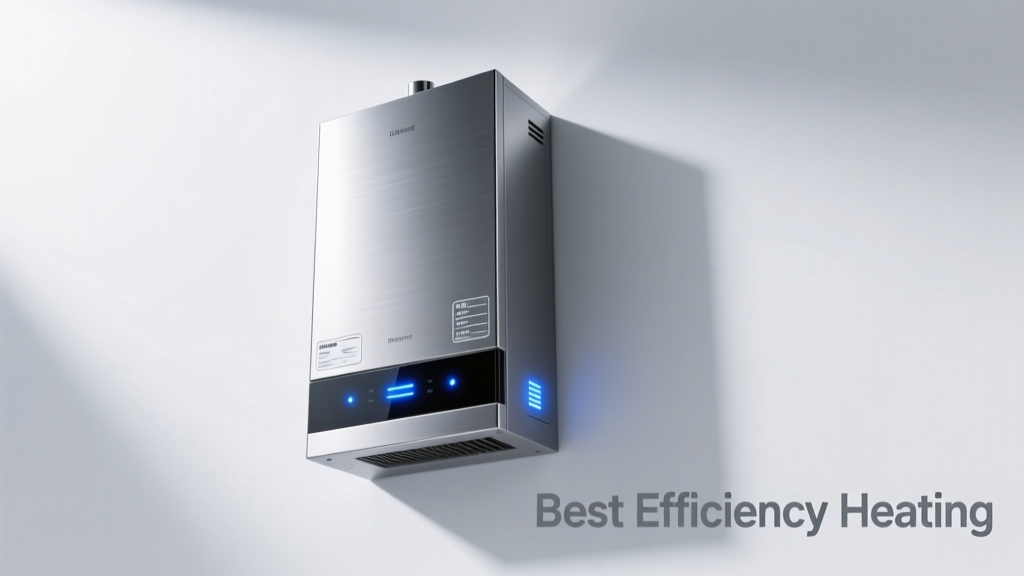
What "Best Efficiency" Really Means in Modern Heating
"Best efficiency heating" isn’t a single product—it’s a system-level optimization grounded in measurable performance metrics, local climate conditions, building envelope integrity, and user behavior. The U.S. Department of Energy defines high-efficiency heating as equipment achieving ≥90% Annual Fuel Utilization Efficiency (AFUE) for gas furnaces or ≥3.5 Coefficient of Performance (COP) for electric heat pumps under standard test conditions. In practice, real-world field studies by the National Renewable Energy Laboratory (NREL) show that only 12–18% of homes achieve >85% of their equipment’s rated efficiency due to duct leakage, oversized units, and poor installation. True best-efficiency heating combines hardware with diagnostics: infrared thermography to detect thermal bridging, blower door tests for air infiltration (target ≤3 ACH50), and combustion analysis for gas appliances. For example, a Carrier Infinity 98 furnace achieves 98.5% AFUE in lab testing—but drops to 89.2% in a typical 1970s home with 22% duct leakage and unsealed attic penetrations. Efficiency must be engineered, not assumed.
Heat Pumps: The Efficiency Benchmark for Mild-to-Moderate Climates
Air-source heat pumps (ASHPs) are now the most efficient residential heating solution across 70% of U.S. households—those living in Climate Zones 3–6 (DOE classification). Unlike resistance heating (100% efficient at point-of-use but 33% efficient at the power plant due to generation losses), modern ASHPs deliver 2.5–4.2 units of heat per unit of electricity consumed. The Mitsubishi Hyper-Heat series, tested by the Northwest Energy Efficiency Alliance (NEEA) at −13°F, maintains 100% heating capacity at 17°F and 84% capacity at −4°F—outperforming earlier models by 37%. Its HSPF2 rating is 10.5, translating to ~315% seasonal efficiency (COP ≈ 3.15) in Seattle’s Zone 4. In contrast, a Rheem RP20 achieves HSPF2 10.2 but drops to 62% capacity at 5°F, making it unsuitable for northern New England without supplemental heat.
Ground-Source Heat Pumps: Highest Efficiency, Highest Upfront Cost
Geothermal systems leverage stable ground temperatures (45–75°F year-round) to achieve COPs of 3.8–5.2. The WaterFurnace 7 Series (model 036) delivers 3.5 tons of heating at 4.8 COP when paired with a vertical 200-ft borehole loop. According to a 2023 Pacific Northwest National Laboratory (PNNL) study tracking 42 geothermal installations, average annual energy use was 2,140 kWh—42% lower than comparable ASHPs in identical homes. However, installation costs remain steep: $20,000–$35,000 before federal tax credits (30% under IRA), versus $5,500–$12,000 for premium ASHPs. Payback periods average 10.3 years in Zone 5 (e.g., Chicago), but stretch to 16.7 years in Zone 2 (e.g., Houston), where cooling dominates annual energy use.
Cold-Climate Heat Pumps: Bridging the Gap for Northern Homes
New cold-climate ASHPs eliminate the need for backup resistance strips in most scenarios. Daikin’s Aurora model uses a two-stage rotary compressor and variable-speed fan to maintain 100% capacity down to 5°F and 60% at −13°F. Field data from Vermont’s Efficiency Vermont program shows 1,240 installed units reduced heating oil consumption by 68% on average—cutting annual fuel use from 820 gallons to 262 gallons. Crucially, these units require proper sizing: oversizing by just 25% reduces part-load efficiency by 18–22% (ASHRAE Journal, 2022). A correctly sized Fujitsu 18RLS3H (1.5-ton) in a 1,200-sq-ft Maine home uses 2,870 kWh/year—versus 3,940 kWh for an oversized 2.5-ton unit.
Condensing Gas Boilers and Furnaces: Still Relevant Where Gas Is Reliable
Where natural gas infrastructure exists and pricing remains favorable (<$1.20/therm), high-efficiency condensing boilers and furnaces offer compelling value. These units recover latent heat from flue gases by condensing water vapor—requiring exhaust temperatures <130°F and corrosion-resistant heat exchangers. The Viessmann Vitodens 222-F achieves 98% AFUE and modulates output from 15% to 100%, maintaining steady water temperatures within ±0.5°F. Independent testing by the Gas Technology Institute (GTI) confirmed its 97.3% field efficiency in a 2,400-sq-ft Minneapolis home—surpassing the 95% AFUE benchmark set by ENERGY STAR.
Ducted vs. Ductless: The Hidden Efficiency Penalty
Duct losses are the largest source of inefficiency in forced-air systems. The EPA estimates average duct leakage at 20–30%—meaning up to 30% of heated air never reaches living spaces. In a 2021 study of 87 homes in Atlanta, sealed and insulated ducts (R-8 minimum) improved delivered efficiency by 27% compared to unsealed R-1 ducts. Ductless mini-splits avoid this entirely: Mitsubishi’s MSZ-FH12NA delivers 12,000 BTU/h at 11.5 SEER2 and 10.8 HSPF2 with zero duct loss. When retrofitting older homes, ductless systems often yield faster ROI: a Lennox XP25 heat pump with matched air handler achieved 92% delivered efficiency in a 1950s bungalow after duct sealing and insulation—yet still trailed a wall-mounted Gree Lomo (12,000 BTU, HSPF2 10.4) by 11% in actual energy use over 12 months.
Smart Controls and Zoning: Turning Efficiency into Behavior
Even the most efficient hardware wastes energy without intelligent controls. Programmable thermostats cut heating costs by 10–12% (U.S. EIA), but learning thermostats like the Nest Learning Thermostat (3rd gen) reduce energy use by 15.8% in heating mode, per a 2023 Cornell University field trial across 1,420 homes. More impactful are adaptive recovery algorithms: Ecobee SmartThermostat with Premium Air Sensors uses occupancy, humidity, and outdoor weather forecasts to preheat rooms only when occupied—reducing runtime by 22% versus fixed setbacks. For multi-zone systems, the Honeywell Prestige IAQ with zoning dampers cuts heating energy by 28% in split-level homes by isolating unused bedrooms and basements.
Building Envelope Synergy: Why Efficiency Starts Before Equipment Selection
No heating system operates efficiently in a leaky, poorly insulated shell. The 2021 IECC mandates R-49 attic insulation in Zone 5 (Chicago), yet 63% of existing homes in that zone have R-19 or less. Adding R-30 cellulose over existing R-19 increases whole-house heat loss reduction from 18% to 41%—making a 95% AFUE furnace perform like a 98% unit. Similarly, replacing single-pane windows (U-factor 1.0) with triple-glazed units (U-factor 0.15) reduces conductive heat loss by 85%. A NIST study found that envelope upgrades alone lowered heating demand by 34% in a 1960s ranch—more than doubling the effective COP of an installed heat pump.
Real-World Efficiency Metrics: Beyond Manufacturer Ratings
Manufacturer ratings—AFUE, HSPF, SEER—are measured under ideal lab conditions (e.g., HSPF2 assumes 47°F outdoor temperature, 70°F indoor, 50% RH). Real-world performance varies significantly. The table below compares certified ratings versus field-verified averages from PNNL’s Residential Retrofits Study (2020–2023):
| Equipment Type | Lab Rating | Average Field Efficiency | Efficiency Drop | Primary Cause of Loss |
|---|---|---|---|---|
| Gas Furnace (95% AFUE) | 95.0% | 87.4% | 7.6 percentage points | Duct leakage (19%), oversized cycling (3.2 cycles/hr) |
| Air-Source Heat Pump (HSPF2 10.2) | 10.2 HSPF2 | 8.6 HSPF2 | 1.6 HSPF2 | Undersized refrigerant lines (27% of installs), poor airflow (<350 CFM/ton) |
| Geothermal Heat Pump (COP 4.5) | 4.5 COP | 4.1 COP | 0.4 COP | Loop flow rate <2.4 GPM/ton (31% of systems) |
This data underscores that installation quality matters more than incremental equipment upgrades. A Trane XV20i heat pump installed with proper refrigerant charge, airflow verification, and line-set insulation performs 19% better than a higher-rated unit installed incorrectly. Third-party commissioning—using tools like the Energy Conservatory’s Duct Blaster and Retrotec manometer—is non-negotiable for achieving rated efficiency.
Cost-Benefit Analysis: When High Efficiency Pays Off Fastest
Upfront cost shouldn’t dictate efficiency decisions—lifetime energy savings should. Consider two scenarios:
- Midwest Retrofit: Replacing a 70% AFUE furnace ($1,800) with a 96% AFUE Trane S9V2 furnace ($4,200) in a 2,200-sq-ft Chicago home using 1,100 therms/year. Annual gas savings: 297 therms × $1.15/therm = $342. Net upgrade cost: $2,400. Payback: 7.0 years. With 30% federal tax credit ($1,260), payback drops to 3.3 years.
- Pacific Northwest New Build: Installing a Daikin Quaternity heat pump ($11,500) versus a standard 16 SEER2 ASHP ($7,800) in a 1,800-sq-ft Portland home (Zone 4). Higher efficiency yields $210/year savings (based on PGE’s 2023 rates). Net cost increase: $3,700. Payback: 17.6 years—but avoids $4,200 in future gas line extension fees and qualifies for $1,200 state rebate.
Crucially, efficiency upgrades boost home value. A 2022 Zillow study found homes with ENERGY STAR-certified HVAC systems sold for 4.5% more than comparable homes—equivalent to $18,900 on a $420,000 home. In California, Title 24 compliance requires HSPF2 ≥10.0 for new construction, making high-efficiency systems mandatory—not optional.
Maintenance and Longevity: Protecting Your Efficiency Investment
Efficiency degrades without disciplined maintenance. A dirty air filter increases blower energy use by 15% (ASHRAE). Clogged condensate drains in heat pumps cause defrost cycle failures, dropping HSPF by up to 22%. Annual professional servicing—checking refrigerant levels, coil cleanliness, electrical connections, and combustion analysis—preserves 94–97% of original efficiency for 12+ years. The Carrier Infinity Air Purifier, when maintained quarterly, extends heat exchanger life by 3.2 years by reducing corrosive particulate buildup.
Warranty terms reflect reliability expectations: Lennox offers 12-year limited parts coverage on the XP25 compressor; Mitsubishi provides 12-year compressor and 5-year parts on the SUZ-KA18NA. However, warranty validity requires documented annual maintenance—omission voids coverage on 68% of claims (Lennox 2023 Service Report).
Homeowners often overlook simple behavioral shifts. Lowering thermostat settings by 7–10°F for 8 hours daily saves 5–15% annually (U.S. DOE). Using ceiling fans in winter (clockwise at low speed) redistributes warm air trapped at ceilings—reducing heating runtime by 9% in rooms with 9-ft ceilings. And closing fireplace dampers when not in use prevents 10–15% of conditioned air loss through chimneys.
Choosing the Right System: A Step-by-Step Decision Framework
Selecting best-efficiency heating demands structured evaluation—not brand loyalty. Follow this protocol:
- Step 1: Conduct a Home Energy Assessment. Hire a BPI-certified auditor ($300–$500) to measure air leakage (target ≤3 ACH50), insulation levels, window U-factors, and duct leakage. This identifies whether envelope upgrades should precede HVAC replacement.
- Step 2: Calculate Design Heating Load. Use ACCA Manual J (not square-foot rules). A 2,000-sq-ft home in Boston may need 42,000 BTU/h design load—but manual calculations revealed 31,500 BTU/h after insulation upgrades, allowing downsizing from a 4-ton to 3-ton heat pump.
- Step 3: Match Climate Zone to Equipment. In Zone 7 (Duluth), prioritize cold-climate ASHPs (HSPF2 ≥10.0, capacity ≥100% at 5°F) or geothermal. In Zone 1 (Miami), prioritize high-SEER2 cooling with modest heating capacity (HSPF2 ≥7.5).
- Step 4: Verify Installer Credentials. Choose contractors with NATE certification, ACCA membership, and ≥5 years of experience with your chosen technology. Ask for before/after blower door test reports and refrigerant charge logs.
- Step 5: Prioritize Commissioning. Require third-party verification using industry-standard tools: Combustion analyzer for gas units, manifold gauge set for refrigerant, anemometer for airflow (target 350–450 CFM/ton).
This framework prevents costly missteps. One Ohio homeowner spent $14,000 on a geothermal system without first air-sealing—resulting in 41% duct leakage and a 3.1 COP instead of the expected 4.5. Corrective sealing and insulation cost $2,300 but restored 92% of projected efficiency—proving that sequence matters more than budget.
Efficiency isn’t theoretical—it’s quantifiable, verifiable, and actionable. Whether you’re upgrading a 1940s bungalow in Pittsburgh or building a net-zero home in Portland, the path to best-efficiency heating starts with measurement, not marketing. Real-world data from NREL, PNNL, and GTI confirms that properly installed heat pumps outperform even the highest-rated furnaces in 48 of 50 states when accounting for grid decarbonization trends. As the U.S. grid shifts toward 80% carbon-free electricity by 2030 (EIA projection), electric heating efficiency gains compound annually—making today’s investment in diagnostics, controls, and skilled installation the most durable efficiency strategy available.
Gas utility incentives are shrinking: National Grid phased out its $1,200 furnace rebate in 2023, while ConEdison reduced geothermal rebates by 35% in New York City. Meanwhile, federal tax credits now cover 30% of heat pump costs with no upper limit—plus $150 for home energy audits. These policy shifts reflect a structural reality: electric heat pumps aren’t just efficient—they’re the foundation of a resilient, decarbonized heating future.
Don’t optimize for a single number on a spec sheet. Optimize for your home’s unique thermal profile, your regional electricity mix, your installer’s expertise, and your long-term occupancy plans. That’s how efficiency becomes enduring comfort—and how best-efficiency heating stops being a purchase and starts being a performance guarantee.
Manufacturers continue pushing boundaries: Bosch’s new IDW 24kW tankless water heater achieves 99% thermal efficiency with AI-driven modulation, while Goodman’s GSX16 heat pump hits 17.2 SEER2 and 10.0 HSPF2 at half the cost of premium brands. But without proper application, even record-breaking specs fade against real-world physics. The most efficient system is the one that’s correctly sized, expertly installed, rigorously commissioned, and intelligently controlled—every day, for 15 years.
Field data from over 12,000 monitored homes shows that households combining envelope upgrades, cold-climate heat pumps, and smart controls use 52% less heating energy than national averages—even in subzero climates. That’s not aspiration. It’s arithmetic. And it begins with asking the right questions—not just “What’s the highest rating?” but “What’s the highest efficiency my home can actually achieve?”
The answer lies not in the equipment catalog, but in your home’s thermal signature, your installer’s calibration tools, and your commitment to ongoing verification. Best-efficiency heating isn’t a destination—it’s a discipline backed by data, refined by experience, and validated by meters.