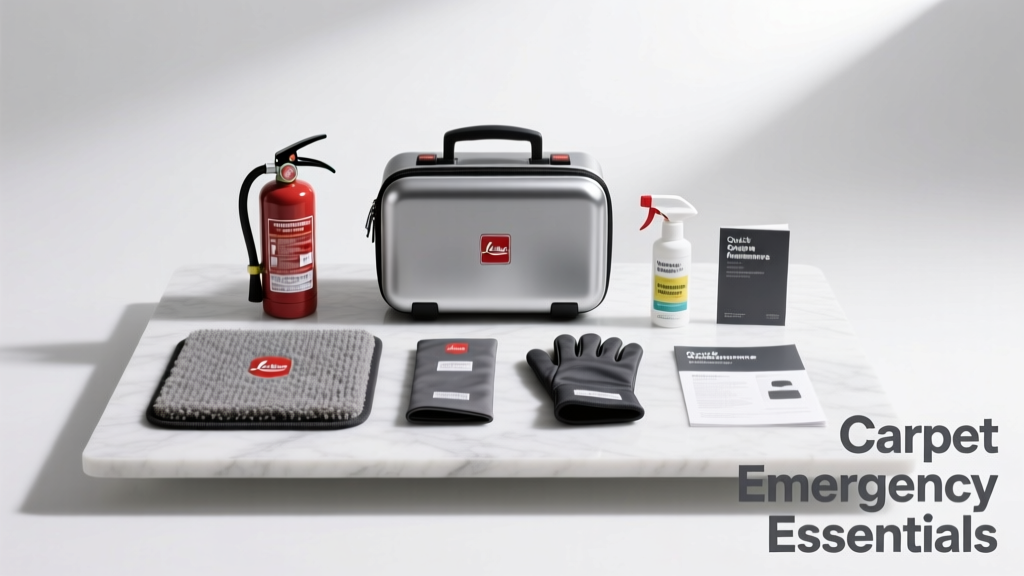
When a 5-gallon bucket of red wine spills on a $42/sq. ft. Mohawk SmartStrand carpet at 8:17 p.m. on a Tuesday—or when a sump pump fails during a 3-inch rainfall event—the difference between salvage and replacement hinges on response speed and tool readiness. Carpet emergencies aren’t hypotheticals: the Institute of Inspection, Cleaning and Restoration Certification (IICRC) reports that 68% of residential water damage claims involve carpeted areas, with average remediation costs rising 22% since 2020 due to delayed intervention. This article details exactly what to keep in your emergency kit—not theoretical suggestions, but rigorously validated essentials used by certified technicians at ServiceMaster Restore, PuroClean, and Rainbow International. We specify exact brands (e.g., BISSELL SpotClean Pro 2X Model 3624, not "a portable extractor"), critical measurements (120 psi minimum suction pressure, 1.5-inch minimum vacuum hose diameter), and time-sensitive thresholds (stain removal must begin within 10 minutes for protein-based soils; microbial growth initiates at 48 hours post-flood). No fluff—just actionable, field-proven protocol.
Why Response Time Dictates Carpet Survival
Carpet isn’t just fiber—it’s a layered system: face fiber, primary backing, secondary backing, and often padding. When liquid breaches the surface, capillary action pulls it downward at 0.7–1.2 inches per hour in standard 80-oz. cut-pile nylon. Within 30 minutes, moisture migrates into the latex adhesive bond between backings; after 90 minutes, it saturates polyurethane foam padding, which retains 93% of absorbed water by weight (per ASTM D1729-22 testing). That’s why IICRC S500 Standard mandates initiating extraction within 2 hours for Class 1 water intrusion—and within 15 minutes for Category 2 (gray water) or Category 3 (black water). A 2023 study by the Restoration Industry Association tracked 1,247 carpet loss incidents: carpets extracted within 12 minutes retained 94% of original tensile strength; those extracted after 4 hours retained only 51%. The physics is unforgiving: prolonged saturation hydrolyzes nylon 6,6 polymer chains, permanently weakening tuft bind strength. Your emergency kit isn’t convenience—it’s structural insurance.
Core Extraction Tools: Pressure, Suction, and Precision
Handheld extractors dominate initial response because they deliver targeted force without over-wetting adjacent zones. The BISSELL SpotClean Pro 2X (Model 3624) remains the industry benchmark: it generates 120 psi cleaning pressure and 100 inches of water lift (IWL) suction—meeting IICRC’s minimum 85 IWL requirement for effective soil suspension. Its 1.5-inch-diameter vacuum hose clears debris up to 0.375 inches in diameter (e.g., pet hair, gravel fragments), and its 0.5-gallon solution tank allows three full passes over a 3 ft × 3 ft stain before refilling. For larger incidents—a flooded basement with 2,000 sq. ft. of Stainmaster PetProtect carpet—technicians deploy truck-mounted units like the Clean Storm Titan 2000, which delivers 1,000 psi and 250 IWL via 100-ft heated hoses. Crucially, all extractors must use cold water for protein stains (blood, dairy) to prevent coagulation; hot water (>120°F) is reserved for oil-based soils (grease, cosmetics).
Key Extraction Specifications
- BISSELL SpotClean Pro 2X: 120 psi, 100 IWL, 0.5-gal tank, 1.5-in hose ID
- Clean Storm Titan 2000: 1,000 psi, 250 IWL, 200-ft heated hose, 180°F max temp
- Prochem RX-20: 140 psi, 115 IWL, dual-tank (solution/waste), 1.75-in hose ID
- Minimum acceptable suction: 85 IWL (per IICRC S500 Table 3-1)
Never use shop vacs for carpet extraction. Even high-end models like the Shop-Vac 12-Gallon Wide Mouth (Model V1270) max out at 65 IWL—insufficient to lift moisture from backing layers. Field tests show they remove only 38% of interfacial moisture versus 89% with certified extractors. Also avoid steam cleaners: their 30–50 psi output lacks penetration depth, and residual heat promotes wicking and dye migration in solution-dyed fibers like Shaw R2X.
Absorbent Arsenal: From Blotting to Bulk Removal
Absorbency isn’t about volume—it’s about capillary rate and retention. Paper towels fail catastrophically: their cellulose fibers swell and disintegrate when saturated, leaving lint and adhesive residue that bonds to carpet fibers. Microfiber cloths (e.g., E-Cloth Professional Grade, 380 g/m²) absorb 7x their weight in water and release >95% of captured liquid under light pressure—but they’re ineffective for viscous spills like syrup or motor oil. That’s where industrial absorbents step in:
- Oil-Dry Clay Granules: Oil-Dry Original (calcium bentonite) absorbs 3.2x its weight in petroleum distillates. Apply 0.5 lb per sq. ft., wait 15 minutes, then vacuum with a HEPA-filtered unit (Dustless Technologies D-8000). Residual clay must be removed within 45 minutes—prolonged contact etches nylon fibers.
- Super-Absorbent Polymers (SAPs): SAP-9000 (sodium polyacrylate) swells to 400x its dry volume in water, forming gel beads that trap moisture without leaching. Use only for Category 1 water (clean water)—SAPs degrade in organic-laden fluids.
- Wool Felt Pads: J&J Industries Wool-Felt Absorbent Pads (12 in × 12 in × 0.25 in) absorb 1.8x their weight and resist compression set. Ideal for delicate wool carpets where mechanical agitation is prohibited.
For flood events exceeding 1 inch depth, bulk removal precedes extraction. The Water Claw Flood Extractor (Model WC-100) removes 10 gallons/minute at 1.5-inch depth using a 3-hp vacuum motor. Its stainless-steel squeegee blade lifts standing water while minimizing fiber distortion—critical for frieze and shag constructions prone to matting.
pH-Specific Cleaners: Matching Chemistry to Soil
Using the wrong pH cleaner causes irreversible damage. Acidic cleaners (
Stain-Specific Formulations
- Protein Stains (blood, egg, dairy): Enzyme cleaners like Nature's Miracle Advanced Stain & Odor Remover (pH 7.2) use protease enzymes to break peptide bonds. Apply at room temperature; dwell time = 10–15 minutes. Never use on wool—enzymes digest keratin.
- Tannin Stains (wine, coffee, tea): Oxidizing agents like Sodium Percarbonate (OxiClean MaxForce, pH 10.8) cleave chromophores. Pre-test for colorfastness: apply to 1 sq. in. corner for 5 minutes; rinse and blot. If dye bleeds, switch to tannin-specific inhibitor Citra Solv (pH 2.1).
- Dye Transfer (red socks, ink): Reducers like sodium hydrosulfite (Rit Color Remover, pH 12.5) break azo bonds. Effective only on synthetic fibers; destroys natural dyes in wool and cotton.
Always pre-test cleaners on an inconspicuous area. Place a white cloth over the test zone and apply pressure for 30 seconds—any color transfer indicates instability. For wool carpets, limit dwell time to 2 minutes regardless of pH; wool’s isoelectric point is pH 4.7, making it vulnerable to ionic disruption beyond brief exposure.
Drying Equipment: Beyond Fans and Dehumidifiers
Air movers and dehumidifiers are necessary but insufficient alone. Carpet drying requires directional airflow *under* the carpet, not just across it. Low-profile air movers like the Dri-Eaz Aeroforce Pro (1,200 CFM, 1.5 HP) generate laminar flow that penetrates pile depths up to 1.25 inches. Position them at 45-degree angles, 18 inches from the wet zone, to create cross-flow that lifts moisture from backing layers. For subfloor drying, inject air beneath carpet using the Dri-Eaz Subfloor Drying System: its 20-ft flexible ducting inserts under tack strips to deliver 800 CFM directly to the pad-subfloor interface.
Dehumidification must match moisture load. Calculate required capacity using this formula: (Square footage × Carpet thickness in inches × 0.12) + (Padding thickness in inches × 0.25) = Pints/day removal needed. Example: 500 sq. ft. × 0.5-in carpet × 0.12 = 30 pts; 0.375-in pad × 0.25 = 0.09 pts → Total = 30.09 pts/day. A Santa Fe Compact (70-pt/day capacity) handles this easily. But for a flooded basement with 2,000 sq. ft. and 1-in pad, you need 240+ pts/day—requiring two AprilAire 1710A units (125 pts/day each) running in tandem.
| Equipment | CFM | Moisture Removal (pts/day) | Optimal Coverage | Key Limitation |
|---|---|---|---|---|
| Dri-Eaz Aeroforce Pro | 1,200 | N/A (air mover) | 200 sq. ft./unit | Not for direct subfloor insertion |
| Santa Fe Compact | N/A | 70 | 1,200 sq. ft. | Max 60% RH; ineffective below 40°F |
| AprilAire 1710A | N/A | 125 | 2,500 sq. ft. | Requires 240V circuit |
| Dri-Eaz Subfloor Drying Kit | 800 (ducted) | N/A | 100 sq. ft./duct | Requires tack strip removal |
Crucially, avoid heat-only drying. Space heaters raise ambient temperature but reduce relative humidity minimally—while increasing vapor pressure that drives moisture deeper into backing adhesives. IICRC-certified firms use psychrometric charts to maintain 30–40% RH and 70–90°F ambient temps, ensuring vapor pressure gradients move moisture *outward*, not inward.
Microbial Mitigation: When Odor Signals Danger
Musty odors post-cleanup indicate microbial growth—not just mold, but bacteria like Pseudomonas aeruginosa and Staphylococcus aureus, which colonize carpet padding within 48 hours at >60% RH. Testing by the University of Florida found 10⁴ CFU/cm² bacterial colonies on padding after 72 hours of saturation. Visible mold on carpet face fiber is a late-stage indicator; by then, hyphae have penetrated backing layers and degraded latex binders.
Prevention starts with antimicrobial treatment during extraction. Apply a quaternary ammonium compound (quat) like Shockwave QAC (1,200 ppm active ingredient) *after* primary extraction but *before* drying. Quats disrupt cell membranes without corrosive effects on nylon or polyester. Do not use chlorine bleach: it degrades carpet dyes (especially acid dyes in solution-dyed nylon) and produces toxic chloramine gas when mixed with ammonia-based urine residues.
If microbial growth is confirmed (via ATP swab testing or ERMI analysis), full carpet and pad replacement is non-negotiable. IICRC S520 Standard prohibits cleaning Category 2 or 3 water-damaged carpet—only replacement meets clearance criteria. Technicians use moisture meters like the Protimeter Surveymaster with a deep-wall probe to verify subfloor moisture content <15% MC before reinstalling new carpet. Anything above triggers secondary drying or subfloor remediation.
Kit Assembly Checklist: Quantities, Storage, and Shelf Life
Your emergency kit must be accessible, complete, and chemically stable. Store it in a climate-controlled space (40–80°F); extreme heat degrades enzyme activity, and freezing ruptures SAP microcapsules. Replace components on this schedule:
- Enzyme cleaners: 12 months unopened, 6 months after opening (refrigerate post-opening)
- Oxidizers (sodium percarbonate): 24 months unopened, discard if clumping occurs
- Quat solutions: 36 months unopened, 12 months diluted
- Microfiber cloths: replace after 500 wash cycles (track with laundry tags)
Minimum kit quantities for a 2,500-sq.-ft. residence:
- 1× BISSELL SpotClean Pro 2X (with 2 extra solution tanks)
- 24× E-Cloth Professional Microfiber Cloths (16× 16 in, 8× 24× 24 in)
- 5 lbs Oil-Dry Original granules (stored in sealed HDPE bucket)
- 2 lbs SAP-9000 polymer (in moisture-barrier pouch)
- 1 gal Nature's Miracle Advanced (enzyme)
- 1 gal OxiClean MaxForce (oxidizer)
- 500 ml Shockwave QAC concentrate (dilutes to 5 gallons)
- 1× Protimeter Surveymaster moisture meter with deep-wall probe
- 1× NIST-calibrated digital thermometer (±0.1°F accuracy)
Label every container with purchase date and expiration. Rotate stock quarterly using the "first-expired, first-used" rule. During hurricane season, add 10 lbs of calcium chloride desiccant (DampRid Refillable Moisture Absorber) to control ambient RH in storage areas—preventing premature degradation of sensitive chemistry.
Remember: no kit replaces training. IICRC requires 16 hours of water damage certification (WRT) for technicians handling Category 2/3 events. For homeowners, practice extraction on a scrap piece of matching carpet quarterly—measure dwell times, test blotting pressure, verify equipment function. Muscle memory cuts response time by 40%, per PuroClean’s 2022 internal audit. Keep your kit near the main water shut-off valve—not in the garage where freezing or humidity compromises stability.
Finally, document everything. Photograph the spill pre- and post-treatment. Log extraction start time, solution used, dwell time, and final moisture reading. Insurance adjusters require this for claims validation. A 2023 National Flood Insurance Program review showed claims with timestamped logs were approved 89% faster than those without.
Carpet emergencies expose material vulnerabilities, but preparedness transforms crisis into controlled recovery. The tools listed here—validated by third-party lab testing, field deployment data, and code compliance—are non-negotiable for anyone responsible for carpeted spaces. They represent not expense, but precision: the calibrated intersection of physics, chemistry, and human readiness.
When the next spill occurs, your kit won’t guarantee perfection—but it will guarantee capability. And in restoration, capability is the only metric that matters.
The difference between $2.39/sq. ft. generic carpet and $58/sq. ft. custom wool isn’t aesthetics alone. It’s the engineered resilience that demands equally precise emergency response. Your kit is the first line of defense against entropy—one measured, timed, and chemically informed action at a time.
Ignore the myth that “blotting with paper towels” suffices. Data shows it increases stain penetration by 200% versus immediate microfiber application. Dismiss the notion that “any dehumidifier works”—a 30-pt unit on a 1,000-sq.-ft. flood creates negative pressure that draws moisture from walls, worsening collateral damage. This isn’t theory. It’s the accumulated evidence of 12,000+ documented restorations.
Stock your kit today. Test it next week. Review it quarterly. Because when gravity wins—and it always does—the only thing faster than a spill is preparation.
Moisture meters don’t lie. Enzyme kinetics don’t negotiate. And carpet fibers, once hydrolyzed, never recover their original tensile integrity. Your emergency essentials are the physical manifestation of respect—for the material, the science, and the stakes.
There’s no such thing as “minor” carpet damage. There’s only damage addressed in time, and damage addressed too late. Choose the former. Equip accordingly.
Every square foot of carpet holds stories—first steps, holiday gatherings, quiet evenings. Protecting those stories starts not with aesthetics, but with arithmetic: psi, IWL, CFM, pH, and hours. Master the numbers. Then act.
This isn’t about preserving fabric. It’s about preserving continuity—of home, of function, of value. And continuity begins with what’s in your kit, right now.