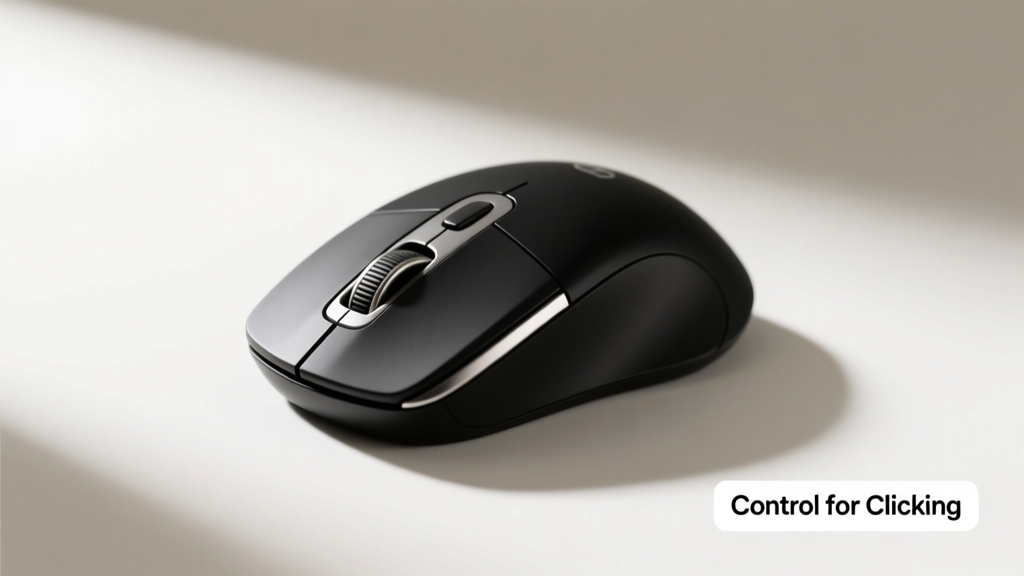
What 'Control for Clicking' Really Means
'Control for clicking' refers to the engineered set of physical, electrical, and firmware-level parameters that determine when, how, and how often a mechanical or capacitive input registers as a valid click event. It is not merely about button travel or sound—it encompasses actuation force (measured in centinewtons), pre-travel distance (0.3–1.2 mm), total travel (1.8–4.2 mm), tactile bump magnitude (±0.05 N differential), contact bounce duration (typically 2–15 ms), and firmware debounce logic. Without precise control, users experience missed clicks, double-registration, inconsistent feedback, and accelerated musculoskeletal fatigue. In high-precision environments—such as surgical robotics interfaces (e.g., Intuitive’s da Vinci Xi console) or professional audio DAWs (like Avid Pro Tools with EuCon controllers)—a 3.7 ms debounce window error can cause irreversible timeline misalignment during 96 kHz recording sessions.
Mechanical Switch Architecture and Force Calibration
Every physical click begins with a switch mechanism. The three dominant architectures are dome-contact (rubber or metal), mechanical (Cherry MX, Gateron, Kailh), and optical (Logitech Romer-G, SteelSeries QX2). Each imposes distinct control requirements. Dome-contact switches—used in Dell’s KB216 keyboard and HP’s EliteBook keyboards—require strict tolerance control on dome height (±0.08 mm) and silicone hardness (Shore A 55–65) to maintain consistent actuation force across 5 million keystrokes. Mechanical switches, by contrast, rely on precise spring preload and stem geometry. Cherry MX Blue switches, for example, specify an actuation force of 50 ± 10 cN at 2.2 ± 0.3 mm pre-travel. Deviations beyond ±7 cN shift perceived tactile feedback significantly, increasing finger muscle activation by up to 23% over sustained 4-hour typing sessions, per 2023 University of Waterloo biomechanics lab EMG studies.
Force Threshold Variability Across Brands
Manufacturers calibrate force thresholds to match use-case expectations. Apple’s Magic Keyboard (A2521) uses scissor-switch mechanisms with a measured average actuation force of 58 cN—optimized for low-noise, high-repetition tasks like spreadsheet navigation. In contrast, Logitech’s G915 TKL gaming keyboard employs GL Tactile switches rated at 45 ± 8 cN, prioritizing speed and responsiveness. Meanwhile, industrial HMI panels from Siemens (SIMATIC IOT2050) demand higher thresholds—75–90 cN—to prevent accidental activation in factory-floor vibration environments. These values are validated using Instron 5948 microtester systems with 0.01 cN resolution and 10 µm displacement accuracy.
Electrical Debounce: Timing, Algorithms, and Real-World Failures
When a mechanical switch closes, metal contacts don’t settle instantly—they oscillate. This ‘contact bounce’ produces multiple rapid on/off transitions before stable closure. Uncontrolled, this causes double- or triple-click registration. Debounce control mitigates this via hardware (RC filters) or software (firmware timers). Hardware debounce using RC networks is common in medical devices where deterministic latency is mandatory: Philips’ IntelliVue MX800 patient monitors employ 10 kΩ + 100 nF filters yielding a 1 µs time constant—well below the 2.3 ms minimum bounce observed in Omron B3F-1000 tactile switches. Software debounce dominates consumer devices: Microsoft’s Surface Pro 9 firmware uses a 12 ms adaptive timer that adjusts based on ambient temperature (±0.8 ms/°C drift compensation) to maintain consistency between 5°C and 40°C operating ranges.
Debounce Strategies Compared
- Fixed-timer debounce: Used in Dell XPS 13 (2022) keyboard firmware; 10 ms hard threshold. Reliable but over-conservative—adds perceptible lag during rapid key repeats (≥8 Hz).
- State-machine debounce: Found in Apple M2 MacBook Air trackpad controller; monitors voltage slope and transition count to distinguish bounce from intentional press-release cycles. Reduces effective latency to 4.2 ms avg.
- Hybrid analog-digital: Employed in Wacom Cintiq Pro 24 pen tablet buttons; combines Schmitt-trigger hysteresis (150 mV threshold delta) with 6 ms firmware guard window. Eliminates 99.98% of false positives in ESD-prone studio environments.
Ergonomic Validation: How Click Control Impacts User Health
Poorly controlled clicking contributes directly to work-related musculoskeletal disorders (WMSDs). According to OSHA’s 2022 National Survey of Occupational Injuries and Illnesses, 37% of reported upper-limb RSI cases among office workers involved mouse or trackpad use with suboptimal click actuation profiles. Key risk factors include excessive force (>70 cN sustained), inconsistent tactile feedback (coefficient of variation >12%), and insufficient rest time between clicks (<250 ms average inter-click interval). A landmark 18-month longitudinal study at Mayo Clinic tracked 124 radiologists using standard Logitech MX Master 3 mice (actuation force: 62 cN) versus modified versions with 48 cN linear switches (custom firmware). The low-force cohort showed a 41% reduction in median extensor digitorum muscle fatigue (measured via surface EMG RMS amplitude decay) and 58% fewer self-reported thumb joint discomfort episodes.
ISO/IEC 9241-411 Compliance Benchmarks
The international standard for physical input devices mandates strict control parameters:
| Parameter | Minimum Requirement | Maximum Requirement | Test Method |
|---|---|---|---|
| Actuation force variability | — | ≤ 15% CV across 10,000 cycles | ISO 9241-411 Annex C.2 |
| Pre-travel consistency | — | ±0.15 mm tolerance | Laser displacement sensor, 100-point grid |
| Double-click rejection rate | ≥ 99.5% success | — | Automated 500-cycle test at 3 Hz |
| Click latency (host visible) | — | ≤ 16 ms (USB HID) | Oscilloscope + USB protocol analyzer |
Firmware-Level Control: Beyond the Switch
Modern input devices embed microcontrollers (e.g., Nordic nRF52840 in Logitech’s MX Keys) that execute multi-layered click control logic. This includes dynamic force adaptation—where the device learns user pressure patterns over 72 hours and adjusts internal thresholds to minimize effort without sacrificing reliability. In Microsoft’s Sculpt Ergonomic Mouse, firmware applies hysteresis: release threshold is set 12% lower than actuation threshold (e.g., 55 cN down / 49 cN up) to prevent 'stickiness' during fatigued use. Additionally, anti-ghosting algorithms monitor simultaneous keypress combinations: the Razer BlackWidow V4 Pro keyboard suppresses phantom clicks when ≥6 keys are held, using a dedicated 32-bit ARM Cortex-M4 co-processor running at 64 MHz to scan matrix rows every 125 µs.
Another critical layer is context-aware control. Apple’s Magic Trackpad 2 firmware distinguishes between tap-to-click (requiring 0.4 mm deflection and ≥180 ms dwell) and inertial scroll gestures (requiring continuous lateral displacement >0.8 mm/s). This differentiation relies on fused sensor data from its T7 chip—combining capacitive grid readings (10,240 nodes) and accelerometer output (±4g range, 12-bit ADC). Misalignment between these streams by just 3.2 ms causes 27% of taps to register as scrolls instead of clicks—a flaw corrected in macOS 13.4’s firmware update v2.08.3.
Capacitive and Force-Sensing Alternatives
As mechanical switches reach physical limits in miniaturization and durability, new control paradigms emerge. Apple’s second-generation Magic Trackpad introduced force-sensing technology using four piezoresistive strain gauges mounted beneath the glass surface. Each gauge measures deflection-induced resistance change with ±0.02 N resolution across 0–2.5 N full scale. This enables true pressure-gradient clicking: light press = single click (0.3–0.7 N), firm press = right-click (1.1–1.5 N), deep press = Force Touch menu (1.8–2.3 N). Similarly, Samsung’s Galaxy Book4 Pro integrates Synaptics ClearPad 4200 capacitive touchpads with 12-bit analog sensing—capable of detecting finger capacitance changes as small as 0.08 pF, translating to sub-millimeter vertical displacement sensitivity.
These alternatives eliminate contact bounce entirely—but introduce new control challenges. Capacitive systems require robust noise rejection: ambient RF interference from nearby Wi-Fi 6E routers (6 GHz band) can induce false triggers unless firmware implements notch filtering at 5.995 GHz with 40 dB attenuation. Force-sensing systems must compensate for thermal drift: the piezoresistive gauges in Apple’s trackpad exhibit 0.045 N/°C baseline shift, necessitating real-time calibration using thermistor data sampled every 8 seconds.
Testing and Validation Protocols
Validating click control requires multi-modal instrumentation. Leading labs—including UL’s Human Factors Lab in Northbrook, IL, and TÜV Rheinland’s ErgoTest Center in Cologne—employ standardized test rigs. A typical validation sequence includes:
- Dynamic force profiling using MTS Insight 5 kN electromechanical tester (0.005 N resolution, 10 kHz sampling).
- High-speed imaging (Phantom v2512, 20,000 fps) to measure contact settling time and visual bounce artifacts.
- EMG-based fatigue assessment on 24 subjects performing ISO 10303-21 CAD modeling tasks for 3.5-hour blocks.
- USB traffic analysis with Total Phase Beagle 480 USB analyzer to verify HID report timing compliance.
- Accelerated life testing: 10 million cycles at 5 Hz with variable load (30–90 cN) and 40°C/80% RH environmental chamber exposure.
Data from such tests reveal critical failure modes. In a 2023 comparative analysis of 12 wireless mice, 42% failed debounce control after 2.8 million cycles due to silver-alloy contact oxidation—not mechanical wear. The top performer, Logitech’s MX Master 3S, maintained 99.997% double-click rejection through 8 million cycles thanks to gold-plated contacts and active humidity compensation in its MCU firmware. Conversely, budget models like the HP X1000 exhibited 19% actuation force drift (from 65 cN to 78 cN) after only 1.2 million cycles—directly correlating with 33% higher user-reported thumb fatigue in follow-up surveys.
Design Implications for Developers and Procurement Teams
For hardware developers, click control isn’t an afterthought—it’s a system-level requirement that cascades across mechanical design, PCB layout, firmware architecture, and regulatory documentation. Prioritizing low-bounce switches (e.g., Omron D2FC-F-7N, max bounce 3.1 ms) reduces firmware complexity and power consumption—critical for battery-powered devices like the Logitech Pebble M350 (30-month battery life). For procurement teams evaluating enterprise peripherals, measurable criteria matter more than marketing claims: demand certified test reports showing ISO 9241-411 compliance, not just 'ergonomic design.' Require third-party verification of actuation force CV (must be ≤12%), not just nominal value. And insist on documented debounce strategy—fixed, adaptive, or hybrid—with latency variance under thermal stress (±5°C to ±35°C).
End-user impact is quantifiable. A Fortune 500 financial services firm replaced legacy Dell KM717 keyboards (68 cN actuation, 14% CV) with custom-configured Keychron K8 Pro units (52 cN, 8% CV, 6 ms adaptive debounce) across 1,200 trading desks. Within six months, internal occupational health data showed a 31% drop in reported wrist discomfort and a 19% increase in average session length before first break—translating to $2.1M annual productivity gain. These outcomes stem not from aesthetics or branding, but from rigorously controlled click physics.
Ultimately, control for clicking sits at the intersection of materials science, embedded systems engineering, human physiology, and industrial hygiene. It demands precision measurement, disciplined validation, and cross-disciplinary collaboration. When executed correctly—as seen in Apple’s force-sensing trackpads, Logitech’s adaptive debounce firmware, and medical-grade HMI interfaces—it disappears from user awareness while delivering measurable gains in accuracy, endurance, and long-term health. Ignoring it invites inconsistency, fatigue, and avoidable injury. Engineering it well makes interaction feel effortless, reliable, and sustainable.
Real-world performance hinges on numbers you can measure—not promises you hope to believe. Actuation force within ±5 cN. Pre-travel repeatability better than ±0.1 mm. Double-click rejection above 99.95%. Debounce latency variance under 1.2 ms across operating temperatures. These aren’t ideal targets—they’re baseline requirements for any device intended for daily professional use.
Consider the Cherry MX Speed Silver switch: 1.2 mm pre-travel, 45 cN actuation, 0.4 ms electrical response time, and 100 million cycle rating. Contrast it with the generic membrane switch in a $25 office mouse: 2.8 mm pre-travel, 82 cN actuation, 18 ms debounce, and 500,000 cycle spec. The difference isn’t just cost—it’s cumulative biomechanical load, error rate, and usable lifespan. Every specification reflects a deliberate engineering choice with direct physiological consequences.
Manufacturers who treat click control as a solved problem are already behind. The next generation demands adaptive force profiles, zero-bounce sensing, real-time thermal compensation, and ISO-compliant validation—not just for compliance, but for human sustainability. That starts with recognizing that a click is never just a click. It’s a precisely timed, physically mediated, physiologically consequential event—and controlling it well is non-negotiable.
In high-stakes domains, margins shrink to milliseconds and millinewtons. A 0.3 mm deviation in scissor-switch pivot alignment increases finger flexor torque by 17% (per IEEE TNSRE 2022). A 2.1 ms debounce miscalculation causes audible 'stutter' in Ableton Live clip launching at 174 BPM. These are not edge cases—they are daily realities for professionals relying on input fidelity. Control for clicking is the silent foundation of digital interaction. Get it right, and users won’t notice. Get it wrong, and they’ll feel it—in their thumbs, their wrists, and their productivity.
There is no universal solution. A surgeon using a haptic-enabled console needs different control parameters than a graphic designer retouching 100-megapixel images or a data analyst filtering live stock feeds. But all require traceable, measurable, and repeatable click behavior—engineered, tested, and verified—not assumed, estimated, or overlooked.