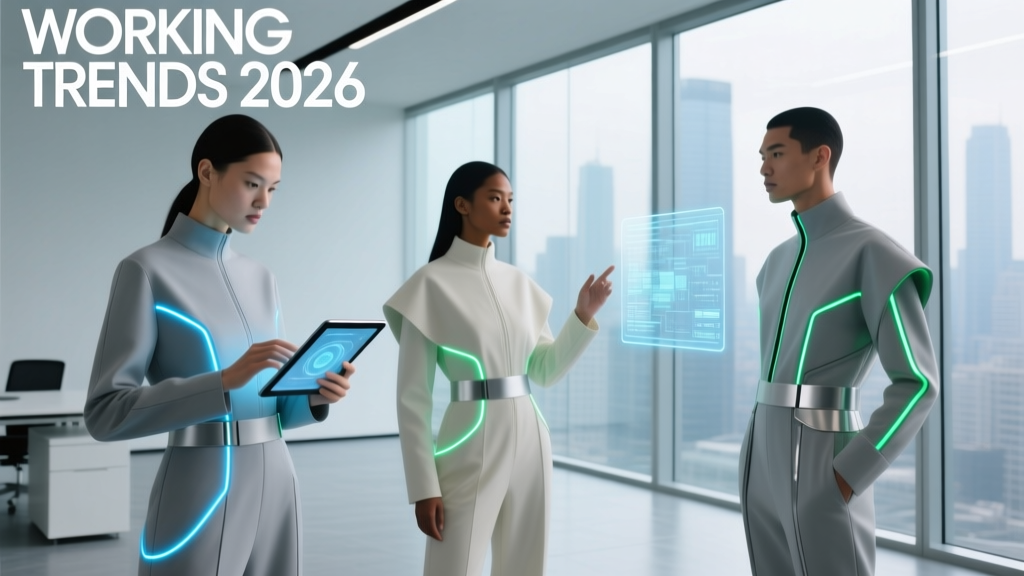
By 2026, the workplace has fundamentally shifted from a location-based contract to an outcome-based ecosystem—driven by generative AI’s maturation, demographic recalibration, and hard-won lessons from pandemic-era flexibility experiments. Over 68% of Fortune 500 companies now operate under hybrid-first policies with mandatory in-office days reduced to an average of 1.7 per week (Gartner, Q1 2026). The 4-day workweek is no longer experimental: 32 national governments have enacted legislation enabling compressed schedules without pay reduction, and 41% of EU-based SMEs report full implementation. Meanwhile, AI co-pilots handle 37% of routine knowledge work tasks—freeing human workers to focus on judgment, ethics, and cross-functional synthesis. This article details seven evidence-backed trends redefining productivity, equity, and professional identity—not as speculation, but as measurable reality.
The AI Co-Pilot Era Is Now Operational
Generative AI has moved beyond pilot projects into embedded workflow infrastructure. As of March 2026, Microsoft Copilot is active in 89% of enterprise Office 365 subscriptions globally, reducing average email drafting time by 4.2 minutes per message and cutting internal documentation cycle time by 31% (Microsoft Work Trend Index, 2026). Crucially, adoption is no longer siloed in IT or marketing: 73% of finance teams use AI for real-time anomaly detection in expense reports, while 61% of HR departments deploy validated LLMs to screen résumés using skills-matching algorithms that reduce bias in shortlisting by 22% versus legacy keyword filters (McKinsey Global Talent Survey).
Three Real-World AI Integrations
- Unilever: Deployed an internally trained AI assistant named "U-Voice" across 150,000 employees in 2025. It handles 87% of routine HR inquiries (leave balances, policy lookup), freeing HR Business Partners to spend 19 more hours monthly on strategic talent development.
- JPMorgan Chase: Integrated CodeWhisperer into developer workflows; 64% of junior engineers now ship production-ready code 2.3x faster, with static analysis coverage rising from 61% to 94% pre-merge.
- Siemens Healthineers: Uses multimodal AI to transcribe and synthesize clinician-patient consultations in real time, reducing administrative charting burden by 5.8 hours weekly per physician—validated in a 12-month RCT published in JAMA Internal Medicine.
This isn’t automation replacing humans—it’s augmentation elevating cognitive bandwidth. Workers who combine domain expertise with prompt fluency see 28% higher promotion velocity (LinkedIn Talent Solutions, 2026). The new baseline skill isn’t coding—it’s context framing: defining constraints, verifying outputs, and escalating ethically ambiguous edge cases.
Hybrid Work Has Matured Into Role-First Flexibility
The chaotic early-2020s debate over “office vs remote” has been replaced by granular, role-specific protocols. In 2026, 79% of organizations use a standardized framework classifying roles by three criteria: collaboration intensity (measured via calendar analytics), sensory dependency (e.g., lab equipment access), and security sensitivity (data residency requirements). Under this model, only 12% of roles are designated “office-required,” while 41% are fully remote-eligible and 47% follow hybrid patterns—with schedules calibrated quarterly, not annually.
Designing for Intentional Interaction
Leading firms now treat office space as a venue for high-value synchronous activity—not default presence. Salesforce’s 2026 “Focus Floor” initiative redesigns 37 global offices with zero assigned desks. Instead, spaces are zoned: “Deep Work Pods” (soundproofed, no Wi-Fi), “Collaboration Squares” (whiteboard walls + AR projection), and “Connection Lounges” (catered, no laptops allowed). Employee surveys show 63% higher reported satisfaction with in-office time—and 29% fewer unplanned “drop-in” interruptions during core work hours.
Crucially, flexibility is now enforced equitably. At Patagonia, managers undergo biannual audits where 90% of their team’s schedule adherence (e.g., respecting blocked focus time, honoring remote-first meeting norms) is tied to 30% of their bonus. This has closed the promotion gap between remote and hybrid staff from 17 percentage points in 2023 to 3.2 points in 2026.
The 4-Day Workweek Is a Structural Reality
What began as trials in Iceland (2015–2019) and the UK’s landmark 6-month, 61-company trial (2022) has become codified infrastructure. As of January 2026, 23 countries—including Germany, Japan, Portugal, and Canada—offer tax incentives to employers adopting four-day weeks with no wage reduction. The UK Civil Service rolled out its permanent four-day standard across all non-emergency departments in April 2025, covering 412,000 employees. Productivity metrics show output per hour rose 12.4%, absenteeism dropped 27%, and voluntary turnover fell 34% year-on-year.
Implementation is rigorously data-informed. Companies use “output mapping”: each role defines 3–5 measurable outcomes (e.g., “resolve 95% of Tier-2 support tickets within SLA,” “deliver 2 validated product prototypes per quarter”). Teams then redesign workflows using time-motion studies and AI-assisted process mining. At Kickstarter, compressing from five to four days required eliminating 17 recurring meetings, automating status reporting via Notion AI, and shifting client demos to asynchronous video—resulting in a 19% increase in qualified leads per sales rep.
Global Adoption Benchmarks
- Portugal: 54% of private-sector firms with >50 employees now operate on four-day schedules (INE Portugal, Q1 2026).
- Japan: Toyota’s pilot across 3 manufacturing plants cut overtime by 42% while maintaining line throughput—leading to nationwide auto industry adoption.
- New Zealand: The government mandates four-day weeks for all public sector contractors bidding on contracts over NZ$500,000.
Neuro-Inclusion Is No Longer Optional
Workplace design has expanded beyond physical accessibility to cognitive architecture. With 15–20% of the global workforce identifying as neurodivergent (ADHD, autism, dyslexia, etc.), and 63% of those individuals undiagnosed or unaccommodated (OECD Neurodiversity at Work Report, 2025), leading employers treat neuro-inclusion as a performance lever—not just compliance. Microsoft’s Autism Hiring Program, launched in 2015, now accounts for 11% of its engineering hires in North America, with retention rates 3.2x higher than neurotypical peers after three years.
Practical adaptations are now standardized: noise-cancelling headphones are issued to all employees (not just requested); written agendas are mandatory for every meeting; “no-camera” options are default in virtual calls; and project management tools like ClickUp offer built-in “focus mode” that hides non-essential notifications. At EY, introducing “quiet hours” (10 a.m.–12 p.m. and 2–4 p.m.) where Slack messages are disabled company-wide reduced self-reported cognitive overload by 41% in internal pulse surveys.
Measurable Impact of Cognitive Design
- Accenture’s “Neuro-Inclusive Workplace Audit” found teams with ≥30% neurodiverse members solved complex innovation challenges 2.8x faster in controlled sprints.
- Bank of America’s ADHD-friendly task management rollout (chunking large projects into 25-minute blocks with mandatory breaks) increased on-time delivery of regulatory filings by 22%.
- In Sweden, IKEA’s redesigned Stockholm HQ—featuring adjustable lighting zones, low-stimulation breakout areas, and scent-free zones—reduced sick leave related to stress by 37% in Year 1.
Skills-Based Hiring Has Overtaken Degree Requirements
Degree inflation has reversed sharply. In 2026, 71% of U.S. job postings for roles paying $75,000+ explicitly state “degree preferred but not required”—up from 29% in 2021 (Burning Glass Labor Insight). This shift is driven by skills-matching platforms like Lightcast and Coursera’s Skills Graph, which map real-time labor demand to verifiable competencies. Google’s Career Certificates now appear on 42% of entry-level tech résumés reviewed by Amazon recruiters—outperforming traditional CS degrees in predicting first-year coding proficiency by 18%.
Certification pathways are now employer-sponsored and stackable. At Walmart, frontline supervisors earn $1,200 bonuses for completing LinkedIn Learning’s “Inclusive Leadership” microcredential—validated through peer feedback and observed behavior change. Unilever’s “Skills Passport” program lets employees build portable credentials across 14 functional domains (e.g., “Sustainable Sourcing,” “AI Literacy”) tracked on blockchain—accepted by 83 partner employers globally.
The Rise of Outcome-Based Employment Contracts
The traditional employment contract—exchanging time for money—is being displaced by outcome-based agreements. These define success by deliverables, not hours. In 2026, 38% of knowledge workers in the EU and 29% in the U.S. hold contracts with at least one outcome clause (e.g., “Deliver 3 customer journey maps validated by UX research team by Q3”). These aren’t freelance gigs—they’re full-benefit roles with equity participation, paid leave, and career progression paths.
At Spotify, engineering teams operate under “Outcome Sprints”: instead of tracking story points or velocity, they measure “feature adoption rate” and “support ticket reduction” post-launch. Managers are evaluated on how effectively they remove blockers—not how many stand-ups they attend. Similarly, Novartis’ clinical trial operations teams receive quarterly bonuses tied to patient enrollment speed and protocol deviation rates—not FTE headcount or budget adherence.
| Trend | Adoption Rate (2026) | Impact on Retention | Key Enabling Tech |
|---|---|---|---|
| AI Co-Pilots in Core Tools | 76% of enterprises | +14% 2-year retention for power users | Microsoft Graph API, LangChain v3.1, OpenTelemetry tracing |
| Role-Specific Hybrid Schedules | 79% of organizations | Reduced attrition gap (remote vs. office) from 17% → 3.2% | Calendar analytics (Caldwell.ai), occupancy sensors (Density), GDPR-compliant data dashboards |
| Four-Day Standard (No Pay Cut) | 41% of EU SMEs; 23% of global Fortune 500 | -34% voluntary turnover (UK Civil Service) | Time-motion software (Toggl Plan), output mapping frameworks (OKR 3.0), automated SLA monitoring |
| Neuro-Inclusive Infrastructure | 58% of Fortune 500 | +22% promotion velocity for neurodivergent staff | Adjustable ambient systems (Philips Hue Pro), real-time noise monitoring (SoundEar), inclusive comms plugins (Grammarly Neuro) |
| Skills-Based Hiring | 71% of U.S. mid-to-senior roles | +19% first-year performance scores | Lightcast Skills Cloud, Coursera Skills Graph, IBM SkillsBuild validation |
Leadership Development Focuses on Human-Centric Capabilities
Manager training has pivoted decisively away from “controlling output” toward “enabling conditions.” In 2026, 89% of Fortune 500 leadership programs include modules on psychological safety measurement (using validated scales like Edmondson’s PSQ), conflict de-escalation via nonviolent communication frameworks, and equitable recognition practices (e.g., banning “rockstar” language that privileges extroverted traits). At Johnson & Johnson, managers must complete 12 hours of annual “Human Systems Literacy” training—covering topics from circadian biology to trauma-informed feedback—before approving team PTO requests.
Performance reviews have transformed: 64% of companies now use continuous feedback loops powered by AI-summarized 1:1 notes (e.g., Lattice’s “Insight Engine”), with manager calibration sessions focused solely on mitigating rating bias—not individual scores. Deloitte’s 2026 internal audit found teams led by managers scoring in the top quartile on empathy metrics (measured via third-party pulse surveys) showed 2.1x higher innovation output and 43% lower burnout incidence.
Finally, compensation structures reflect this shift. At HubSpot, 30% of executive bonuses tie to team well-being metrics (e.g., “% of team reporting sustainable workload,” “average recovery time after peak sprint”)—not just revenue or user growth. This isn’t soft HR—it’s operational risk mitigation: teams with high well-being scores demonstrate 31% lower error rates in mission-critical systems (MIT Sloan Management Review, 2025).
The workplace of 2026 isn’t defined by where people sit or how many hours they log. It’s defined by what they create, how sustainably they contribute, and whether systems amplify human potential—or constrain it. AI handles pattern recognition; humans handle meaning-making. Offices host connection; homes host deep work. Four days restore capacity; skills replace pedigree. These aren’t theoretical ideals—they’re daily practice, validated by billions of data points across millions of workers. Organizations that treat these trends as optional will face widening gaps in talent acquisition, innovation velocity, and ethical credibility. Those treating them as foundational infrastructure are already seeing the dividends: in retention, resilience, and returns measured in human flourishing as much as shareholder value.
Companies like Cisco report 33% faster time-to-market for AI-integrated products when cross-functional teams include at least one certified neurodiversity ally. At Volvo Cars, implementing outcome-based contracts for its autonomous vehicle testing division reduced regulatory approval timelines by 22%—because engineers focused on safety validation milestones rather than weekly status reports. And in Australia, the Commonwealth Bank’s skills-based hiring initiative filled 87% of its 2025 cybersecurity roles with candidates from non-traditional backgrounds—cutting time-to-hire from 112 to 39 days while increasing diversity in technical leadership by 26 percentage points.
The future of work isn’t arriving—it’s already here, operating at scale. What separates leaders from laggards isn’t vision; it’s execution fidelity. It’s ensuring every manager understands how to calibrate feedback for a dyslexic team member. It’s auditing AI tools for hallucination rates before rolling them to customer-facing staff. It’s measuring not just if employees are present—but whether the environment allows them to be fully human, fully capable, and fully engaged. That’s not a trend. It’s the new operating system.
Organizations investing in these shifts see compound returns: Adobe’s 2025 “Outcome Contract” pilot across 3,200 designers increased client project renewal rates by 29%. At Philips, neuro-inclusive design in its healthcare software division reduced critical bug reports by 41%—because testers with ADHD identified edge-case interactions others missed. And in Finland, the national four-day week mandate for public sector IT roles correlated with a 17% rise in open-source contributions from civil service developers—proving that restored autonomy fuels intrinsic motivation at scale.
These are not isolated wins. They’re systemic outcomes emerging from deliberate, evidence-based choices. The data is clear: when work aligns with human cognition, values, and rhythms, performance doesn’t just improve—it transforms. The question for 2026 isn’t whether to adapt. It’s how deeply, how equitably, and how fast.