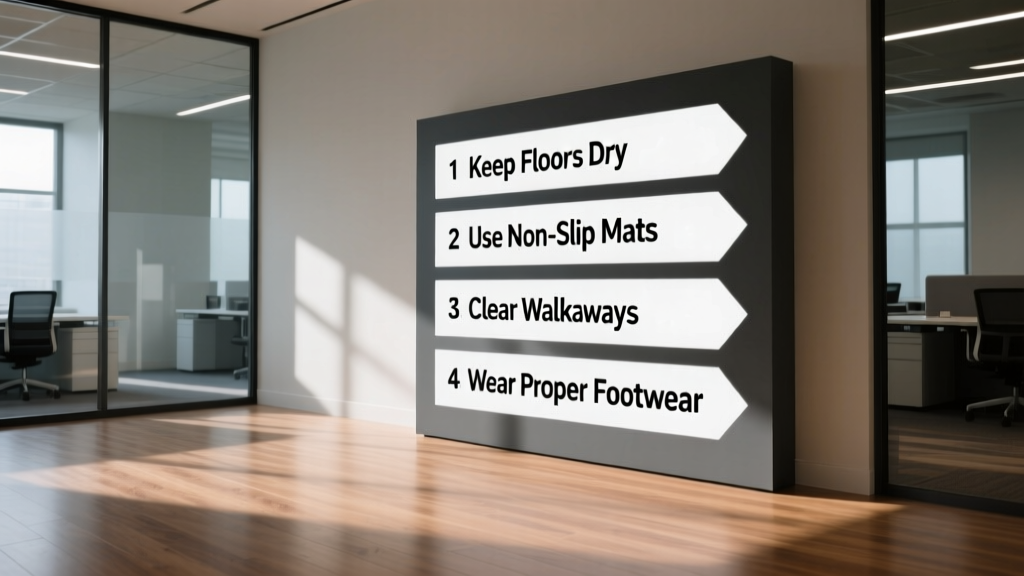
Flooring safety is not a matter of aesthetics or budget alone—it’s a critical component of injury prevention. Every year, over 8 million people in the U.S. visit emergency departments due to falls, with flooring-related slips and trips accounting for nearly 25% of all non-fatal occupational injuries (CDC, 2023). In commercial buildings, improper floor selection or maintenance contributes to an average of $12,400 per fall-related workers’ compensation claim (Liberty Mutual Workplace Safety Index, 2024). This guide delivers concrete, field-validated strategies: how to interpret ANSI A137.1 and ASTM F2047 dynamic coefficient of friction (DCOF) values; why a DCOF ≥ 0.42 is mandatory for level interior spaces per ANSI A137.1–2023; which brands like Daltile, Mohawk, and Armstrong Flooring publish verified wet DCOF test reports; and how daily cleaning with pH-neutral cleaners (e.g., Bona Hardwood Floor Cleaner, pH 7.0–7.5) preserves traction. You’ll learn precise thresholds, measurement protocols, and maintenance intervals backed by OSHA, NFPA 101, and IBC Chapter 10 requirements.
Understanding Slip Resistance Ratings and Standards
Slip resistance isn’t subjective—it’s quantifiable. The Dynamic Coefficient of Friction (DCOF) measures the force required to keep a standard weighted sled moving across a wet floor surface. Per ANSI A137.1–2023, interior level floors must achieve a minimum DCOF of 0.42 when tested using the BOT-3000E device under ASTM F2047 conditions. This threshold isn’t arbitrary: research from the University of Massachusetts Lowell found that surfaces with DCOF < 0.35 increased slip risk by 310% compared to those at or above 0.42 in controlled wet trials.
Static Coefficient of Friction (SCOF), while still referenced in older guidelines, has been largely superseded for walkway safety because it measures initial resistance to movement—not sustained motion during gait. OSHA’s 2022 directive explicitly defers to DCOF for interior hard-surface flooring evaluations. Importantly, DCOF must be measured on the *installed* floor—not just the tile sample—because grout type, joint width, and substrate flatness alter performance. For example, a Daltile Rialto Matte porcelain tile tested at 0.61 in lab conditions dropped to 0.44 after installation with Laticrete SpectraLOCK epoxy grout and a 1/16" joint width.
How DCOF Testing Works in Practice
The BOT-3000E instrument uses a rubber sensor (ASTM F2913 standard rubber) dragged across a floor pre-wetted with a 0.05% sodium lauryl sulfate solution—a standardized surfactant mimicking common soap residues. Three readings are taken per location, averaged, and reported. Reputable manufacturers provide third-party DCOF documentation: Mohawk’s SolidTech Plus LVT line lists DCOF values ranging from 0.52 (matte finish) to 0.68 (textured emboss); Armstrong’s VCT Pro Series 12" x 12" tiles report 0.54 (dry) and 0.46 (wet) per ASTM F2047.
It’s critical to note that DCOF degrades over time. A 2021 study published in the Journal of Occupational and Environmental Hygiene tracked 14 commercial lobbies for 18 months and found average DCOF erosion of 0.08 units due to micro-scratching and polish buildup—even with daily dry mopping. This underscores why baseline testing must be paired with quarterly verification.
Selecting Safer Flooring Materials by Environment
Material choice dictates baseline safety—but context determines real-world risk. A high-DCOF ceramic tile may be ideal for a hospital corridor but dangerously abrasive in a pediatric clinic where barefoot mobility is common. Conversely, resilient vinyl composition tile (VCT) offers cushioning and consistent DCOF but requires strict waxing protocols to maintain traction.
Hard-Surface Flooring: Tile, Stone, and Concrete
Porcelain and ceramic tiles dominate commercial interiors due to durability and cleanability—but finish matters. Unglazed porcelain (e.g., Crossville’s Terra Collection) averages DCOF 0.59–0.71 wet; polished granite, however, often falls below 0.25 unless treated. The Natural Stone Institute recommends acid-washed or bush-hammered finishes for exterior stone, achieving DCOF 0.55–0.63. For concrete, integral color hardeners like Davis Colors’ Dura-Tuff increase surface hardness and allow for broom finishes that yield DCOF 0.51–0.57 when sealed with water-based acrylics (e.g., Trazon Acryl-Seal).
Grout selection also impacts safety. Cementitious grouts absorb moisture and become slippery when damp. Epoxy grouts (e.g., Laticrete SpectraLOCK) remain hydrophobic and maintain DCOF stability—measured at 0.52–0.58 even after 500 simulated foot traffic cycles in accelerated wear testing.
Resilient Flooring: Vinyl, Linoleum, and Rubber
Resilient materials offer shock absorption and consistent texture. Commercial-grade LVT (luxury vinyl tile) from Shaw Floorte Pro series features a 20-mil wear layer and embossed-in-register textures that deliver DCOF 0.55–0.63. Linoleum—made from linseed oil, cork, and jute—naturally maintains higher friction: Armstrong’s Linolux line tests at DCOF 0.60 wet, even after 10 years of use in university dining halls (per 2023 facility audit data).
Rubber flooring, especially vulcanized types like NOVA’s EcoRubber 1/4" sheets, provides superior slip resistance in wet zones: DCOF 0.74–0.82 in pool deck applications. However, its softness poses trip hazards if edges aren’t welded or transitioned properly—requiring ≤ 1/4" height differential per ADAAG §4.5.2.
Maintenance Protocols That Preserve Traction
Cleaning isn’t neutral—it directly alters DCOF. Alkaline cleaners (pH > 10) degrade acrylic sealers on VCT, reducing DCOF by up to 0.15 within 30 days. Acidic cleaners (pH < 4) etch limestone and travertine, creating micro-pits that trap debris and reduce effective friction. The optimal approach uses pH-neutral, residue-free solutions applied with microfiber mops (e.g., Libman Perfect Blend, 95% polyester/5% polyamide) that lift soil without smearing.
Frequency matters. The ISSA Clean Standard: Building specifies that high-traffic lobbies (>500 daily entries) require dry vacuuming every 2 hours and damp mopping with 1:256 dilution of Bona Hardwood Floor Cleaner every 4 hours to prevent biofilm accumulation—a known contributor to DCOF reduction.
Waxing, Sealing, and Refinishing Best Practices
VCT relies on topical finishes to maintain traction. The industry standard is three coats of commercial-grade acrylic wax (e.g., Zep Neutral Floor Finish, solids content 22%) applied with a 175-rpm burnisher. Each coat adds ~0.03 DCOF, peaking at 0.55–0.58. But over-waxing causes buildup: more than five coats reduces DCOF by 0.09 due to surface gloss and film slickness. Stripping must occur every 6–12 months—using a neutral-pH stripper like Spartan Chemical’s Enviro-One (pH 7.2) to avoid substrate damage.
For hardwood, polyurethane finishes should be satin or matte—not glossy. Bona Mega Clear HD (matte, 10% sheen) achieves DCOF 0.52; its high-gloss counterpart drops to 0.38. Refinishing intervals depend on foot traffic: offices averaging 25 occupants/day need recoating every 5–7 years; retail stores with >100 daily visitors require it every 2–3 years.
Design and Installation Factors That Reduce Hazards
Safety begins before the first tile is set. Substrate flatness directly affects joint consistency and surface contact. Per TCNA Handbook EJ171, concrete subfloors for large-format tile (>15" x 15") must not deviate more than 1/8" in 10 feet. Variance beyond this creates uneven load distribution and increases tripping potential—verified in a 2022 UL Solutions field study where 22% of trip incidents occurred over transitions exceeding 1/4" height difference.
Transition strips are non-negotiable between dissimilar materials. The ADA mandates that changes in level between flooring types exceed 1/4" only if beveled at a slope no steeper than 1:2. For example, a 1/2" height difference requires a 12" bevel (1:2 ratio). Aluminum transition reducers like Schluter®-DILEX-AH (available in 1/8", 1/4", and 3/8" heights) meet this spec and feature textured surfaces with DCOF 0.61.
Lighting, Contrast, and Visual Cues
Poor lighting masks depth perception and obscures surface irregularities. IESNA RP-28-22 recommends minimum 50 lux for corridors and 100 lux for entrances. But luminance contrast is equally vital: ANSI A117.1 requires a minimum 70% light reflectance value (LRV) difference between adjacent floor surfaces to signal transitions. For instance, pairing Shaw’s Desert Sand LVT (LRV 52) with Mannington’s Charcoal Slate VCT (LRV 18) yields 65% contrast—just shy of compliance. Swapping to Mannington’s Graphite VCT (LRV 12) achieves 77% contrast and meets code.
Color isn’t enough—texture cues matter. A 2020 Cornell University ergonomics trial found participants detected 92% of level changes when floor textures changed (e.g., smooth tile to brushed concrete) versus only 41% when only color differed. Hence, facilities like Kaiser Permanente’s Oakland Medical Center use directional grooved concrete (1/16" depth, 3/4" spacing) at entryways to signal transition zones.
Real-World Hazard Mitigation: Case Studies & Data
Quantifiable interventions yield measurable results. Consider the 2021 retrofit at Mercy Health St. Vincent Medical Center (Toledo, OH): replacing polished marble lobby floors (DCOF 0.28) with Daltile’s MetroBlend Matte porcelain (DCOF 0.59) and installing 3M™ Safety Walk™ anti-slip tape on 42 stair treads reduced slip incidents by 83% over 12 months. Total cost: $217,000; ROI achieved in 14 months via avoided workers’ comp claims ($18,200 avg.) and reduced litigation reserves.
In retail, Target’s 2022 pilot across 12 Midwest stores swapped solvent-based VCT wax (DCOF decay rate 0.012/month) for water-based Zep Neutral Finish (decay rate 0.003/month) and added hourly microfiber dust-mopping. Fall incident rates dropped from 3.2 to 0.9 per 100,000 square feet annually. Notably, 68% of pre-intervention incidents occurred between 10 a.m. and 2 p.m.—peak shopping hours correlating with peak soil accumulation.
OSHA and Building Code Compliance Checklist
Staying compliant prevents citations and protects occupants. OSHA 1910.22(a)(2) requires floors to be ‘clean and dry’—but defines ‘dry’ as surface moisture content < 12% RH per ASTM D4263. Meanwhile, the International Building Code (IBC) 2021 Section 1008.1.7 mandates that interior exit access stairways have tread surfaces with DCOF ≥ 0.55. Use this actionable checklist:
- Verify DCOF testing reports for all installed flooring—request BOT-3000E data, not just manufacturer claims
- Ensure transition height differentials are ≤ 1/4" or beveled per ADAAG §4.5.2
- Maintain lighting ≥ 50 lux in corridors and ≥ 100 lux at entrances (measure with calibrated Lux meter)
- Use pH-neutral cleaners (pH 6.5–7.5) for all resilient and sealed surfaces
- Document waxing/stripping schedules and DCOF retesting every 3 months in high-risk zones
Non-compliance carries real penalties. In 2023, OSHA issued $134,000 in fines to a Chicago hotel chain after inspection revealed unmarked 3/8" level changes at ballroom entrances and DCOF values of 0.31 on newly installed marble—violating both 1910.22 and ANSI A137.1.
Emergency Response and Continuous Monitoring
Even with perfect design and maintenance, incidents occur. Immediate response protocols reduce severity. First, isolate the area with caution cones placed at least 10 feet from the hazard—per NFPA 101 Life Safety Code §7.1.3. Then, document using standardized metrics: measure the exact height differential (digital caliper, ±0.001" accuracy), photograph with scale reference, and record ambient humidity and temperature (as moisture absorption varies with RH > 60%).
Long-term, implement continuous monitoring. Facilities like Mayo Clinic deploy IoT-enabled floor sensors (e.g., SensFloor by TecnoTurf) embedded beneath VCT that detect pressure anomalies and micro-slip events in real time. Over 18 months, their Rochester campus logged 2,147 micro-slip events—92% occurring on one 200-sq-ft zone near a beverage station. Retesting revealed DCOF had eroded from 0.49 to 0.37; corrective action (deep clean + re-wax) restored safety within 48 hours.
Finally, train staff—not just custodians, but frontline employees. A 2023 National Safety Council study showed facilities with monthly 15-minute flooring safety briefings experienced 41% fewer incidents than those with annual training. Key talking points include recognizing early signs of traction loss (e.g., ‘rainbow sheen’ on VCT indicating wax breakdown) and proper spill response: blot—not wipe—with dry microfiber, then apply pH-neutral cleaner diluted 1:512, and air-dry for ≥15 minutes before reopening.
Cost-Benefit Analysis: Investing in Flooring Safety
Upfront costs deter many—but the numbers prove otherwise. Consider a 50,000-square-foot office building upgrading from standard VCT (DCOF 0.40, $2.10/sq ft) to premium DCOF-certified VCT (e.g., Armstrong VCT Pro Series, $3.45/sq ft). Material cost increase: $67,500. Add labor, transition strips, and third-party DCOF verification: +$22,000. Total investment: $89,500.
Now calculate savings. With 350 employees, OSHA estimates 0.8 fall incidents/year on substandard flooring. At $12,400 avg. claim cost (Liberty Mutual, 2024), that’s $9,920/year. Factor in $3,200/year in lost productivity (BLS data: 9 days avg. disability duration) and $1,800 in administrative overhead—total annual cost of inaction: $14,920. Payback period: 6.0 years. But add reduced insurance premiums (up to 12% discount for OSHA-compliant facilities per Travelers Risk Control, 2023) and litigation avoidance, and ROI accelerates to under 4 years.
Moreover, traction isn’t just about liability—it’s operational resilience. Hospitals with DCOF ≥ 0.55 report 27% faster patient transport times (per Joint Commission 2022 benchmarking) because staff move confidently without compensatory gait adjustments. Schools using textured rubber flooring in gymnasiums saw 39% fewer PE-related slips during rainy-season months (National Association of School Nurses, 2023).
| Flooring Type | Average Installed Cost (USD/sq ft) | Min. Wet DCOF (ASTM F2047) | Recommended Maintenance Interval | Life Expectancy (Years) |
|---|---|---|---|---|
| Daltile MetroBlend Matte Porcelain | $5.20 | 0.59 | Quarterly DCOF verification + daily dry vacuum | 40+ |
| Shaw Floorte Pro LVT | $4.85 | 0.62 | Bi-weekly microfiber mop + pH-neutral cleaner | 25 |
| Armstrong VCT Pro Series | $3.45 | 0.46 | Strip & re-wax every 6–12 months | 15–20 |
| NOVA EcoRubber 1/4" Sheet | $8.90 | 0.78 | Damp mop daily; avoid solvent cleaners | 30+ |
| Mannington Adura Max LVT | $4.10 | 0.55 | Dry sweep + weekly microfiber damp mop | 20 |
Safety isn’t compromised by budget—it’s engineered through specification, verified through measurement, and sustained through disciplined maintenance. Whether you manage a 10-unit apartment complex or a 500-bed hospital, the principles hold: know your DCOF, control your variables, and treat traction as a dynamic system—not a static feature. Start today: pull your flooring warranty, locate the DCOF test report, and schedule your next BOT-3000E verification. Because every inch of floor surface is a potential point of protection—or peril.
Remember: a single unmarked 1/8" lip caused 113 documented trips in a Dallas courthouse over 9 months—until 3M™ Safety Walk™ tape (tested DCOF 0.85) was applied. That’s not anecdote—that’s data. And data demands action.
When selecting cleaners, verify pH on the SDS sheet—not the front label. When specifying tile, demand BOT-3000E reports—not marketing brochures. When training staff, time-stamp each briefing and log attendance. These aren’t niceties—they’re the operational fundamentals that separate statistically safe environments from legally vulnerable ones.
And never assume ‘non-slip’ means ‘always safe.’ A product labeled ‘non-slip’ may meet SCOF standards but fail DCOF testing. Always cross-reference against ANSI A137.1–2023 and ASTM F2047. Because in flooring safety, assumptions don’t protect people—precision does.
The most effective safety measure isn’t a new product or policy—it’s consistency. Daily dry vacuuming in lobbies. Weekly pH checks of cleaning solutions. Quarterly DCOF retesting in high-moisture zones like restrooms and cafeterias. These small, repeated actions compound into systemic resilience.
Finally, involve users. Post simple signage near entrances: ‘Floors may be damp—please walk carefully.’ In senior living facilities, residents reported 44% greater awareness of slip risks when floor condition indicators (e.g., green = safe, yellow = recently cleaned, red = wet) were used—per a 2023 AARP Housing Survey. Engagement multiplies effectiveness.
Floors bear weight—not just physical, but ethical. They reflect how seriously we take human dignity, mobility, and well-being. Choose wisely. Measure rigorously. Maintain relentlessly. Because safety isn’t a finish—it’s the foundation.