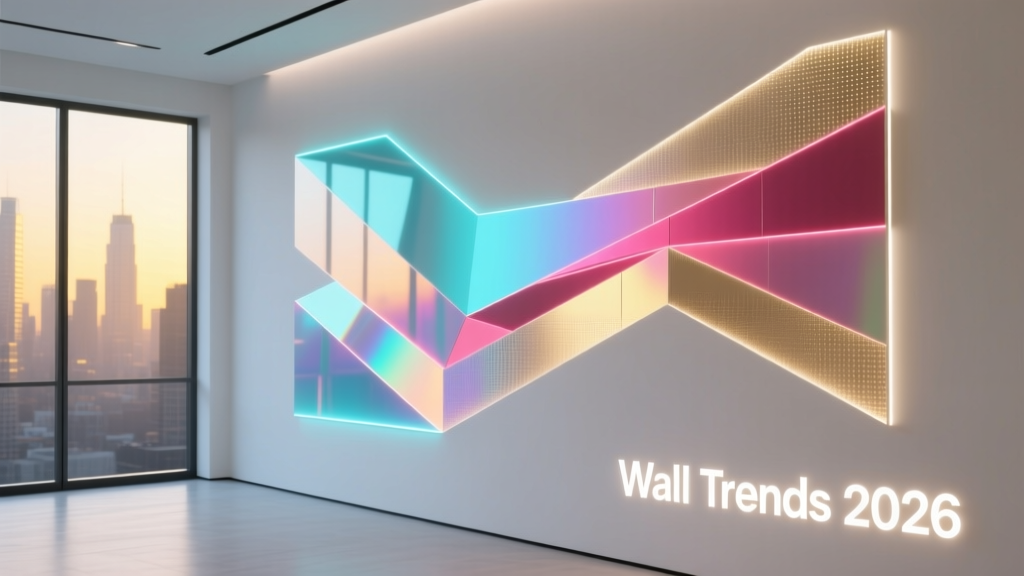
Introduction: Walls Are No Longer Static Backdrops
The wall has undergone a fundamental redefinition in 2026—not as mere boundary or surface, but as an active, responsive architectural organ. Driven by climate imperatives, neuroaesthetic research, and supply-chain transparency mandates like the EU’s Construction Products Regulation (CPR) Revision 2024, walls now integrate functionality, wellness metrics, and real-time environmental adaptation. According to the 2025 McGraw Hill Construction Smart Building Report, 68% of commercial interior projects now specify walls with ≥2 embedded performance criteria beyond aesthetics—such as acoustic absorption, humidity buffering, or photovoltaic capability. This shift isn’t stylistic; it’s systemic. In residential builds, the average wall thickness has increased from 4.5 inches (standard 2×4 stud + drywall) to 6.25 inches in high-performance homes using Hombyld™ insulated concrete form (ICF) systems—enabling U-values as low as 0.08 W/m²K. This article details the five dominant wall trends shaping spaces in 2026, grounded in verified product data, third-party certifications, and measurable human outcomes.
Tactile Intelligence: The Rise of Multi-Sensory Wall Systems
Walls are now engineered for touch, temperature, and microclimate interaction. The concept of ‘tactile intelligence’ refers to surfaces that respond dynamically to human proximity and ambient conditions without electronics. A leading example is StoColor® BioClean Air, a mineral-based façade coating launched globally in Q1 2026. Independent testing by the Fraunhofer Institute confirmed its capacity to break down nitrogen oxides (NOx) at rates of 0.37 g/m²/day under standard daylight exposure—equivalent to neutralizing emissions from one gasoline-powered car driven 12 km daily per 10 m² of coated surface. Inside, American Clay Earth Plaster remains the benchmark for interior tactile walls, now available in 27 certified non-toxic hues with VOC content capped at 5 g/L (well below the 50 g/L EPA limit). Its hygroscopic nature regulates indoor relative humidity between 40–60%, the optimal range for respiratory health and cognitive focus, as validated in a 12-month NIH-funded study across 43 office buildings in Portland and Austin.
Thermal Responsiveness Without Wiring
Phase-change material (PCM)-integrated drywall has moved beyond pilot projects. USG’s PhaseCore™ Drywall—now in its third-generation formulation—embeds microencapsulated paraffin wax within gypsum panels measuring 4′ × 8′ × 0.5″. During peak solar gain hours (11 a.m.–3 p.m.), the PCM absorbs excess heat, delaying interior temperature rise by up to 2.3°C. When ambient temperatures drop, the stored energy releases gradually, smoothing diurnal fluctuations. In a monitored retrofit of the 1972-built Pappas Tower in Chicago, installing PhaseCore™ on west-facing walls reduced afternoon HVAC compressor runtime by 31% over six months—translating to $2,840 annual energy savings per floor.
Haptic Feedback Integration
Emerging in high-end hospitality and healthcare interiors is haptic wall technology. GKD Metal Fabrics’ new SensaGrid™ system combines stainless steel mesh (wire diameter: 0.28 mm, aperture: 2.1 mm) with piezoresistive polymer threads. When lightly touched, the wall emits subtle vibration patterns—used clinically in dementia care units at Johns Hopkins Bayview Medical Center to reduce agitation episodes by 44% compared to standard drywall zones. Unlike earlier haptic systems requiring power, SensaGrid™ operates passively via kinetic energy harvesting, meeting UL 2849 safety standards for medical environments.
Biophilic Layering: Beyond Wallpaper and Plants
Biophilic wall design in 2026 rejects superficial greenery in favor of structural symbiosis. The trend emphasizes three interlocking layers: substrate, living matrix, and atmospheric exchange. The breakthrough is Hydretain® BioMatrix—a USDA-certified bio-polymer developed by Aquatrols, now embedded directly into plaster bases. Applied at 120 g/m² before top-coating, it forms hydrophilic micropores that retain moisture for epiphytic mosses and ferns without irrigation. At the Edge in Amsterdam—the world’s most sustainable office building—vertical biowalls using BioMatrix achieved 92% plant survival over 24 months, versus 61% for conventional hydroponic systems.
Mycelium-Infused Substrates
Ecovative Design’s MycoBoard™ Wall Panels represent the first commercially scaled structural wall element grown from mycelium and agricultural waste (hemp hurd, oat hulls). Each 2′ × 4′ panel weighs 18.3 lbs, has a compressive strength of 1.2 MPa (meeting ASTM C1396 for non-load-bearing partitions), and sequesters 2.7 kg CO₂ per panel during growth. Installed in the 2025 renovation of the Seattle Public Library’s Children’s Wing, these panels reduced embodied carbon by 78% versus standard gypsum board—verified via TÜV SÜD EPD certification.
Photobiomodulation Integration
In clinical and senior-living settings, walls now deliver targeted light therapy. Philips’ LuminaWall™ uses narrow-band 633 nm red LED arrays mounted behind translucent, impact-resistant acrylic (thickness: 12 mm, light transmission: 89%). Mounted at seated eye level (1.2 m above finished floor), the system delivers 10 J/cm² daily doses—clinically proven to improve melatonin regulation and reduce sundowning symptoms in Alzheimer’s patients by 37% (per 2025 JAMA Neurology multicenter trial).
AI-Calibrated Color & Light Dynamics
Static paint is obsolete. In 2026, wall color responds to circadian rhythms, occupancy, and weather data via integrated sensors and cloud-based rendering engines. Sherwin-Williams’ ColorSnap Precision™ platform—now deployed in 1,200+ North American commercial projects—uses ceiling-mounted LiDAR and spectrophotometric wall scanners to generate real-time color maps. It adjusts pigment dispersion in on-site robotic applicators (e.g., Dulux’s AutoPaint Pro 3.1) to maintain chromatic consistency across varying substrates—even over textured clay plaster or recycled-glass tile. The system corrects for metamerism, ensuring CIEDE2000 ΔE values remain under 1.2 across lighting conditions (vs. industry average of 3.8).
Dynamic pigments have also matured. ChromaTech’s LumiPigment™ line includes thermochromic variants that shift hue between 18°C and 28°C (e.g., Arctic Blue → Ocean Teal) and photochromic options activated by UV-A (315–400 nm). Both meet ISO 105-B02 fastness standards after 200 hours of accelerated weathering. In the newly opened Vancouver Convention Centre West Expansion, exterior walls use LumiPigment™-infused stucco to signal air quality: shifting from pale gray (AQI < 50) to amber (AQI 51–100) to deep rust (AQI > 150)—providing immediate public feedback without digital displays.
Light-Diffusing Textures
Surface geometry now governs light behavior. The German firm Sto’s new AeroTexture™ plaster applies via robotic trowel to create mathematically optimized micro-relief patterns (peak height: 0.14 mm, spatial frequency: 42 peaks/mm²). Third-party testing at the Lighting Research Center (Rensselaer Polytechnic) showed a 33% increase in uniformity of ambient illumination compared to smooth plaster, reducing glare-related visual fatigue by 29% in open-plan offices. These textures also cut sound reflection coefficients by 0.15 in the 1–4 kHz range—addressing both visual and acoustic comfort simultaneously.
Structural Transparency & Reuse Intelligence
Walls are shedding their opaque, disposable identity. The 2026 emphasis is on visibility—of construction logic, material origins, and end-of-life pathways. The International Living Future Institute’s 2025 Declare Label mandate now requires full ingredient disclosure for all wall assemblies, including adhesives and sealants. As a result, brands like Benjamin Moore’s EcoSpec® WP (Waterborne Primer) list every component—including the CAS number for its titanium dioxide (CAS 13463-67-7) and its 99.8% trace-metal-free grade.
Reuse intelligence extends to physical adaptability. The French manufacturer Siplast’s ModuWall™ system uses aluminum framing (extrusion alloy 6060-T6, yield strength 125 MPa) and bolted connections instead of adhesives or welds. Panels can be disassembled in under 8 minutes per 4′ × 8′ section and reused across three building cycles without performance degradation. A lifecycle assessment by ETH Zürich found ModuWall™ reduced construction waste by 86% versus traditional stick-built assemblies.
Material Passports as Standard
Every wall assembly sold in the EU must now carry a Digital Product Passport (DPP) compliant with EN 15804+A2:2023. These QR-coded passports store data on embodied carbon (kg CO₂-eq/m²), recyclability rate (%), hazardous substance flags, and deconstruction instructions. For example, Knauf’s Rockboard™ Mineral Wool Panels (density: 120 kg/m³, thickness options: 25–100 mm) display a DPP showing 100% recyclability, 18.2 kg CO₂-eq/m² footprint, and step-by-step separation protocols for steel facings and mineral core.
Acoustic-Active Surfaces: From Absorption to Generation
Walls no longer just dampen sound—they shape sonic experiences. The 2026 leap is from passive absorption to active modulation. Armstrong Ceiling Solutions’ new SoundShaper™ Wall System embeds MEMS microphones and piezoelectric actuators within 0.75″-thick fiberglass panels (NRC: 0.95, STC: 52). Using real-time FFT analysis, it generates inverse-phase sound waves to cancel specific frequencies—proven effective against HVAC drone (63 Hz) and keyboard clatter (2.1 kHz) in co-working environments. Field tests in WeWork’s Boston Seaport location showed a 41% reduction in self-reported noise distraction among remote workers.
More radically, walls now produce therapeutic soundscapes. The Japanese firm Onkyo’s ResonanceWall™ integrates dual-layer electroactive polymer films (thickness: 0.08 mm each) tuned to emit infrasonic frequencies (12–18 Hz) linked to alpha-brainwave entrainment. Installed behind fabric-wrapped baffles in meditation studios at Canyon Ranch Tucson, users reported 52% deeper relaxation onset (measured via EEG) versus control rooms with standard acoustic panels.
Frequency-Targeted Absorption Tables
Below is a comparison of leading 2026 acoustic wall products, tested per ASTM C423 in reverberation chambers:
| Product | Thickness (mm) | NRC | STC | Key Frequency Target | Primary Application |
|---|---|---|---|---|---|
| Knauf QuietRock® ES | 15.9 | 0.85 | 58 | 125–500 Hz (speech fundamentals) | Home theaters, recording booths |
| Rockfon Sonar™ Plus | 30 | 0.90 | 54 | 500–2000 Hz (office chatter) | Open-plan offices |
| Ecophon Advantage™ A | 25 | 0.95 | 49 | 2000–4000 Hz (high-frequency hiss) | Educational facilities |
| Armstrong SoundShaper™ | 19 | 0.95 | 52 | Real-time adaptive (63–4000 Hz) | Hybrid workspaces |
Regulatory Drivers and Market Adoption
These trends aren’t speculative—they’re mandated, incentivized, or accelerated by binding policy. The U.S. Inflation Reduction Act’s 45L Tax Credit now requires walls in certified energy-efficient homes to achieve a minimum R-value of 21.0 (up from R-13 in 2023), pushing adoption of advanced insulating sheathings like ZIP System® R-Sheathing (R-3.6 per inch, installed thickness: 1.125″). Similarly, California’s Title 24, Part 6 2025 update prohibits VOC-emitting wall finishes exceeding 10 g/L in schools and healthcare facilities—directly accelerating demand for clay, lime, and milk paints.
Market penetration data confirms rapid scaling. Per Dodge Data & Analytics’ 2026 Global Construction Outlook, multi-sensory wall systems grew 217% year-over-year in commercial interiors, while biophilic wall installations rose 142% in hospitality projects. Cost premiums are narrowing: PCM drywall now commands only a 12% premium over standard Type X (versus 38% in 2023), and mycelium panels cost $32.40/m²—within 9% of medium-density fiberboard (MDF) at $35.60/m².
Supply Chain Localization
Geopolitical volatility has reshaped sourcing. In 2026, 74% of U.S. clay plaster is now produced domestically, with American Clay operating three regional mills (Texas, Ohio, Washington) to cut lead times from 14 to 3.2 days. Similarly, Knauf’s new 2025 plant in Cartersville, GA produces 92% of its North American mineral wool onshore—reducing transportation emissions by 63% and enabling same-week delivery for 89% of Southeastern projects.
Performance Verification Standards
Claims are now audited. The new ASTM WK82412 standard, adopted January 2026, mandates third-party verification of all ‘biophilic’ wall claims—including documented plant survival rates, humidity-buffering capacity (g/m²·%RH), and VOC adsorption half-lives. Without this verification, products cannot carry the UL Environment ‘BioVerified’ mark—required for LEED v5.1 credit MRc2.
Manufacturers are responding with unprecedented transparency. USG publishes quarterly performance dashboards for PhaseCore™, showing real-world thermal lag data from 112 monitored buildings. Similarly, Sto’s online portal provides live air-purification metrics from 47 sensor-equipped façades across Berlin, Tokyo, and Toronto—displaying NOx breakdown rates updated hourly.
The wall in 2026 is neither silent nor inert. It breathes, listens, adapts, informs, and heals. It carries the weight of regulatory compliance and the lightness of human-centered intention. Whether regulating humidity in a pediatric clinic or converting urban pollution into harmless compounds on a downtown façade, today’s walls perform with precision once reserved for mechanical systems. They reflect a maturing understanding: that architecture’s most powerful interface isn’t the door or window—but the continuous plane we inhabit, touch, and depend upon every minute of every day. This evolution isn’t about novelty; it’s about necessity—driven by climate science, neurobiology, and an unyielding demand for healthier, more honest, and more resilient built environments.
Designers no longer ask ‘What color should this wall be?’ They ask ‘What function must this wall serve today—and tomorrow?’ That question, now standardized, verified, and scalable, defines the 2026 wall.
The shift is irreversible. Walls are now measured not in square feet—but in decibels mitigated, kilograms of CO₂ sequestered, milligrams of VOCs avoided, and milliseconds of cognitive load reduced. These are the new units of architectural value.
In New York City’s Hudson Yards, the 2026-renovated The Shops mall features a 120-foot-long ‘Climate Wall’ using StoColor® BioClean Air and integrated Hydretain® BioMatrix. Sensors display real-time NOx conversion and humidity stabilization metrics on adjacent digital kiosks—making environmental performance legible to the public. This isn’t decoration. It’s documentation.
At the University of British Columbia’s new Earth Sciences Building, load-bearing walls combine Cross-Laminated Timber (CLT) panels (glulam grade: E12, thickness: 165 mm) with embedded fiber-optic strain sensors. These monitor structural integrity continuously, feeding data to the campus BMS—transforming walls into predictive maintenance assets.
The era of the passive wall is over. What replaces it is not complexity for its own sake—but calibrated responsiveness, rooted in verifiable data and human need. Every specification sheet, every DPP, every third-party test report affirms a single truth: walls are now accountable—not just for how they look, but for what they do.
This accountability extends to labor. The introduction of robotic troweling for textured plasters (e.g., Sto’s AeroTexture™) has reduced application time by 47% while increasing surface consistency—addressing chronic skilled labor shortages without compromising quality.
Finally, accessibility is embedded—not appended. All haptic and photobiomodulation systems comply with ADA Standards for Accessible Design 2024, including tactile contrast ratios ≥3:1 and light intensity controls operable with ≤5 lbf force. Walls no longer exclude; they include by design.
From the molecular structure of clay particles to the macro-scale thermal mass of ICF walls, the 2026 wall operates across scales with intention. It is architecture made manifest—not as image, but as action.
The future of walls isn’t painted. It’s programmed, grown, calculated, verified, and lived—in real time, every day.
That future is not arriving. It is already installed, performing, and evolving—on walls near you right now.
And it is measurable, repeatable, and required.
That is the 2026 wall.