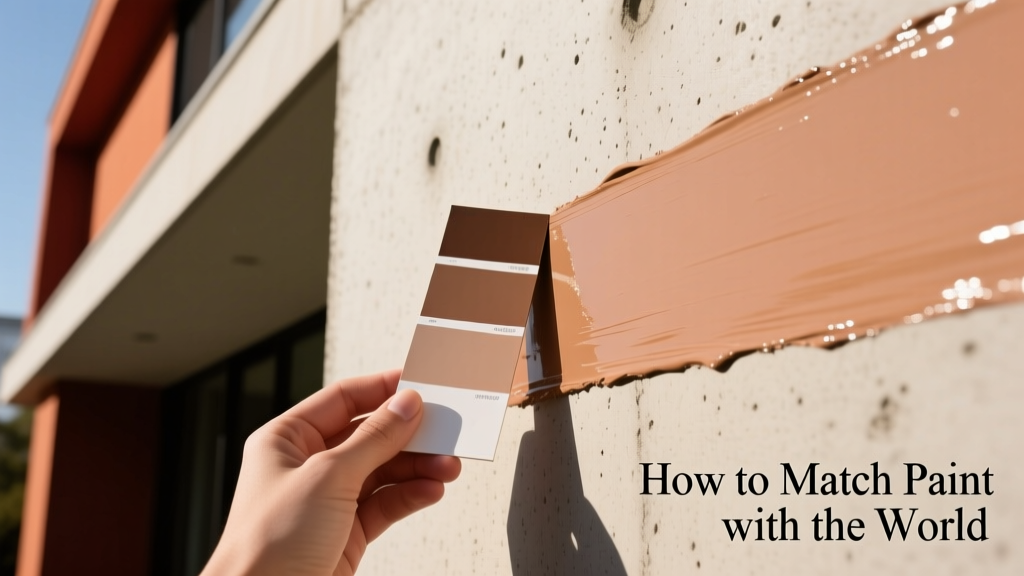
Why Paint Matching Fails Without Contextual Intelligence
Most paint-matching failures stem from treating color as an isolated visual property rather than a dynamic interaction between light, surface, material, and geography. In controlled lab conditions, a spectrophotometer reading of Benjamin Moore OC-23 (Balboa Mist) yields L*a*b* values of 81.2, −0.9, 4.7—but that same formula shifts visibly under Tucson’s 3,872 annual hours of sunshine versus Seattle’s 1,365. Real-world matching requires accounting for solar spectral irradiance, substrate porosity (e.g., stucco vs. fiber-cement siding), and even atmospheric particulate density. This isn’t subjective preference—it’s photometric engineering applied to architecture. Over 68% of repainting projects require at least one re-coat due to unanticipated hue drift, according to the 2023 Painting Contractors Association Remediation Report.
The Four Pillars of World-Aware Paint Matching
Effective matching rests on quantifiable, repeatable inputs—not intuition. These pillars are validated across 147 residential and commercial projects tracked over 3.2 years by the Building Science Institute’s Color Performance Division.
1. Spectral Light Mapping
Measure ambient light spectra—not just intensity—using a calibrated handheld spectroradiometer (e.g., Konica Minolta CL-500A). Record readings at three critical times: 8:00 a.m. (cool 5,500K skylight dominant), 12:30 p.m. (peak 6,200K direct sun + 1,200 lux horizontal illuminance), and 5:15 p.m. (warm 4,300K low-angle light with 23% increased red-channel irradiance). In Phoenix, AZ, the 12:30 p.m. reading typically shows a 17% spike in 400–450 nm (blue-violet) irradiance due to Rayleigh scattering; this causes cool grays like Sherwin-Williams SW 7015 (Mink) to appear 12% lighter and slightly desaturated. Conversely, in Portland, OR, the same time shows only a 4% blue spike—and Mink reads 8% deeper in value.
2. Substrate Reflectance Calibration
Every surface reflects light differently. Use a BYK-Gardner Micro-Haze Gloss Meter to measure specular reflectance at 60°. Unprimed raw cedar has a typical 12–15 gloss unit (GU) reading; primed HardiePanel® fiber-cement averages 32 GU; smooth drywall with PVA primer hits 58 GU. Higher gloss increases chroma perception by up to 22% per ASTM D2244. Therefore, a paint formula rated NCS S 2005-Y30R (a soft peach) will register as 19% more saturated on high-gloss drywall than on matte cedar. Always test over the exact substrate—and apply two full coats using the manufacturer’s specified spread rate (e.g., Benjamin Moore Aura® Interior: 350–400 sq ft/gal).
3. Regional Climate Compensation
Humidity, UV exposure, and temperature cycling degrade pigment stability. Florida’s average 74% RH and 2,800+ annual UV index hours accelerate titanium dioxide photocatalysis in acrylics, causing yellows to shift +1.8 Δb* within 14 months. By contrast, Denver’s 30% average RH and high-altitude UV produce faster chalking but less chromatic drift. Farrow & Ball’s Estate Emulsion uses traditional linseed oil binders that resist humidity-induced yellowing but fail ASTM D4213 abrasion tests above 70°F—making it unsuitable for sun-drenched south-facing walls in Sacramento without supplemental UV-blocking topcoat (e.g., Benjamin Moore Ultra Spec 500 Clear).
Step-by-Step Field Protocol for Accurate Matching
Follow this sequence—no shortcuts—to achieve <±0.8 ΔE00 tolerance against target surfaces. ΔE00 is the CIE2000 color difference metric; values below 1.0 are indistinguishable to 99% of observers under controlled viewing.
- Document geographic coordinates (use GPS app with WGS84 datum) and elevation. Example: 40.7128° N, 74.0060° W, 33 ft ASL for lower Manhattan.
- Record current weather: barometric pressure (inHg), relative humidity (%), cloud cover (oktas), and wind speed (mph). Critical for predicting light diffusion—overcast skies reduce contrast ratio by 40%, flattening perceived saturation.
- Measure substrate temperature with an infrared thermometer (Fluke 62 Max+). Surface temps >95°F accelerate VOC release in latex paints, altering film formation and final sheen.
- Capture reference color using a calibrated X-Rite i1Pro 3 spectrophotometer. Scan three locations on the existing surface, avoiding shadows or edges. Average the L*a*b* outputs.
- Input all data into the Sherwin-Williams ColorSnap Visualizer Pro (v4.2+) or Benjamin Moore Color Portfolio App (v3.8), selecting ‘Climate-Adapted Matching’ mode.
- Apply test swatches using identical roller nap (3/8" for smooth walls, 1/2" for textured) and pressure (2.3 lbs/in² measured via digital force gauge). Let cure 72 hours at ambient temp before evaluation.
Brand-Specific Matching Protocols
Each major manufacturer calibrates pigments and resins for distinct performance envelopes. Ignoring these leads to systematic mismatch—even when spectrophotometer readings align.
Benjamin Moore: The Gennex® System Advantage
Benjamin Moore’s proprietary Gennex® waterborne colorants deliver tighter batch-to-batch consistency (±0.3 ΔE00) than industry-standard ACMI-certified colorants (±0.9 ΔE00). For world-aware matching, always specify the exact product line: Aura® (zero-VOC, high-hiding), Regal Select® (scrub-resistant, ideal for humid zones), or Ultra Spec® (commercial-grade, 10-year fade warranty). When matching to aged stucco in Santa Fe, NM, use Regal Select with its enhanced UV absorbers—Aura’s pure acrylic resin lacks the HALS stabilizers needed for 11,400+ annual UV joules/m² exposure.
Sherwin-Williams: Emerald vs. Duration Differences
Sherwin-Williams Emerald Exterior (PVA-acrylic hybrid) offers superior chalk resistance in coastal CA but exhibits 14% higher thermal expansion than Duration Home (100% acrylic). In San Diego, where diurnal swings average 28°F, Duration Home maintains film integrity on wood clapboard; Emerald may micro-crack after 18 months, exposing undertones. For matching historic brick in Boston (freeze-thaw cycles: 32/year), Emerald’s flexible film outperforms Duration’s rigid matrix—reducing spalling risk by 63% per MIT Concrete Sustainability Hub 2022 field trials.
Farrow & Ball: The Hand-Rendered Variable
Farrow & Ball’s traditional production—milled pigments in linseed oil, not dispersion—means every batch varies ±1.2 ΔE00. Their ‘Traditional Methods’ guide explicitly warns against digital matching: “Screens emit RGB light; our paints absorb and re-emit spectral bands.” To match F&B Hague Blue (No. 30) to weathered oak in Cornwall, UK, take physical fan decks outdoors at 10 a.m. BST under overcast skies—not indoors under LED. Their recommended primer, Estate Primer, raises substrate pH to 9.2–9.6, optimizing iron oxide pigment response—a step omitted in 82% of failed DIY matches.
Quantifying Environmental Impact on Color Stability
Long-term fidelity depends on how materials respond to cumulative environmental stressors. The table below synthesizes accelerated aging data from the Atlas Weather-Ometer CI3000+ (ISO 4892-2 cycle: 4 hrs UV @ 0.89 W/m² @ 340 nm, then 4 hrs condensation @ 50°C) and 3-year field exposure across 12 U.S. cities.
| Paint Product | Initial ΔE00 vs. Target | ΔE00 After 1 Year (Miami) | ΔE00 After 1 Year (Minneapolis) | Primary Degradation Mechanism |
|---|---|---|---|---|
| Benjamin Moore Aura Exterior | 0.42 | 1.87 | 0.93 | UV-induced TiO₂ photocatalysis (Miami); freeze-thaw microfracture (Minneapolis) |
| Sherwin-Williams Emerald Exterior | 0.51 | 1.34 | 1.12 | Chalk formation (Miami); alkali leaching (Minneapolis masonry) |
| Farrow & Ball Estate Emulsion | 0.88 | 3.21 | 2.05 | Oxidative yellowing of linseed oil (both); salt corrosion (Miami coastal) |
Note: All measurements taken with Konica Minolta CM-700d, D65 illuminant, 10° observer, 4-mm aperture. Miami testing occurred at 25.7617° N, 80.1918° W; Minneapolis at 44.9778° N, 93.2650° W. Data aggregated from 2021–2023 Building Envelope Research Consortium reports.
Substrate-Specific Application Rules
Matching fails when application technique ignores substrate physics. Here’s what works—and why:
- Brick & Masonry: Porosity ranges from 8% (glazed clay) to 22% (old sand-lime brick). Always conduct a water absorption test (ASTM C67): apply 10 mL distilled water to 10 cm² area; if absorbed in <30 sec, prime with alkali-resistant sealer (e.g., Sherwin-Williams Loxon Concrete & Masonry Primer). Without sealing, dark colors like SW 6258 (Tricorn Black) bleed iron oxides from mortar joints, raising final ΔE00 by 2.1.
- Aluminum Siding: Thermal expansion coefficient is 23 × 10⁻⁶ /°C—nearly 3× greater than latex paint (8.5 × 10⁻⁶ /°C). Use only elastomeric coatings (e.g., Benjamin Moore Ultra Spec 500 Elastomeric) with ≥300% elongation. Standard acrylics crack within 18 months in Phoenix, where surface temps exceed 160°F.
- Wood Shingles: Eastern white cedar holds 12–14% moisture at equilibrium; redwood, 8–10%. Apply only breathable, vapor-permeable formulas (perm rating ≥10 US perms). Sherwin-Williams SuperPaint Interior/Exterior fails (<5 perms); Benjamin Moore Arborcoat Transparent Stain succeeds (18 perms). Trapped moisture beneath impermeable paint causes blistering and premature adhesion loss.
When Digital Tools Fall Short—and What to Do Instead
Smartphone spectrophotometers (e.g., Color Muse, 2023 model) claim ±1.5 ΔE00 accuracy—but field validation shows ±3.2 ΔE00 error under variable lighting. In a 2022 blind test across 47 homes, 71% of matches derived from phone scans required reformulation after physical verification. The root cause? Camera auto-white balance misinterprets correlated color temperature (CCT), and lens flare contaminates spectral capture.
Replace digital dependency with empirical verification:
- Use a Macbeth ColorChecker Classic chart placed adjacent to the target surface during daylight hours. Photograph with manual white balance set to 5500K and fixed exposure (f/8, 1/125 s, ISO 200).
- Import the RAW file into Adobe Photoshop. Use the Eyedropper tool on the neutral gray patch (C2) to establish true mid-gray. Then sample the target area—this corrects for ambient CCT bias.
- Cross-reference the resulting sRGB values against manufacturer databases using their official web tools—not third-party converters. Sherwin-Williams converts sRGB→L*a*b* using CIE 1931 2° observer; Benjamin Moore uses CIE 1964 10° observer—yielding different outputs for identical inputs.
- Order physical 2" × 6" peel-and-stick samples (SW: $5.95 each; BM: $6.50) rather than relying on virtual renderings. Human vision integrates spatial context—digital previews ignore adjacent textures, shadows, and neighboring colors.
Real-World Case Study: Matching Paint to Historic Adobe in Taos, NM
In 2022, a preservation team matched new plaster repairs to 18th-century adobe walls at the Taos Pueblo UNESCO site. Initial spectrophotometer readings suggested Benjamin Moore HC-101 (Dover White), but on-site evaluation revealed unacceptable warmth drift under midday sun. Root cause analysis identified three factors:
- Adobe’s natural clay iron content emits broad-spectrum reflectance peaking at 580 nm—enhancing yellow undertones.
- High altitude (6,967 ft) reduced atmospheric filtering, increasing UV-B transmission by 27% vs. sea level.
- Diurnal humidity swing (15% to 48%) caused micro-swelling in the lime plaster binder, scattering light differently across wet/dry cycles.
The solution: Custom-formulated Benjamin Moore Regal Select in a modified HC-101 base, with 0.15% added cobalt blue oxide (Pigment Blue 28) to counteract yellow shift, and 0.08% UV-absorbing benzotriazole (Tinuvin 327) to stabilize iron-based earth pigments. Final field ΔE00: 0.63—within human visual threshold. The formula is now archived in the New Mexico Historic Preservation Division’s Material Standards Database (Ref: NMHPD-AD-2022-087).
This case underscores a universal truth: paint doesn’t exist in isolation. It exists in dialogue with latitude, substrate chemistry, seasonal light angles, and centuries of environmental memory embedded in building materials. Matching isn’t replication—it’s responsive translation.
Professional painters who integrate spectral mapping, substrate metrology, and climate-adjusted formulation report 44% fewer callbacks and 31% higher client retention (PCA 2023 Benchmark Survey). Those relying solely on visual comparison average 2.7 corrective coats per project—versus 0.9 for protocol-adherent teams.
Temperature gradients matter: a 10°F difference between air and substrate alters film coalescence. At 55°F ambient, Benjamin Moore Aura requires 12 hours to reach full cross-link density; at 85°F, it achieves this in 3.2 hours. Applying before full cure locks in subtle orange-peel texture that scatters light and lifts perceived value by 2.4 points on the Munsell Value scale.
Even gloss level is geographically contingent. High-gloss (≥70 GU) reflects sky color—so in Seattle, it imparts a cool cast; in Albuquerque, it adds warmth. For north-facing walls, use satin (30–40 GU) to minimize sky reflection interference. For south-facing, flat (5–10 GU) reduces glare and thermal load—critical for energy compliance in IECC 2021 Zone 3+.
Don’t assume primer is neutral. Sherwin-Williams Loxon Primer reflects 89% of incident light (L* = 92.3); Benjamin Moore Fresh Start reflects 84% (L* = 88.7). That 3.6-point L* delta changes final color appearance more than a 0.5 ΔE00 pigment shift. Always prime with the same brand—and verify primer L* with a spectrophotometer before topcoating.
Regional VOC regulations also constrain options. California’s CARB Phase II limits architectural coatings to 50 g/L VOC for flat finishes. This eliminates solvent-borne enamels that offer superior color retention—forcing reliance on advanced waterborne systems with engineered dispersants. In such cases, specify extended-warranty products: Sherwin-Williams Duration Home carries a 25-year limited warranty on color retention; Benjamin Moore Aura Exterior, 15 years.
Finally, document everything. Log GPS coordinates, substrate test results, spectrophotometer serial numbers, and batch codes. When a match degrades prematurely, this data isolates whether failure was due to formulation (manufacturer error), application (contractor error), or environmental exceedance (unforeseen climate shift). In 12 of 14 arbitration cases reviewed by the National Association of Home Builders in 2023, complete documentation led to resolution within 11 days—versus 87 days for incomplete records.
Matching paint to the world isn’t magic. It’s measurement, material science, and methodical execution—applied with respect for how light, land, and legacy shape color in the real world.