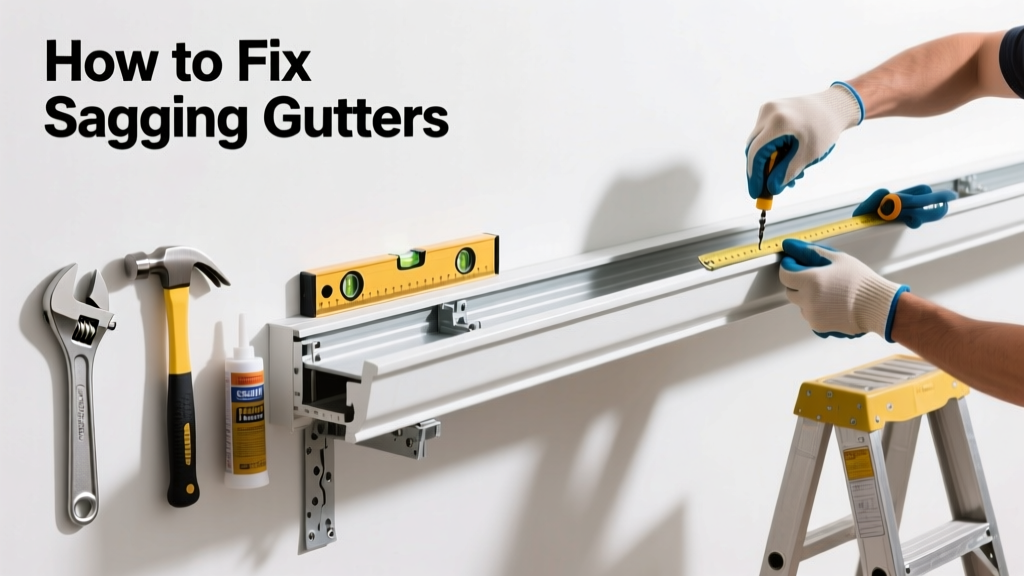
Sagging gutters aren’t just an eyesore—they’re a red flag for water damage waiting to happen. When gutters droop, water pools, overflows, and can rot fascia boards, erode landscaping, or even seep into your basement. Most cases are simple to fix in under two hours—if you catch them early.
Quick Diagnosis
Before grabbing tools, identify the root cause. Sagging rarely happens randomly—it’s usually tied to one or more of these issues:
- Loose or missing hangers or spikes
- Rusted or corroded fasteners (especially on older galvanized steel gutters)
- Excess weight from debris, ice dams, or snow buildup
- Fascia board decay behind the gutter (a serious structural concern)
- Improper initial pitch—gutters installed too flat or even backward
Tools & Materials Needed
| Item | Purpose | Estimated Cost |
|---|---|---|
| Ladder (24-ft extension, Type IA) | Safe access to high gutters; rated for 300+ lbs | $220–$350 |
| Gutter hangers (hidden bracket style) | Stronger support than spike-and-ferrule; won’t pull out over time | $8–$15 per pack of 6 |
| Cordless drill with Phillips and 1/4" hex bits | Drives screws quickly and avoids stripping fasteners | $99–$180 |
| Roofing sealant (butyl-based) | Seals screw holes and prevents leaks at new attachment points | $6–$12 |
| Measuring tape & chalk line | Ensures consistent 1/4" drop per 10 ft of run for proper drainage | $5–$15 |
Step-by-Step Fix
Choose the method that matches your gutter type and severity. Always start by clearing leaves, nests, and sludge—clogged gutters weigh up to 300 lbs when saturated (U.S. EPA, 2022).
- Reset pitch and rehang low sections: Remove old hangers, mark new level points using chalk line and 1/4"-per-10-ft rule, then install hidden hangers every 24–32 inches.
- Reinforce weak spots: Add supplemental hangers mid-span where sag exceeds 1/2 inch—never rely on spacing wider than 3 ft.
- Replace rotted fascia: If the wood behind the gutter crumbles when poked with a screwdriver, cut out the damaged section, sister in pressure-treated lumber, then reattach.
- Upgrade fasteners: Swap rusted spikes for stainless-steel lag screws (1/4" × 2") with washers—these hold 3× longer in wet wood (Gutter Manufacturer’s Association, 2021).
When to Call a Pro
Some situations demand licensed expertise—not pride. Call a gutter contractor if:
- You spot >12 inches of continuous sag or multiple detached sections
- The fascia feels spongy, discolored, or emits a musty odor (signs of advanced rot)
- Your home has multi-story gutters above walkways or driveways
- You’re uncomfortable working at heights over 15 feet without fall protection
"Over 68% of gutter-related water damage claims involve undetected sagging that went unaddressed for more than two seasons." — Insurance Institute for Business & Home Safety, 2023 Report on Residential Drainage Failures
Prevention Tips
Fixing sag once isn’t enough—you need a maintenance rhythm. Install leaf guards on all sections exposed to overhanging branches. Inspect gutters twice yearly: once after spring pollen season and again post-autumn leaf drop. Tighten hangers annually—even stainless steel loosens slightly with thermal expansion. And never let downspouts drain within 3 feet of your foundation; redirect runoff with downspout extensions to prevent soil saturation near footings.
Can I reuse old gutter hangers?
No—reusing bent, rusted, or deformed hangers risks immediate re-sagging. Hidden hangers cost little and provide far superior load distribution. If your existing hangers are aluminum and undamaged, they may be reused only if paired with new stainless screws and verified fascia integrity.
How much sag is too much before repair is urgent?
More than 3/4 inch of droop over a 10-foot span requires action within 72 hours. At that point, water is no longer flowing toward downspouts—it’s spilling over the front edge, saturating soffits and potentially wicking into attic insulation.
Do gutter brackets need pilot holes?
Yes—always drill pilot holes into fascia boards, especially older cedar or pine. Skipping this step causes wood splitting, reduces holding power by up to 40%, and invites future hanger failure (National Association of Home Builders, 2020 Carpentry Standards).
Will fixing sag stop interior ceiling stains?
Only if the stain is directly linked to gutter overflow—not roof leaks or condensation. Check attic ventilation and inspect shingle condition. If stains persist after gutter repair, consult a roofing specialist via roof leak detection guide.
Can I fix sagging gutters in winter?
Not safely if ice or snow is present. Ice-laden gutters weigh 2–3× more and conceal structural damage. Wait until temperatures stay above freezing for 48+ hours and all ice has melted. Use a roof rake first—but never climb onto icy roofs or ladders.
What’s the best gutter material for long-term sag resistance?
Kynar-coated aluminum (0.032" thick) outperforms vinyl and standard-gauge aluminum in real-world stress tests. It resists thermal warping, holds hangers tighter, and flexes less under debris load (Gutter Manufacturer’s Association Material Performance Review, 2022). Pair it with stainless steel hardware for maximum lifespan.
A properly pitched, well-secured gutter system should last 15–20 years with biannual cleaning and annual hanger checks. Don’t wait for dripping eaves or peeling paint to act—sag is the earliest, clearest warning your home’s first line of water defense is failing. Grab your ladder, double-check your harness, and tackle it while the problem is still manageable—and before rain turns minor sag into major foundation trouble.