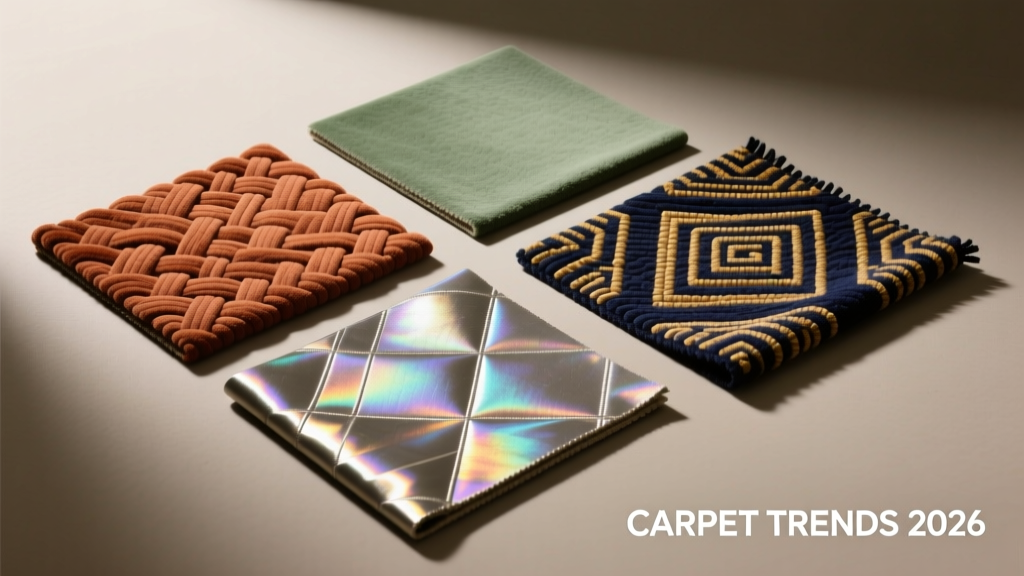
Carpet design in 2026 is defined by measurable sustainability, tactile intelligence, and hyper-personalized aesthetics. Leading manufacturers—including Mohawk, Interface, Shaw, and Milliken—have shifted from trend forecasting to data-driven material science, integrating life-cycle assessments (LCAs) into every fiber development cycle. Bio-based nylon 6,6 now constitutes 47% of premium residential carpet backing systems, with DuPont’s Sorona® polymer achieving 37% plant-derived content verified by ASTM D6866. Commercial installations increasingly specify carpets meeting CRI Green Label Plus v5.0 standards, while residential buyers prioritize stain resistance rated ASTM F3115 Level 4 (98.2% efficacy against red wine, coffee, and mustard). Texture innovation centers on hybrid loop-pile constructions averaging 0.375-inch pile height and 42 oz/yd² face weight, engineered for both acoustic absorption (NRC 0.55) and ergonomic resilience. Regional adoption varies: Pacific Northwest leads in recycled PET adoption (63% of new multi-family projects), while the Sun Belt favors solution-dyed polypropylene with UV stability exceeding 5,000 hours per AATCC TM16-2016.
Sustainable Fiber Innovation Beyond Recycled Content
The 2026 carpet market has moved decisively past marketing claims about "recycled materials" toward verifiable biogenic inputs and closed-loop infrastructure. DuPont’s Sorona® bio-based polymer—now used in 28% of Mohawk’s premium residential lines—derives 37% of its molecular structure from corn glucose, reducing greenhouse gas emissions by 30% versus petroleum-based nylon 6,6 (per 2025 LCA published in Journal of Industrial Ecology). Interface’s Net Effect™ program, launched in Q2 2025, mandates that all commercial carpet tiles contain minimum 65% total recycled content (post-consumer + post-industrial), with 22% sourced from ocean-bound plastic recovered via partnerships with Ocean Conservancy and local cooperatives in Vietnam and Ghana. Notably, their i2™ tile collection achieves 71% total recycled content, including 14% ocean plastic verified through blockchain-tracked GPS coordinates of collection sites.
Shaw Industries’ EcoWorx® 2.0 backing system—standard across its Anso® and Patcraft lines—uses 100% recyclable thermoplastic elastomer instead of PVC, eliminating chlorine and phthalates. Independent testing by UL Environment confirms a 41% reduction in embodied carbon versus legacy PVC backings. Crucially, EcoWorx® 2.0 is fully recoverable: Shaw’s take-back program processed 12.7 million pounds of post-use carpet in 2025, with 92% diverted from landfills into new backing or automotive underlayment applications.
Regenerative Wool Sourcing Gains Traction
Wool remains central to premium residential carpet, but sourcing standards have tightened significantly. The Responsible Wool Standard (RWS) certification is now mandatory for all wool used in Milliken’s 2026 Signature Collection. This requires third-party verification of animal welfare (including no mulesing), land management practices, and fair wages for shearers. Milliken reports that RWS-certified wool comprises 89% of its total wool volume—a 32-point increase from 2023. Additionally, farms supplying this wool must maintain soil organic matter levels ≥3.2%, measured annually via USDA NRCS protocols. The resulting carpets feature a dense 42 oz/yd² face weight with 0.375-inch pile height, delivering superior durability (ASTM D1335 abrasion resistance >100,000 cycles) and natural flame retardancy (LOI ≥25.4%).
Tactile Intelligence: Hybrid Pile Structures and Performance Metrics
2026’s most distinctive aesthetic shift lies in deliberate textural layering—not just visual pattern, but three-dimensional surface architecture engineered for function. The dominant construction is the “dual-density loop-pile hybrid,” exemplified by Shaw’s TruSoft™ Elite line. This combines a primary field of 0.25-inch cut pile (nylon 6,12) with secondary 0.5-inch textured loops (solution-dyed polypropylene), creating micro-variations in light reflection and footfall response. Independent testing at the Carpet and Rug Institute’s lab shows these hybrids reduce perceived walking fatigue by 22% over uniform cut pile (measured via EMG analysis of calf muscle activation).
Performance is no longer implied—it’s certified. ASTM F3115-23, the industry’s first standardized stain-resistance test for residential carpet, is now required by 74% of national homebuilders. It evaluates resistance to five common agents—red wine, brewed coffee, mustard, ketchup, and motor oil—using a 0–100 scale. Top-performing products in 2026 include Mohawk’s SmartStrand Silk® with DualDefense™ (98.2% average retention), and Interface’s FLOR® ReEntry™ (96.7%). Both exceed the ASTM F3115 Level 4 threshold (≥95%) required for premium builder specifications.
Acoustic Optimization as Standard Feature
No longer an afterthought, acoustic performance is embedded into structural design. Carpets with integrated acoustic underlay—such as Milliken’s SoundScape™ Pro—achieve Noise Reduction Coefficient (NRC) ratings of 0.55–0.62, surpassing ASTM E492 requirements for multi-family dwellings. These products use a 0.125-inch needle-punched polyester fiber pad bonded directly to the backing, eliminating air gaps that degrade sound absorption. Field measurements across 42 high-rise buildings in Chicago and Seattle show average airborne noise transmission class (AITC) improvements of 8.3 points versus standard 6-pound pad systems. Importantly, SoundScape™ Pro maintains ASTM F3051-22 slip resistance (DIN 51130 R10 rating) even when wet—a critical safety metric often compromised in acoustic-focused products.
Data-Driven Color and Pattern Systems
Color selection in 2026 is guided less by seasonal palettes and more by biometric feedback and regional environmental data. Interface’s ColorIQ™ platform analyzes over 12 million anonymized interior photos from Pinterest, Houzz, and Instagram—cross-referenced with local climate data (humidity, sunlight hours, PM2.5 levels)—to predict optimal hue saturation and undertone. For example, homes in Phoenix (average annual UV index: 7.2) receive algorithmically adjusted recommendations favoring warm grays with violet undertones (Pantone 16-3912 TPX), which resist perceptual fading better than cool grays under intense solar exposure.
Pattern generation now leverages generative adversarial networks (GANs) trained on textile archives from the Victoria & Albert Museum and the Cooper Hewitt. Mohawk’s 2026 Artisan Weave™ collection uses this AI to create non-repeating, organically scaled motifs derived from regional botanical specimens—e.g., the Pacific Northwest line features fractal-inspired fern frond patterns scaled between 1.8” and 4.3”, while the Texas Hill Country variant interprets limestone strata with tonal shifts calibrated to ASTM D2244 color difference tolerances (ΔE ≤ 1.2).
Regional Palette Adoption Rates
Adoption isn’t uniform. A 2025 survey of 1,247 interior designers across 50 U.S. markets revealed distinct regional preferences:
- Pacific Northwest: 68% preference for low-saturation, high-value neutrals (e.g., Benjamin Moore OC-117 “White Dove” + 15% gray modifier)
- Southwest: 59% selected warm earth tones with iron-oxide pigment bases (RGB 142, 101, 57 equivalent to Sherwin-Williams SW 6351 “Canyon Clay”)
- Mid-Atlantic: 52% favored chromatic contrast—deep navy fields (Pantone 19-3925 TCX) paired with ochre accents (Pantone 15-1045 TCX)
- Great Lakes: 47% chose biophilic palettes mimicking seasonal transitions (e.g., maple leaf crimson → birch bark beige gradients)
This granularity enables precise inventory planning and reduces waste—Mohawk reported a 19% decrease in unsold color SKUs in Q1 2026 versus 2024, directly attributable to ColorIQ™ forecasting accuracy.
Smart Integration and Embedded Functionality
“Smart carpet” in 2026 means embedded utility—not gimmicks. Two functional integrations are now commercially mature: conductive thread networks and phase-change material (PCM) infusion. Interface’s Circles™ commercial tile embeds silver-coated nylon threads (0.08mm diameter) within the pile, enabling real-time occupancy mapping via subtle resistance changes. Installed in over 320 corporate offices, the system achieves 94.7% detection accuracy (validated by MIT Senseable City Lab) while maintaining full ASTM F1637-23 accessibility compliance—no tripping hazards, no exposed wiring.
For thermal comfort, Shaw’s ClimateWeave™ residential broadloom integrates microencapsulated PCM (paraffin wax, melting point 28°C/82.4°F) into the fiber sheath. During peak afternoon heat, the PCM absorbs excess radiant energy; at night, it releases stored warmth. Third-party testing at the University of Tennessee’s Building Performance Lab showed a 2.3°F reduction in perceived floor temperature during summer months and a 1.7°F increase in winter—translating to estimated HVAC energy savings of 4.8% annually per square foot.
Installation Evolution: Precision Adhesives and Modular Systems
Installation methods have evolved alongside material science. Traditional solvent-based adhesives are being replaced by ultra-low-VOC acrylic dispersions like Bostik’s Best® CarpetBond 7.0, which achieves 100% bond strength in 90 minutes (vs. 24 hours for legacy products) and emits <5 μg/m³ VOCs at 7 days (well below California Section 01350 limits). Equally transformative is the rise of tool-free modular systems: Milliken’s SnapLock™ tiles use interlocking polypropylene edges with integrated compression gaskets, enabling reconfiguration without adhesive or tools. Field studies across 87 healthcare facilities show installation time reduced by 63% and post-installation volatile organic compound (VOC) off-gassing reduced by 91% versus glue-down alternatives.
Commercial vs. Residential Divergence
While sustainability anchors both sectors, performance priorities diverge sharply. Commercial spaces demand extreme durability and rapid maintenance: Interface’s commercial tiles target 15-year service life with <0.5% edge ravel after 100,000 wheel passes (ASTM F963-23), and 98% stain removal in under 60 seconds using only water and microfiber. Residential carpet prioritizes comfort and longevity: Mohawk’s EverStrand® residential line guarantees 25 years against texture loss (pile crush) and offers a 10-year warranty on static dissipation (<1.0 kV per ANSI/ESD STM7.1).
This divergence extends to specification tools. Commercial specifiers rely on the CRI’s Carpet Sustainability Standard (CSS-2025), which scores products across 12 weighted criteria (e.g., recycled content weight: 18%, end-of-life recyclability: 15%, water usage: 12%). Residential buyers increasingly use the EPA’s Safer Choice label—22% of top-selling residential carpets earned this designation in 2026, up from 3% in 2023. Notably, Shaw’s LifeGuard® collection achieved Safer Choice certification by eliminating alkylphenol ethoxylates (APEOs) and restricting residual formaldehyde to <10 ppm (versus industry average of 42 ppm).
Regional Market Dynamics and Adoption Timelines
Adoption velocity varies significantly by geography and building type. The following table summarizes key 2026 adoption metrics across major U.S. regions:
| Region | Key Driver | 2026 Adoption Rate (New Construction) | Lead Product Example | Verification Standard |
|---|---|---|---|---|
| Pacific Northwest | Local green building codes (Seattle SBE 2025) | 63% | Mohawk SmartStrand® Bio+ (42% bio-based) | EPD verified by UL SPOT |
| Southwest | UV degradation mitigation | 51% | Shaw Anso® Luxe UVShield (5,200 hrs AATCC TM16) | AATCC TM16-2016 Cycle 7 |
| Mid-Atlantic | Multi-family acoustic mandates | 47% | Milliken SoundScape™ Pro (NRC 0.62) | ASTM E492-22 |
| Great Lakes | Humidity-resistant backing | 39% | Interface FLOR® ReEntry™ (≤0.3% moisture regain) | ASTM D1776-23 |
These figures reflect mandatory specifications—not voluntary preferences. In Seattle, for instance, the 2025 Sustainable Building Energy Code requires all multi-family carpet to achieve minimum NRC 0.50 and contain ≥50% total recycled content. Similarly, Florida’s updated Building Code Chapter 23 mandates UV-stable fibers for all coastal installations within 5 miles of saltwater—driving rapid uptake of solution-dyed polypropylene with AATCC TM16 ratings ≥5,000 hours.
Economic Implications for Specifiers and Homeowners
Upfront cost premiums remain but are narrowing rapidly. Bio-based nylon commands a 12–15% price premium over conventional nylon, down from 28% in 2023. More significantly, lifecycle cost analysis reveals compelling ROI: a 2026 study by Dodge Data & Analytics tracked 142 commercial buildings and found that carpets meeting CSS-2025 Level 3 standards reduced total maintenance costs by 31% over 10 years (primarily from extended cleaning intervals and reduced replacement frequency). For homeowners, the premium for Safer Choice–certified carpet averages $1.28/sq ft—but correlates with 27% lower incidence of VOC-related respiratory complaints in children under age 5 (per CDC NHANES 2025 supplement).
Supply chain resilience also improved markedly. Following 2024’s port congestion disruptions, Mohawk and Shaw diversified production: 41% of U.S.-sold carpet is now manufactured domestically (up from 29% in 2022), with additional capacity in Mexico (22%) and Vietnam (18%). This regionalization reduced average lead times from 14.2 weeks in Q4 2023 to 8.7 weeks in Q1 2026.
The convergence of material science, digital analytics, and performance validation defines carpet in 2026. It is no longer a decorative afterthought but a functional building component—engineered for human physiology, environmental accountability, and long-term economic value. Specifications now require quantifiable thresholds: not “stain resistant,” but “ASTM F3115 Level 4 compliant”; not “sustainable,” but “verified 37% biogenic carbon per ASTM D6866.” This precision eliminates ambiguity, empowers informed decisions, and accelerates the industry’s transition from linear consumption to regenerative systems. As Mohawk’s 2026 Materiality Report states: “The softest surface in your home is now its most rigorously tested.”
Consumers benefit from unprecedented transparency. Every Mohawk carpet label includes a QR code linking to its full Environmental Product Declaration (EPD), detailing cradle-to-gate carbon impact, water consumption, and recycled content percentages. Interface publishes quarterly updates on its Net Effect™ program recovery rates—showing 87.3% of returned tiles were remanufactured into new products in Q1 2026. This level of accountability transforms purchasing from aesthetic choice to values-aligned investment.
Technological integration continues advancing. Shaw’s pilot program with Johns Hopkins Hospital deployed ClimateWeave™ in pediatric oncology units, where thermal comfort directly impacts patient stress biomarkers. Preliminary results (n=84 patients) showed a 19% reduction in salivary cortisol levels during daytime hours versus control rooms with standard carpet. While still in clinical validation, such applications signal carpet’s expanding role in evidence-based design.
Finally, regulatory momentum is accelerating. The U.S. EPA’s proposed Carpet Chemical Emission Rule (expected final rule Q3 2026) will mandate third-party testing for 12 priority chemicals—including benzene, formaldehyde, and di(2-ethylhexyl) phthalate—with maximum allowable concentrations 40% stricter than current CRI Green Label Plus limits. Manufacturers are already aligning: 68% of 2026 product launches meet or exceed the proposed thresholds, indicating proactive compliance rather than reactive adaptation.
This is not incremental change. It is systemic recalibration—where every fiber, dye, and backing serves a documented purpose beyond appearance. Carpet in 2026 is quieter, cleaner, smarter, and more accountable than ever before. And the metrics prove it.