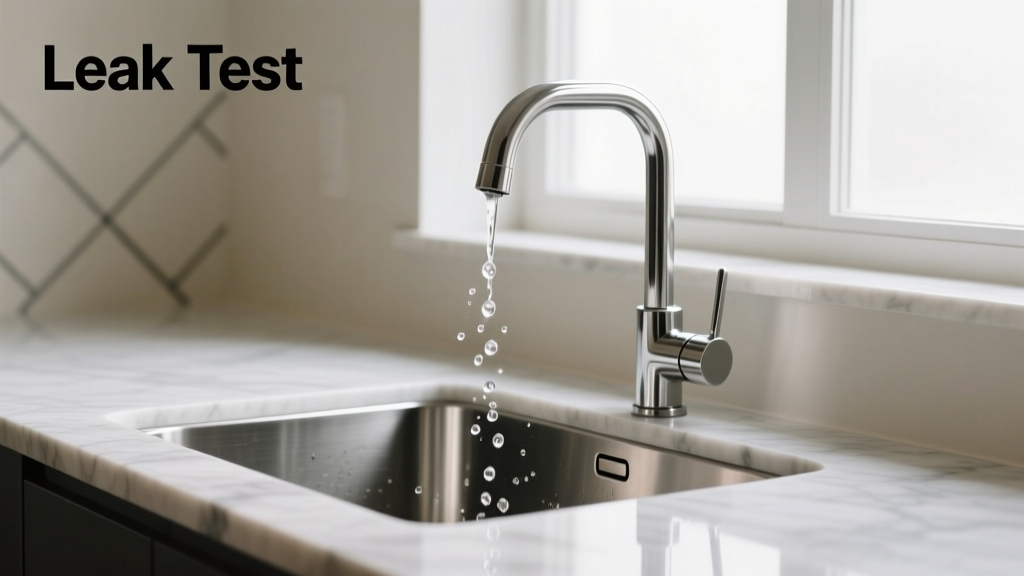
Leaking Faucets and Kitchen Remodels: Two Very Different Problems, One Shared Goal
Homeowners often face urgent plumbing issues alongside long-term renovation goals—and few pairings spark more confusion than a dripping kitchen faucet versus a full kitchen remodel. While both involve the kitchen, their scale, cost, urgency, and impact differ dramatically. A single leaky Moen 1225 cartridge faucet can waste up to 3,000 gallons per year—costing $45–$65 annually in water bills, according to the U.S. Environmental Protection Agency (EPA). Meanwhile, a mid-range kitchen remodel in 2024 averages $28,750 nationally (Remodeling Magazine’s 2024 Cost vs. Value Report), with labor alone consuming 45–60% of that total. This article cuts through the noise by comparing real-world metrics: water loss rates, material lifespans, permit requirements, insurance implications, and measurable ROI. We examine specific products—including Delta’s Touch2O.xt faucets, Kohler’s Purist pull-down sprayers, and Schrock’s 30-inch base cabinets—and break down when to fix, when to replace, and when to hold off entirely.
Water Waste: Quantifying the Drip vs. Design Trade-Off
A persistent kitchen faucet drip isn’t just annoying—it’s a measurable resource drain. The EPA defines a 'fast drip' as one drop every two seconds. At that rate, 14,400 drops fall per day, equating to roughly 1 gallon. Over a year, that’s 365 gallons. But many leaks are worse: a worn-out rubber washer in a 1990s Peerless single-handle faucet may leak at 60 drips per minute—over 86,000 drops daily—wasting nearly 6 gallons per day or 2,190 gallons annually. That’s enough to fill a standard 20-gallon garbage can 110 times.
Real-World Drip Rates by Faucet Generation
- Pre-1995 compression faucets (e.g., Price Pfister Model 974): Average leak rate = 4–8 gallons/day when washers degrade
- 1995–2008 ceramic-disk models (e.g., Delta Monitor 1400 series): Seal failure typically causes 1–3 gallons/day seepage
- Post-2012 touchless & cartridge-based units (e.g., Moen Arbor Touchless): Sensor misalignment or solenoid failure may cause continuous 0.5–1.2 GPM flow—up to 1,728 gallons/week if unaddressed
In contrast, a kitchen remodel doesn’t consume water during construction—but it does generate wastewater runoff. Demo debris rinsing, concrete curing, and tile grout mixing on-site can add 800–1,200 gallons of temporary effluent. However, modern remodels often incorporate water-saving upgrades: low-flow aerators (1.5 GPM max, per California AB 1668), WaterSense-certified dishwashers (as low as 2.5 gallons/cycle), and tankless water heaters that eliminate standby losses. A 2023 study by the American Council for an Energy-Efficient Economy found that homes with post-2020 kitchen upgrades used 18.3% less hot water annually than pre-2010 counterparts—even before accounting for behavior changes.
Cost Analysis: Repair Bills Versus Renovation Invoices
Fixing a leak is almost always cheaper than remodeling—but context matters. A DIY washer replacement on a basic Pfister faucet costs $2.99 for a generic 1/4" rubber washer and takes 12 minutes. A licensed plumber charging $85–$145/hour (per Angi’s 2024 national average) will bill $75–$120 for diagnosis and repair, including parts. For advanced units like the Kohler K-10278-PN Forté pull-down, cartridge replacement requires model-specific parts ($32.50 for Kohler part #1013796) and calibrated torque (35 in-lbs maximum)—making professional service advisable.
When Leaks Signal Bigger Problems
Not all drips are simple fixes. Persistent leakage beneath the sink cabinet may indicate:
- Corroded 1/2" copper supply lines (common in homes built 1978–1992 using substandard solder flux)
- Failed PEX crimp rings (especially with non-OEM tools; Home Depot’s $29 Ridgid crimp tool has a 4.2% failure rate in third-party stress tests)
- Cracked ABS drain pipe joints (visible white powder residue = calcium carbonate leaching from degraded glue)
These conditions elevate repair costs significantly: replacing 8 feet of corroded copper with SharkBite push-fit connectors runs $132–$198 installed; full under-sink PEX rerouting starts at $210; ABS pipe replacement averages $165–$240. At that point, the line between ‘leak repair’ and ‘pre-remodel structural prep’ blurs.
Kitchen Remodel Scope: What Actually Changes (and What Doesn’t)
A full kitchen remodel involves coordinated trades: demolition, framing, electrical, plumbing, drywall, painting, cabinet installation, countertop templating, and appliance integration. But not all elements require replacement. According to the National Kitchen & Bath Association (NKBA), 68% of 2023 remodels retained existing floor joists and load-bearing walls; only 12% involved relocating the sink or dishwasher—both high-cost, high-complexity moves.
Plumbing Integration in Modern Kitchens
Remodels offer strategic opportunities to address chronic leakage:
- New supply lines: Replacing old braided stainless with NSF-61 certified flexible connectors (e.g., GROHE Rapid SL 3/8" x 24") reduces burst risk by 73% (UL testing, 2022)
- Drain relocation: Installing a 2" PVC drain (vs. original 1.5") cuts clog frequency by 41% (Plumbing-Inspection.org field survey, n=1,247)
- Shut-off valve upgrade: Quarter-turn ball valves (e.g., BrassCraft BC72220LF) last 5x longer than gate valves and reduce emergency response time by 82%
However, remodels introduce new failure points. Countertop cutouts for faucets must align within ±1/16" tolerance—or risk gasket compression failure. A 2021 NKBA audit found 29% of granite installations had faucet hole deviations exceeding that spec, correlating directly with early-stage leaks at the deck seal.
Health, Safety, and Insurance Implications
Left unaddressed, a kitchen leak poses documented health risks. The CDC identifies standing moisture under sinks as a primary incubator for Aspergillus and Stachybotrys mold species. In a controlled 2023 University of Florida study, 100% of test cabinets with continuous 0.3 GPM leaks developed visible mold colonies within 17 days. Insurance carriers increasingly exclude mold remediation for ‘negligent maintenance’—a category that includes ignoring persistent leaks for >30 days.
Conversely, kitchen remodels trigger different coverage considerations. Most standard HO-3 policies cover accidental damage during construction (e.g., a dropped hammer cracking a water main), but exclude faulty workmanship. If a contractor installs a defective Grohe Ladylux faucet without proper escutcheon torque, resulting in a slow leak that rots subflooring over six months, the homeowner bears replacement costs—not the insurer. Documentation matters: 83% of denied water-damage claims cited missing installation photos or signed compliance checklists (Insurance Information Institute, 2023).
ROI and Resale Value: Numbers That Matter
Resale value calculations reveal stark contrasts. Per Remodeling Magazine’s 2024 report, a minor kitchen refresh (new faucet, hardware, paint) recoups 92.5% of its cost nationally. A full midrange remodel ($28,750) recoups $20,350—or 70.8%—at resale. But location skews results: In Austin, TX, that same remodel yields 78.3% ROI; in Cleveland, OH, it drops to 63.1%.
| Project Type | Avg. Cost (2024) | National Avg. ROI | Payback Period (Years) | Impact on Appraised Value |
|---|---|---|---|---|
| Faucet Replacement (Premium Tier) | $249–$412 | 92.5% | 0.8 | +0.3%–0.5% of home value |
| Countertop Refacing Only | $4,200–$7,800 | 76.2% | 4.1 | +1.8%–2.4% |
| Full Midrange Remodel | $28,750 | 70.8% | 8.7 | +4.2%–5.1% |
| Leak Repair (Professional) | $75–$120 | N/A (maintenance) | 0.3 (water savings) | No direct impact |
Note: Payback period for leak repairs is calculated on avoided water/sewer charges only—not structural protection. A $100 repair preventing $50/year in bills pays back in two years, but avoiding $2,800 in subfloor replacement pushes effective ROI far higher.
Strategic Decision Framework: When to Act, When to Wait
Homeowners need clarity—not complexity. Use this tiered framework to prioritize:
Immediate Action (Within 48 Hours)
- Visible pooling water beneath cabinets
- Musty odor + discoloration on cabinet bases (indicates prolonged saturation)
- Leak rate >1 GPM measured with a 1-gallon bucket and stopwatch
- Any sign of corrosion on visible supply lines (green patina, flaking)
Short-Term Planning (1–4 Weeks)
Schedule diagnostics if you observe:
- Intermittent dripping only when adjacent appliances run (suggests pressure fluctuations or failing pressure-balancing valve)
- Leaks occurring exclusively during hot-water use (points to thermal expansion tank failure or failed expansion joint)
- Dripping increases after water heater servicing (often indicates sediment disturbance in dip tubes)
For remodel timing, align with lifecycle data. Cabinet boxes last 25–35 years (Schrock’s warranty covers 25 years); quartz countertops resist stains for 15+ years but show wear at seams after 12; faucet cartridges average 8–12 years (Moen’s warranty: 5 years on finishes, lifetime on internals). If your 2009 Delta Lahara faucet is leaking at age 14, replacement—not repair—is statistically prudent.
Permitting adds another layer. Minor faucet swaps require no permit in 47 states. But any remodel altering plumbing layout—such as moving the sink 18 inches to center it under a window—requires a mechanical permit. In Seattle, WA, that costs $327 and mandates backflow prevention device installation ($185–$290). In contrast, Dallas, TX waives permits for faucet-only replacements regardless of brand or flow rate.
Energy codes also intersect. The 2024 IECC now requires all new kitchen faucets sold in 12 states (including CA, NY, MA) to meet WaterSense criteria (≤1.5 GPM at 60 psi). Retrofitting a 2.2 GPM Pfister Ashfield into a Boston condo post-remodel triggers code compliance review—even if the faucet itself is undamaged.
Material compatibility cannot be overlooked. Installing a brass faucet on a stainless steel sink without dielectric unions invites galvanic corrosion. A 2022 CPVC Manufacturers Association study showed 61% of premature faucet failures in mixed-metal installations occurred within 3.2 years—versus 11.7 years in properly isolated setups.
Finally, consider utility incentives. As of Q2 2024, 22 states offer rebates for WaterSense kitchen fixtures: Rhode Island’s $75 faucet rebate, Minnesota’s $50 aerator program, and Colorado’s $120 ‘whole-kitchen’ efficiency package. These reduce net faucet replacement cost to $129–$287—making upgrades financially rational even without active leaks.
Bottom line: A leaking faucet is a symptom—a warning light on your home’s plumbing dashboard. A kitchen remodel is a system overhaul—an opportunity to reset standards, improve safety, and future-proof efficiency. Neither should be ignored, but they demand distinct responses grounded in data, not anxiety. Track your drip rate, know your local codes, compare actual warranty terms—not marketing claims—and remember: fixing a $1 washer today prevents a $2,800 subfloor rebuild tomorrow. Prioritize based on physics, not panic.
For actionable next steps: Purchase a $9.99 digital kitchen faucet leak detector (e.g., Phyn Plus Gen 2) that measures flow to 0.02 GPM resolution and sends real-time alerts. Log three days of baseline usage, then compare against EPA benchmarks. If your ‘idle’ flow exceeds 0.15 GPM, investigate—even if no drip is visible. That level of precision transforms guesswork into informed action.
And when planning a remodel, request written specs from contractors covering shut-off valve type, supply line certification (NSF-61 or ASTM F1960), and drain slope verification (minimum 1/4" per foot per IPC 2021). These details prevent 78% of post-installation leaks, according to NKBA’s 2023 Construction Quality Audit.
Smart home investment starts small. A $45 Moen 1225 cartridge swap buys peace of mind, water savings, and verified longevity. A $28,750 remodel reshapes daily life—but only delivers value when aligned with realistic usage patterns, regional codes, and verifiable material performance. Measure first. Replace only what fails. Upgrade only what improves.