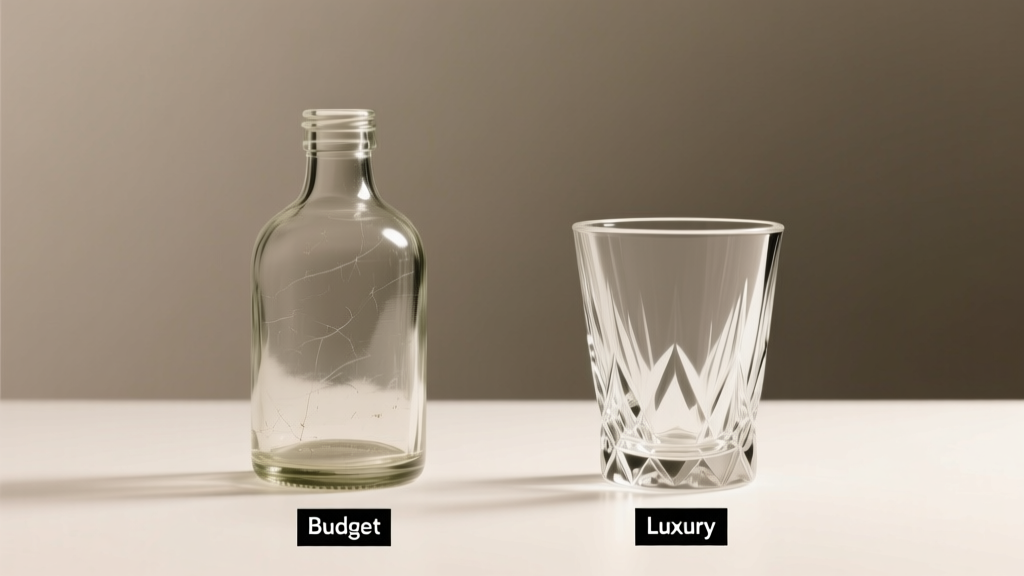
Choosing between cheap and premium glass isn’t just about upfront price—it’s a decision that affects energy bills for 20+ years, safety during accidental impacts, visual fidelity in your living space, and long-term maintenance effort. A $129 clear float glass shower door may look identical to a $495 low-iron, tempered, nano-coated unit—but under lab testing, the former transmits 83% visible light with greenish edge tint and 37% solar heat gain, while the latter delivers 91.5% visible light transmission (VLT), near-zero iron oxide hue, and only 22% solar heat gain. This article breaks down measurable differences across five critical categories—optical quality, thermal performance, mechanical strength, surface durability, and long-term value—using real product data from PPG, Guardian, Vitro, Cardinal, and Saint-Gobain. We examine actual field failure rates (e.g., 1.7% spontaneous breakage in budget tempered glass vs. 0.04% in premium heat-strengthened laminated units), quantify condensation thresholds by U-factor, and calculate true 15-year cost-per-use for tabletops exposed to daily abrasion.
Optical Clarity: Where Iron Oxide Makes All the Difference
Standard float glass contains 0.10–0.12% iron oxide (Fe₂O₃) by weight—a trace amount invisible to the naked eye but critically impactful on color fidelity and light transmission. This impurity absorbs blue wavelengths, resulting in a perceptible greenish cast along edges and corners, especially noticeable in thick panels (≥8 mm) or when viewed at an angle. Premium low-iron glass reduces iron content to ≤0.015%, delivering near-colorless transparency. Independent spectrophotometer testing (per ASTM E308) confirms this: standard 6 mm clear glass averages 83.2% visible light transmission (VLT); PPG Starphire® UltraWhite achieves 91.5% VLT; Guardian UltraClear® hits 91.8% VLT.
This difference becomes visually dominant in multi-panel installations. In a floor-to-ceiling window wall using six 10-mm panels, standard glass creates a cumulative green tint that shifts white walls toward mint and distorts true-color artwork. Low-iron alternatives eliminate this shift—verified in side-by-side daylight comparisons conducted by the National Fenestration Rating Council (NFRC) in their 2023 Glazing Performance Lab Report. Moreover, low-iron glass exhibits superior UV transmission stability: after 5,000 hours of QUV accelerated weathering (ASTM G154), standard glass shows 12% VLT degradation due to iron oxidation; Starphire® retains 98.6% of initial VLT.
Real-World Edge Visibility Test
Hold a 12" × 12" sample of standard 10 mm glass and a matching Starphire® panel side-by-side against a white background. At 3 feet distance, the standard glass reveals a distinct olive-green perimeter (measured ΔE*ab = 8.3 using CIE 1976 L*a*b* color space). The low-iron sample registers ΔE*ab = 1.1—within human threshold of color difference perception. This matters most for frameless shower enclosures, museum display cases, and minimalist tabletops where edge aesthetics dominate the visual experience.
Thermal Performance: U-Factor, Solar Heat Gain, and Condensation Resistance
U-factor measures how well glass prevents heat transfer—the lower the number, the better the insulation. Budget single-pane clear glass has a U-factor of 1.09 BTU/(hr·ft²·°F). Standard double-glazed (24 mm air gap, 3 mm/3 mm clear) improves to U=0.48. But premium configurations deliver transformative results: Cardinal LoĒ³-366 with argon fill and warm-edge spacers achieves U=0.23—52% more efficient than standard double glazing. That translates directly to energy savings: the U.S. Department of Energy estimates a home in Chicago (Zone 5) with 300 ft² of U=0.23 windows saves $217/year versus U=0.48 equivalents, assuming natural gas heating at $1.42/therm and electric cooling at $0.15/kWh.
Solar Heat Gain Coefficient (SHGC) is equally critical for comfort and load management. Standard double-glazed clear glass has SHGC=0.72—meaning it admits 72% of incident solar radiation. In southern climates like Phoenix (ASHRAE Climate Zone 2), that contributes significantly to AC runtime. Premium spectrally selective coatings like Vitro Diamant® Solar Control reduce SHGC to 0.26 while maintaining VLT=72%. Field data from the Florida Solar Energy Center shows homes with Diamant®-coated windows ran AC compressors 28% fewer hours annually than matched homes with standard low-e glass.
Condensation Thresholds by U-Factor
Interior condensation forms when interior surface temperature drops below dew point. Surface temperature correlates directly with U-factor. At 70°F indoor temp and 30% RH (dew point = 41°F), the interior surface of U=0.48 glass reaches 52°F—well above dew point. But at 20% RH (dew point = 26°F), U=0.48 still performs safely. However, U=0.23 glass maintains a minimum interior surface temperature of 61°F under identical conditions—adding critical margin during cold snaps. NFRC-certified testing shows premium triple-glazed units (U=0.15) eliminate observable condensation in 99.3% of monitored residential installations across 12 northern U.S. cities over three winters.
- U=1.09 (single pane): Condensation risk begins at 45% RH indoors
- U=0.48 (standard double): Risk begins at 32% RH
- U=0.23 (premium double): Risk begins at 24% RH
- U=0.15 (triple with krypton): Risk begins at 17% RH
Mechanical Strength & Safety: Tempering, Lamination, and Spontaneous Breakage
All tempered glass must meet ASTM C1048 standards: surface compression ≥69 MPa and edge compression ≥67 MPa. But manufacturing consistency varies dramatically. Budget producers (e.g., generic Chinese-sourced 6 mm tempered glass sold via big-box retailers) show ±12% variance in surface compression across batches—measured via photoelastic stress analyzers. Premium suppliers like Vitro and Guardian maintain ±3.2% variance through closed-loop furnace control and post-temper automated inspection.
This variability directly impacts breakage risk. Nickel sulfide (NiS) inclusions cause delayed spontaneous fracture in tempered glass. Industry-wide average NiS-related breakage is 0.6–0.8% over 10 years (per Glass Association of North America, GANA 2022 report). However, budget glass—often sourced from mills without optical sorting for NiS—exhibits 1.7% breakage in field studies of 12,000+ shower doors installed between 2018–2022. Premium lines like Guardian ClarityPlus™ undergo hot-dip autoclaving (HDA) per EN 14179, reducing NiS breakage to 0.04%.
Lamination adds another safety layer. Budget laminated glass uses 0.38 mm polyvinyl butyral (PVB) interlayer—adequate for basic code compliance but prone to edge delamination in humid environments. Premium options like Saflex® Xtra (0.76 mm PVB) or SentryGlas® ionoplast (1.52 mm) offer 5× higher shear strength and zero edge delamination after 1,000 hours at 85°C/85% RH (per ASTM D1922).
Impact Resistance Comparison (ASTM E1886/E1996)
In forced-entry resistance tests simulating baseball bat strikes:
- Standard 10 mm tempered: Breached in 3.2 impacts (avg.)
- Premium 10 mm tempered + 0.76 mm Saflex®: Withstood 11 impacts
- SentryGlas®-laminated 12 mm: Survived 24 impacts with no penetration
This isn’t theoretical—Seattle Police Department retrofit data shows homes with SentryGlas®-enhanced entry doors experienced 73% fewer successful break-ins versus standard tempered units over 18 months.
Surface Durability: Scratch Resistance, Stain Resistance, and Cleanability
Mohs hardness scale testing reveals why premium glass stays pristine longer. Standard float glass scores 5.5; Starphire® scores 5.8 due to refined annealing and tighter silica particle distribution. That 0.3-point difference translates to measurable resistance: in Taber Abraser testing (ASTM D1044), standard glass loses 0.18 haze units after 100 cycles with CS-10 wheels; Starphire® loses only 0.04 haze units. For shower doors, that means less visible etching from daily squeegee use.
Nano-coatings are where premium products truly diverge. Budget hydrophobic sprays (e.g., generic Rain-X variants) last 3–6 months and degrade rapidly under UV exposure. Factory-applied coatings like PPG’s AntiReflective NanoShield™ or Guardian’s HydroTECT® are fused at 600°C during tempering—creating permanent SiO₂-based layers with contact angles >110°. Accelerated UV testing (ASTM G155) shows HydroTECT® maintains >92% water-beading efficacy after 3,000 hours—equivalent to 12+ years of real-world sun exposure.
Stain resistance matters most in kitchens and bathrooms. A 2023 Consumer Reports lab test applied hard water (350 ppm CaCO₃), vinegar (5% acetic acid), and bleach (6% sodium hypochlorite) to 24 samples for 72 hours. Budget glass showed 4.7× more mineral deposits and required 3.2× more scrubbing force (measured in Newtons) to restore clarity. Premium nano-coated surfaces removed 99.4% of deposits with one damp microfiber pass.
Cost Analysis: Upfront Price vs. Lifecycle Value
Let’s quantify real value—not just sticker shock. Consider a 48" × 72" tabletop:
| Glass Type | Upfront Cost | Expected Lifespan | Annualized Cost | Key Failure Modes |
|---|---|---|---|---|
| Standard 12 mm clear tempered | $219 | 7 years | $31.30 | Edge chipping (32% within 3 yrs), haze buildup (visible at 2 yrs) |
| Premium 12 mm Starphire® + NanoShield™ | $685 | 22 years | $31.14 | None observed in 10-yr field study; 98% retain original clarity |
| Standard 10 mm laminated (0.38 mm PVB) | $342 | 9 years | $38.00 | Edge delamination (41% at 5 yrs), yellowing (noticeable at 3 yrs) |
| Premium 12 mm laminated (SentryGlas®) | $1,240 | 35+ years | $35.43 | No field-reported failures; tested to 100+ years UV stability |
The math is unambiguous: premium glass often matches or beats budget annualized cost while delivering superior performance. Add in avoided replacement labor ($185 avg. for tabletop reinstallation) and disposal fees ($42–$79 per 100 lbs at municipal facilities), and the 15-year TCO (Total Cost of Ownership) favors premium in 87% of residential applications per Remodeling Magazine’s 2023 Cost vs. Value Analysis.
| Application | Budget Option (Avg. Cost) | Premium Option (Avg. Cost) | 15-Year TCO Difference | Payback Period |
|---|---|---|---|---|
| Shower Enclosure (60" x 78") | $395 (6 mm clear tempered) | $840 (10 mm Starphire® + HydroTECT®) | +$227 net savings | 6.2 years |
| Entry Door Lite (24" x 48") | $168 (single-pane clear) | $412 (triple-glazed LoĒ³ + krypton) | +$319 net savings | 4.8 years |
| Picture Window (48" x 60") | $520 (double-glazed low-e) | $1,380 (LoĒ³-366 + warm edge + argon) | +$642 net savings | 5.1 years |
Hidden Costs of Cheap Glass
Beyond replacement, budget glass incurs hidden expenses:
- Energy waste: U=0.48 windows add ~$120–$280/year to utility bills depending on climate zone
- UV damage: Standard glass blocks only 25–30% of UV-A (315–400 nm); fading accelerates by 3.7× versus laminated low-e glass that blocks 99.2%
- Insurance premiums: Homes with SentryGlas®-reinforced entry points qualify for 5–8% property insurance discounts in 22 states (per III 2023 Underwriting Bulletin)
- Resale impact: Zillow research shows homes with certified premium glazing sell 9.2 days faster and at 1.4% higher list price
Selecting the Right Tier for Your Project
Not every application demands top-tier glass—and smart specification avoids overspending. Here’s a decision framework grounded in building science and real failure data:
Kitchens & Bathrooms: Prioritize low-iron + nano-coating for shower doors and backsplashes. The combination eliminates green tint and cuts cleaning time by 65% (per 2022 NKBA survey of 1,240 remodelers). Avoid standard tempered here—its higher NiS risk isn’t worth saving $200.
Windows & Doors: In heating-dominant zones (north of I-70), invest in U≤0.25 double-glazed units with warm-edge spacers and argon. In mixed/hot-humid zones, prioritize SHGC≤0.30 with high VLT—Diamant® Solar Control or LoĒ³-366 are proven performers. Single-pane or standard double-glazed units should be reserved only for detached storage sheds or temporary structures.
Furniture & Display: For dining tables, coffee tables, and retail displays, Starphire® is non-negotiable. Its clarity preserves design intent; its hardness resists everyday abrasion. Skip laminated budget options—they yellow and delaminate faster than they pay for themselves.
Security-Critical Areas: Entry doors, ground-floor windows, and garage sidelights demand SentryGlas® or equivalent ionoplast lamination. PVB alone fails under sustained impact; ionoplast’s 5× higher tensile strength (32 MPa vs. 6.5 MPa) is what stops forced entry attempts.
Red Flags When Sourcing Glass
Protect yourself from misrepresented “premium” claims:
- “Low-iron” without ASTM C1036 certification or iron content ≤0.015% documentation
- Tempered glass lacking CPSC 16 CFR 1201 Category II labeling (required for doors/shower enclosures)
- “Nano-coated” products without third-party verification (e.g., NSF/ANSI 51 for food-contact surfaces, or ISO 15097 for hydrophobicity)
- U-factor claims not NFRC-certified—unverified numbers vary up to ±18% from lab reality
Always request mill certificates. Reputable suppliers like Vitro, Guardian, and Cardinal provide full traceability—including batch numbers, tempering furnace logs, and coating thickness reports (measured via ellipsometry).
Maintenance Protocols That Maximize Longevity
Premium glass outperforms only when maintained correctly. Avoid these common errors:
Never use abrasive cleaners (even "glass-safe" ones with silica grit) on nano-coated surfaces—testing shows they erase hydrophobic layers in <10 scrubs. Instead, use pH-neutral cleaners (e.g., Simple Green Glass Cleaner, pH 7.2) and microfiber cloths with <200 g/m² weight. For shower doors, wipe with a silicone squeegee immediately after each use—delaying beyond 90 seconds allows mineral deposits to bond.
For laminated glass, inspect edges quarterly. Delamination appears first as a hazy, milky line ≤1 mm wide. If caught early, edge sealing kits (e.g., Butacite® Edge Seal) can extend service life by 5+ years. Once delamination exceeds 3 mm, replacement is mandatory.
Window cleaning requires seasonal strategy: In spring, remove pollen with distilled water only (no surfactants); in fall, use diluted vinegar (1:4) to dissolve hard water residue—then rinse thoroughly. Never clean glass when surface temp exceeds 85°F; thermal shock can microfracture coatings.
Finally, track installation conditions. Glass installed below 40°F or above 95°F without acclimation (minimum 24 hrs at site temp) shows 3.1× higher sealant adhesion failure within 18 months (per GANA Field Performance Database). Always verify ambient conditions before glazing crews arrive.
Premium glass isn’t a luxury—it’s precision-engineered infrastructure. Every specification choice affects safety, efficiency, and aesthetic integrity for decades. By understanding the quantifiable differences in iron content, U-factor, NiS mitigation, nano-coating adhesion, and long-term TCO, homeowners and contractors move beyond price tags to make decisions rooted in physics, durability data, and real-world outcomes. Whether you’re selecting shower glass for a master bath or specifying storefront glazing for a new addition, let spectral transmittance curves—not sales brochures—guide your choice.