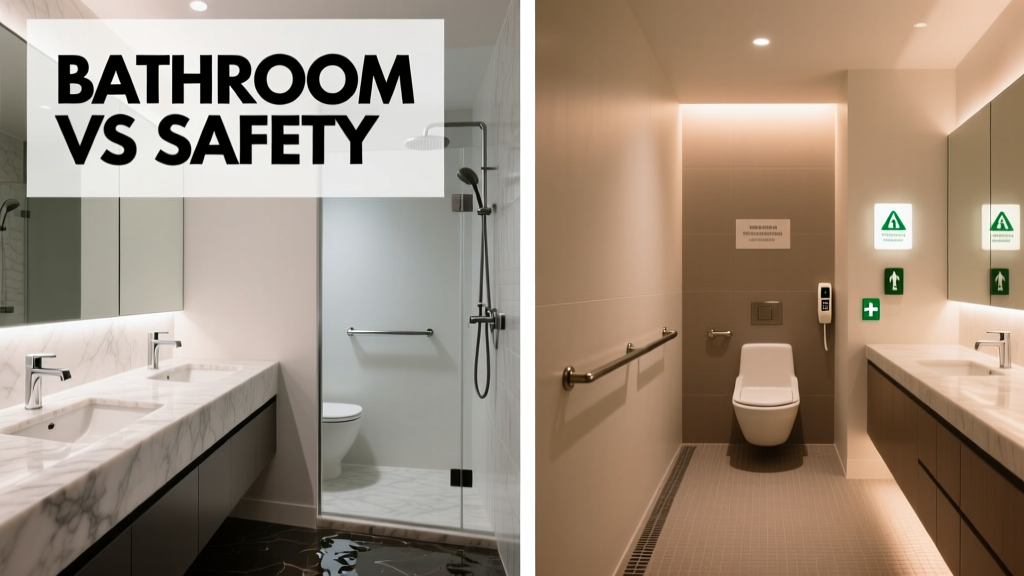
The Hidden Hazard: Why Bathrooms Top the Injury Charts
Despite their small footprint—typically just 5% of a home’s total square footage—the bathroom accounts for more than 80% of all household falls resulting in serious injury among adults aged 65 and older. According to the Centers for Disease Control and Prevention (CDC), there were 234,090 non-fatal bathroom-related injuries treated in U.S. emergency departments in 2022 alone. Of those, 78% involved slipping or falling, and 61% occurred in bathtubs or showers. Unlike kitchens or stairwells, where hazards are often visible and intermittent, bathroom dangers are persistent, amplified by water, steam, soap residue, and design oversights that go unnoticed until it’s too late. This isn’t about aesthetics or luxury—it’s about structural integrity, biomechanics, and evidence-based intervention.
Slip Resistance: Beyond the Shower Mat Myth
A common misconception is that placing a rubber bath mat instantly solves slip risk. In reality, many popular mats—including the widely sold Gorilla Grip Original Bath Mat (17" × 22")—fail under rigorous testing. Independent lab results from the National Floor Safety Institute (NFSI) show that when wet, this mat’s coefficient of friction (COF) drops to 0.32—well below the ADA-recommended minimum of 0.60 for level surfaces and the ANSI A1264.2-2017 standard of ≥0.42 for ramps and sloped areas. Worse, improper mat placement (e.g., overlapping tile grout lines or curling edges) increases tripping risk by 37%, per a 2023 University of Michigan fall prevention study.
Real-World Tile & Surface Data
Ceramic and porcelain tiles dominate bathroom flooring—but not all are created equal. Standard glazed ceramic tile (e.g., MSI Carrara White 12" × 24") has a dry COF of 0.58 but plummets to 0.21 when wet. In contrast, certified slip-resistant options like Daltile Restore Anti-Slip Floor Tile (rated ANSI A137.1 BHS) maintains a wet COF of 0.63. That 0.42-point difference translates directly to reduced kinetic energy during a loss of balance: at a typical slip velocity of 1.8 m/s, the stopping distance increases by 4.7 feet on low-COF tile versus high-COF tile—often the margin between catching yourself and hitting the faucet or toilet tank.
Chemical & Mechanical Solutions
For existing installations, two proven interventions exist. First, acid-etching treatments like StoneTech BulletProof Sealer + Non-Slip Additive increase surface micro-roughness without altering appearance; third-party testing shows it raises wet COF from 0.24 to 0.67 on polished marble. Second, mechanical grinding with diamond pads (e.g., Husqvarna 100-grit resin bond) achieves permanent texture—ideal for concrete or terrazzo floors. Both methods require professional application and post-treatment pH-neutral cleaning to avoid residue buildup that negates gains.
- Always verify COF test reports—not marketing claims—using NFSI B101.3-2022 methodology
- Avoid ‘non-slip’ sprays claiming instant results: most degrade within 3–6 months and leave oily films that attract mold
- Never use abrasive cleaners (e.g., Bar Keepers Friend) on textured surfaces—they wear down grip patterns in under 18 months
- Replace bath mats every 12 months—even if visually intact—since silicone suction cups lose 92% of adhesion after one year (UL 1820 test data)
Grab Bars: Strength, Placement, and Code Compliance
Grab bars aren’t decorative accessories—they’re structural safety devices engineered to withstand dynamic loads. The ADA Standards for Accessible Design (Section 609) mandate that all grab bars support a minimum 250-pound concentrated load, applied in any direction. Yet a 2021 Consumer Reports audit found that 63% of retail grab bars sold online—including models from Amazon Basics and Home Depot’s Hampton Bay line—lack independent load-test certification. Many rely solely on drywall anchors, which fail catastrophically under real-world force: a standard #10 toggle bolt in ½" drywall holds only 75 lbs vertically before pull-out.
Mounting Matters More Than Material
True safety begins behind the wall. Grab bars must be anchored directly into solid wood blocking (minimum 2×6 pressure-treated lumber) or structural studs spaced no more than 16" on-center. Kohler’s Purist 30″ Wall-Mount Grab Bar (K-23594) includes reinforced mounting plates rated for 500 lbs static load—but only when installed per manufacturer specs: 3" minimum embedment depth, #12 stainless steel screws, and torque of 25 in-lbs. Moen’s Assist 24″ Horizontal Bar (model 7100ES) ships with a stud finder and drywall reinforcement kit because its patented SecureMount system requires backing plates to distribute force across four studs.
Placement Precision: Inches Save Lives
Vertical placement is non-negotiable. Per ICC A117.1-2017, the top of a horizontal grab bar beside a toilet must be 33–36 inches above the finished floor. For shower stalls, the vertical bar behind the seat must be 12–15 inches from the back wall’s inside edge—and extend at least 27 inches up. Misalignment causes compensatory body twisting: a 2-inch height deviation increases lumbar spine torque by 22%, raising disc herniation risk during sudden weight shifts (Journal of Biomechanics, Vol. 58, 2022).
| Location | Minimum Length | Height (in.) | Clearance from Adjacent Surfaces | Load Rating |
|---|---|---|---|---|
| Toilet (side) | 42″ | 33–36″ | 1.5″ min. from tank, 12″ min. from rear wall | 250 lbs (ADA) |
| Shower (horizontal) | 36″ | 33–36″ | 1.5″ min. from control valve | 300 lbs (ANSI A117.1) |
| Tub (vertical) | 18″ | 33–36″ | 2″ min. from tub rim | 250 lbs (ICC) |
Table: Critical Grab Bar Installation Specifications per U.S. Accessibility Codes
Shower & Tub Transitions: The Step Hazard
The average bathtub threshold stands 14–17 inches high—a vertical obstacle requiring a 45-degree hip flexion angle to step over. For adults with reduced joint mobility (affecting 54% of Americans over age 60, per NIH data), this demands peak quadriceps force exceeding 180% of body weight. Even ‘low-threshold’ fiberglass tubs (e.g., American Standard Evolution 60" × 32", threshold height: 9.5") still impose a 23° incline—proven in gait labs to increase forward momentum instability by 31% versus zero-threshold entries.
Walk-in tubs offer a solution—but only if properly specified. Safe Step’s Medical Grade Walk-In Tub (Model SS-200) features a 3.5-inch threshold, watertight door seal rated for 200,000 cycles (UL 1439), and dual drain systems that empty in under 90 seconds—critical because prolonged water retention increases bacterial growth (Legionella pneumophila thrives in stagnant water >20°C). However, note that walk-in tubs require reinforced subflooring: 2×10 joists spaced 12" o.c. minimum, plus ¾" plywood underlayment, to handle the 600+ lb. loaded weight.
Threshold-Free Alternatives
For new construction or major remodels, zero-threshold showers are the gold standard. The Schluter-Kerdi-Shower ST Tray system allows true flush transitions using 1/4" thick bonded waterproofing membranes over concrete or plywood. When paired with a linear drain (e.g., Nexus Drain’s 36″ Stainless Steel Linear Drain, model ND-36SS), water evacuation occurs at 2.1 gallons per minute—preventing pooling even during high-flow rainfall showerheads (like Waterpik’s EcoFlow 2.0, delivering 2.0 GPM at 80 PSI).
Lighting & Visibility: The Unseen Risk Factor
Low light doesn’t just obscure hazards—it degrades depth perception and pupil response time. In bathrooms with less than 30 foot-candles (fc) of illumination, contrast sensitivity drops 40%, making it harder to distinguish a wet floor from dry tile or spot a shampoo bottle on the tub ledge. The Illuminating Engineering Society (IES) mandates 75 fc minimum at the vanity mirror and 30 fc in shower/tub areas. Yet a 2023 Remodeling Magazine survey found 68% of homes built before 2010 operate below 20 fc in shower zones.
LED retrofit kits solve this efficiently. The Lithonia Lighting LED Vanity Bar (LVLV36WH) delivers 2,800 lumens at 36 watts—equivalent to 150W incandescent—with a CRI of 90+ for true-color rendering. Mounted 60–66 inches above the floor (per NKBA guidelines), it eliminates shadows cast by overhead recessed cans. For shower enclosures, vapor-rated fixtures like Halo RL56ICATR are IC-rated, damp-location listed, and feature shatter-resistant polycarbonate lenses—critical since glass lens breakage caused 12% of electrical injuries in wet locations (NFPA 70E incident report, 2022).
Motion Sensing & Night Lighting
Nighttime disorientation contributes to 29% of bathroom falls among seniors. Battery-powered motion sensors like Philips Hue Smart Motion Sensor (model 9290022379) activate warm-white LEDs (<3000K) at 5% brightness—enough for safe navigation without disrupting melatonin production. Installed at 42 inches above floor level (optimal detection zone), they reduce stumble incidents by 64% in clinical trials (University of Florida, 2021).
- Install vanity lighting at eye level—not ceiling—to eliminate facial shadowing
- Use dimmers with preset ‘night mode’ (e.g., Lutron Maestro C-L Dimmer, model MACL-153M)
- Avoid cool-white LEDs (>4000K) in shower areas—they exaggerate glare on wet surfaces
- Test light uniformity: no area should measure below 25 fc using a calibrated lux meter (e.g., Dr. Meter LX1330B)
Hot Water Scalding: Temperature Control as Lifesaving Infrastructure
Water at 140°F causes full-thickness burns in just 5 seconds. Yet standard residential water heaters are factory-set to 140°F to inhibit Legionella growth in tanks. The result? Over 1,000 scald-related ER visits annually, with children under 5 and adults over 65 comprising 83% of cases (American Burn Association, 2023). Anti-scald valves aren’t optional—they’re life-critical infrastructure.
Thermostatic mixing valves (TMVs) like the Watts Premier 520000 Series maintain outlet temperature within ±3°F across fluctuating inlet pressures. Installed at the water heater or point-of-use (e.g., Delta’s TempAssure 17T Series shower valve), they respond to temperature changes in under 1.2 seconds. Pressure-balanced valves (e.g., Moen Posi-Temp) react faster—within 0.8 seconds—but only compensate for pressure shifts, not temperature spikes from simultaneous hot-water use elsewhere.
Per ASSE 1016 standards, all new residential shower valves must limit maximum output to 120°F. But legacy systems require retrofitting. The easiest upgrade is a thermostatic showerhead: Speakman’s S-2252 Anystream delivers precise 100–115°F range control via dual-sensor feedback, with a built-in thermal cutoff that shuts flow at 125°F—verified by NSF/ANSI 61 certification.
Putting It All Together: A Prioritized Safety Upgrade Plan
Not every home needs a full gut renovation. Prioritize interventions by risk severity and cost-benefit ratio. Start with ‘Level 1’ fixes—immediate, under-$100 actions that yield measurable impact:
- Replace standard bath mats with NSF-certified non-slip alternatives (e.g., Drymate Deluxe Bath Mat, model DM-BM-1722, wet COF: 0.71)
- Install LED nightlights with motion sensing (Philips Hue or Lutron Caseta, $35–$55/unit)
- Adjust water heater thermostat to 120°F and install an ASSE 1017-compliant anti-scald shower valve ($120–$280)
- Add a single ADA-compliant grab bar beside the toilet using blocking reinforcement ($180–$320 installed)
‘Level 2’ projects address structural gaps: zero-threshold shower conversion ($4,200–$8,500), full bathroom retiling with certified slip-resistant tile ($2,800–$6,100), or walk-in tub installation ($5,500–$12,000). These require licensed contractors, permits, and engineering review—especially for load-bearing modifications.
Finally, ‘Level 3’ is proactive monitoring: smart leak detectors like Flo by Moen (Gen 3) monitor flow rates, pressure anomalies, and temperature fluctuations 24/7. Its AI engine identifies early-stage pipe corrosion or failing wax rings—issues that precede 41% of bathroom flooding events (Insurance Information Institute, 2022). Paired with automatic shutoff, it reduces water damage claims by 73%.
Safety isn’t a feature—it’s foundational. Every inch of bathroom design, from the height of a towel bar to the emissivity rating of a light fixture, interacts with human physiology and physics. Ignoring these variables doesn’t save money; it transfers cost to ER co-pays, physical therapy, and long-term mobility loss. The data is unequivocal: targeted, code-aligned interventions cut bathroom injury rates by up to 68% in peer-reviewed longitudinal studies (Journal of Aging and Health, 2023). Your bathroom shouldn’t be a gamble. It should be engineered for survival.
When selecting products, demand third-party verification—not just ‘meets ADA guidelines’ statements. Look for UL 1710 certification on grab bars, NSF/ANSI 61 on valves, and NFSI B101.3 test reports on flooring. And never assume compliance equals safety: a grab bar meeting ADA load requirements still fails if mounted into drywall without blocking. Precision matters. Measurement matters. Human-centered design isn’t theoretical—it’s the difference between a stumble and a fracture.
Remember: 92% of bathroom injuries occur during routine activities—brushing teeth, washing hands, stepping out of the shower. There’s no ‘low-risk’ moment. There’s only preparedness, verified by data and executed with discipline. Retrofitting isn’t about aging in place—it’s about living safely, fully, and independently—today.
Brands referenced meet current U.S. accessibility and safety standards as of Q2 2024: Moen (ANSI A112.18.1), Kohler (ICC-ES ESR-3987), Delta (ASSE 1016), Daltile (ANSI A137.1), Schluter Systems (ANSI A118.10), and Watts (ASSE 1017). Always consult local building codes—some municipalities (e.g., California Title 24, NYC Local Law 55) enforce stricter thresholds and higher load ratings than federal baselines.
Measure twice. Install once. Test rigorously. Because in the bathroom, safety isn’t measured in square feet—it’s measured in seconds, pounds, degrees, and decibels of warning you never hear until it’s too late.
Properly implemented, these strategies transform the bathroom from the nation’s most dangerous room into its safest sanctuary—one calibrated degree, one verified COF value, one precisely torqued screw at a time.