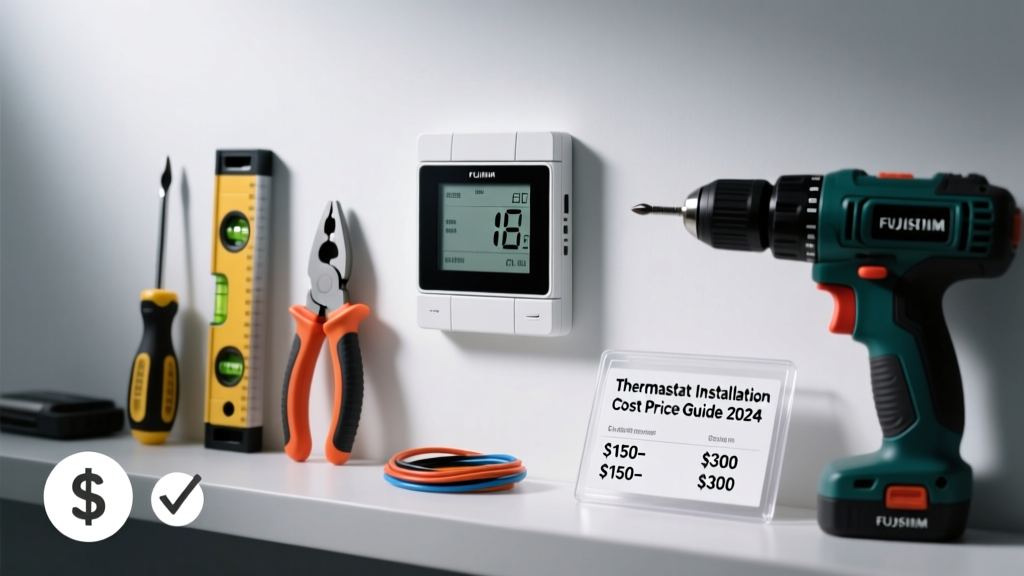
Thermostat installation costs vary widely depending on equipment type, wiring complexity, and whether you hire a pro or DIY. This guide breaks down actual 2024 pricing from HVAC contractors, home improvement retailers, and utility rebate programs—so you can budget accurately and avoid surprise fees.
Quick Price Range
| Service/Item | Low End | Average | High End |
|---|---|---|---|
| Basic programmable thermostat (DIY) | $15 | $25 | $45 |
| Smart thermostat (e.g., Nest, Ecobee) + pro install | $125 | $220 | $350 |
| Wi-Fi thermostat with C-wire retrofit | $180 | $265 | $410 |
| Multi-zone smart system (2–3 zones) | $420 | $680 | $950 |
What Affects the Price
Four key factors shift your final bill:
- Thermostat type: Basic digital units cost $15–$40; smart models range from $99–$299 before labor.
- Wiring condition: Homes built before 1990 often lack a common (C) wire—adding $75–$150 for retrofitting or using a power extender kit.
- HVAC compatibility: Older furnaces or heat pumps may need relay adapters or firmware updates, pushing labor up $60–$120.
- Location & contractor rates: Labor averages $75/hour in Dallas but $135/hour in San Francisco (HomeAdvisor 2024 Contractor Rate Survey).
DIY vs Professional Installation
Most homeowners can install basic thermostats—but smart units introduce compatibility checks and Wi-Fi pairing that trip up 37% of first-time installers (Ecobee User Support Data, 2023). Here’s how the numbers stack up:
| Cost Component | DIY | Professional |
|---|---|---|
| Thermostat unit | $15–$299 | $15–$299 |
| Labor | $0 | $75–$180 |
| C-wire retrofit (if needed) | $25–$60 (parts + time) | $90–$150 |
| Post-install testing & calibration | Self-guided (15–45 min) | Included (30–90 min) |
Money-Saving Tips
Save $50–$200 without sacrificing reliability:
- Check for utility rebates—PG&E, ComEd, and ConEd offer $50–$100 off smart thermostats when installed by a certified contractor.
- Buy during Black Friday or Home Depot’s Spring HVAC Sale: Nest and Ecobee units drop 20–30% with free shipping.
- Use your existing wiring diagram (often taped inside the old thermostat cover) to avoid miswiring and callbacks.
- Bundle installation with an annual HVAC tune-up—many contractors discount labor by 15% when paired.
Do I need a C-wire for my new thermostat?
Yes—if you’re installing a smart thermostat that requires continuous power. About 68% of homes built before 2005 lack one (U.S. Department of Energy Residential Wiring Assessment, 2022). You’ll see five or fewer wires at your current thermostat; if there’s no blue (C) wire connected, you’ll need a retrofit or power extender kit.
Can I install a smart thermostat on a heat-only or cooling-only system?
Absolutely—but verify compatibility first. Most modern smart thermostats support single-stage heating or cooling only. Ecobee’s SmartThermostat with Voice Control explicitly lists compatibility with millivolt systems and oil furnaces, unlike some Nest models. Always cross-check your furnace’s label against the thermostat’s HVAC system compatibility checklist.
How long does professional thermostat installation take?
Most pros complete standard replacements in 45–75 minutes. If they discover damaged wires, missing insulation, or a faulty transformer, it can stretch to 2+ hours—and trigger a separate diagnostic fee. According to the Air Conditioning Contractors of America (ACCA), 12% of service calls for thermostat installs require unexpected electrical repairs.
Will a smart thermostat lower my energy bills?
Yes—when used correctly. The U.S. EPA estimates smart thermostats reduce heating and cooling energy use by 8–12%, saving $50–$120 annually (ENERGY STAR Program Report, 2023). But savings depend on consistent scheduling, occupancy sensing, and avoiding manual overrides.
Is thermostat installation covered by home warranty plans?
Rarely as a standalone item—but many home warranty providers (like American Home Shield and Select Home Warranty) cover thermostat replacement if it fails due to normal wear and tear *and* is part of a larger HVAC repair claim. Read your policy’s exclusions: most deny coverage for upgrades or smart thermostat add-ons.
What happens if I wire the thermostat wrong?
Miswiring can blow a fuse on your furnace control board, trip a breaker, or cause your AC compressor to run continuously. One in five DIY thermostat returns to Home Depot cite ‘no power’ or ‘furnace won’t ignite’—both commonly tied to reversed R/C or Y/O wires (common thermostat wiring mistakes). When in doubt, snap a photo of your old wiring before disconnecting anything.
"If your furnace doesn’t power on after install, check the 24V transformer first—not the thermostat. A blown low-voltage fuse is the culprit 60% of the time, not a bad unit." — Carlos Mendez, NATE-certified HVAC technician, Austin, TX (2024)
Thermostat installation sits at the intersection of comfort, control, and cost. Whether you choose a $25 manual model or a $299 smart hub, understanding the variables—wiring, labor rates, and rebate eligibility—keeps your project on budget. For more on related upgrades, see our guides on HVAC tune-up cost and furnace replacement cost.