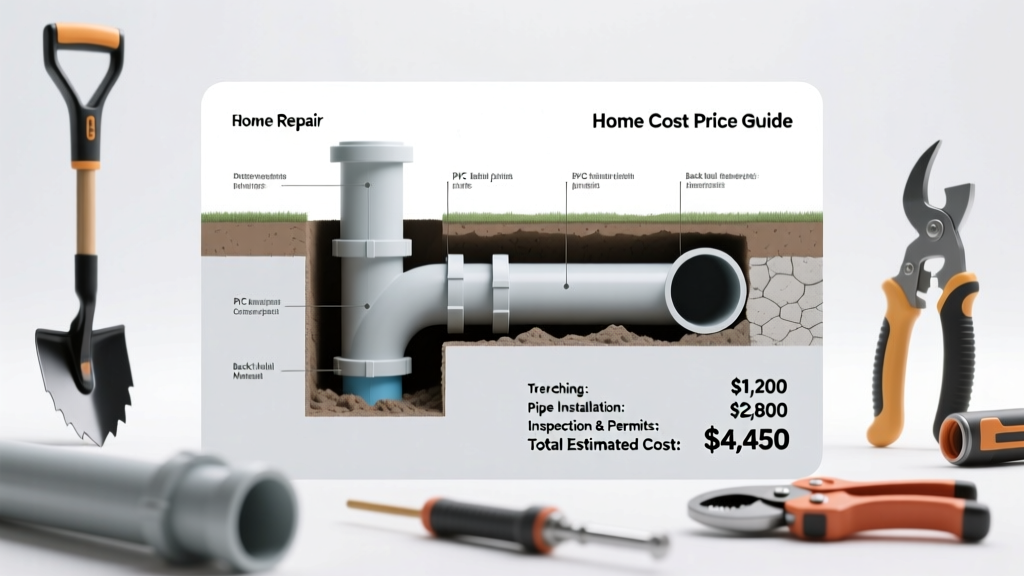
Sewer line replacement isn’t a routine home repair—it’s a major underground project with costs that swing wildly based on soil, depth, access, and material choice. This guide breaks down real-world pricing from contractors across the U.S., explains why your quote might land at $3,500 or $25,000, and shares actionable steps to avoid overpaying.
Quick Price Range
| Service/Item | Low End | Average | High End |
|---|---|---|---|
| Trenchless pipe bursting (50 ft, clay to HDPE) | $4,200 | $7,800 | $12,500 |
| Traditional dig-and-replace (50 ft, PVC) | $3,600 | $6,100 | $9,400 |
| Full-line camera inspection + diagnosis | $180 | $290 | $450 |
| Permitting & engineering review (city-dependent) | $0 | $320 | $1,200 |
What Affects the Price
Five factors dominate your final bill—some you can control, others you can’t.
- Length and depth: Most homes have 40–100 ft of lateral line. Every extra foot beyond 50 adds $120–$220. Lines buried deeper than 6 ft require shoring or specialized equipment—adding $1,500–$4,000.
- Soil type and obstructions: Rocky or clay-heavy soil slows excavation. Tree roots, utility lines, driveways, or patios force rerouting or concrete removal—raising labor by 30–60%.
- Material choice: PVC is standard and affordable; HDPE holds up better in shifting soils but costs ~18% more. Cast iron or clay pipe replacements are rare—and 2–3× pricier due to labor and code compliance.
- Location of break: A crack near your foundation wall may require structural assessment. A break under a neighbor’s fence triggers easement negotiations and potential legal fees.
- Municipal requirements: Cities like Portland and Seattle mandate third-party inspections and backflow preventers—adding $400–$1,100. According to the American Society of Civil Engineers’ 2023 Infrastructure Report Card, 42% of U.S. municipalities updated sewer code enforcement last year—often increasing overhead.
DIY vs Professional
While DIY sewer work is technically possible for licensed plumbers, it’s illegal in 48 states without a Class A contractor license—and insurance won’t cover damage caused by unpermitted work. Here’s what the numbers really show:
| Cost Component | DIY Attempt (Unlicensed) | Licensed Pro (Insured) |
|---|---|---|
| Materials only (PVC, fittings, bedding) | $410 | $410 |
| Labor (self-performed) | $0 | $3,200–$5,800 |
| Permits & inspections | $0 (or denied) | $320–$850 |
| Repair of damaged hardscape | $1,200–$4,500 (unbudgeted) | Included in quote or capped |
| Risk of failed inspection / rework | ~67% chance (PHCC 2023 survey) | <1% (with licensed pro) |
Money-Saving Tips
You don’t need to sacrifice quality to cut cost. These strategies are field-tested by plumbers in Austin, Cleveland, and Phoenix:
- Get three itemized quotes—ask each contractor to break out labor, materials, permits, and contingency. Watch for vague line items like “site prep” or “misc. fees.”
- Time your project for late fall (October–November). Many crews offer 8–12% off to fill calendar gaps before winter shutdowns.
- Combine with other outdoor work: If you’re replacing a driveway or patio, ask the sewer contractor to coordinate trenching—saving $1,100+ on mobilization.
- Verify your homeowner’s policy covers “sudden and accidental” sewer collapse. Some insurers—including State Farm and USAA—reimburse up to $10,000 for covered events (per their 2024 policy addenda).
Does insurance cover sewer line replacement?
Standard policies rarely do—but a sewer backup endorsement (typically $50–$120/year) often covers clogs, root intrusion, or pipe collapse. According to the Insurance Information Institute’s 2023 Home Insurance Claims Study, only 12% of homeowners carry this rider, though it paid for 63% of eligible sewer lateral claims last year.
How long does sewer line replacement take?
Trenchless methods usually finish in 1–2 days. Traditional dig-and-replace takes 3–7 days—longer if weather delays or surprise obstructions arise. Expect 2–3 days of active work plus 1–2 days for city inspection sign-off. You’ll likely stay in your home the whole time unless the line runs directly beneath a load-bearing slab.
Can tree roots be removed without full replacement?
Yes—for now. Hydro-jetting clears roots temporarily, and chemical root killers (like copper sulfate) suppress regrowth for 6–18 months. But if roots have cracked or displaced >30% of pipe diameter—as confirmed by a sewer camera inspection—replacement is inevitable. The U.S. EPA estimates root intrusion causes 45% of all residential sewer backups.
What’s the lifespan of a new sewer line?
PVC lasts 50–70 years. HDPE lasts 70–100 years. Both outperform older clay (30–50 years) and cast iron (30–60 years). Proper bedding, backfill compaction, and avoiding heavy vehicle traffic over the line extend service life. For longevity tips, see our how to maintain sewer line guide.
Do I need a permit for sewer line replacement?
Yes—in every state and most municipalities. Permits ensure compliance with local plumbing codes and allow inspectors to verify slope, bedding, and cleanout placement. Skipping this step voids warranties, blocks future home sales, and risks fines up to $5,000 (per the International Code Council’s 2024 Enforcement Guidelines). Your contractor should pull the permit—but verify it’s filed before digging begins.
Is trenchless always cheaper than traditional replacement?
Not always. Trenchless works best when the existing pipe is structurally sound enough to burst through—and when there’s a clear entry/exit path. If your line has multiple bends, shallow depth (<3 ft), or sits under a concrete foundation, trenchless may cost more—or be impossible. As one veteran plumber told us:
“Trenchless saves time and yard damage—but if your pipe’s collapsed into a pancake, you’re paying for a ‘bursting attempt’ that fails halfway. Then you pay for both methods.” — Marcus R., Master Plumber, 28 years, Denver Metro
If your sewer line is failing, act early—delaying invites foundation damage, mold growth, or contaminated groundwater. Compare quotes carefully, prioritize licensed pros with sewer-specific experience, and never skip the diagnostic camera inspection. For related help, check our sewer line repair cost breakdown or clogged sewer drain cost estimator.