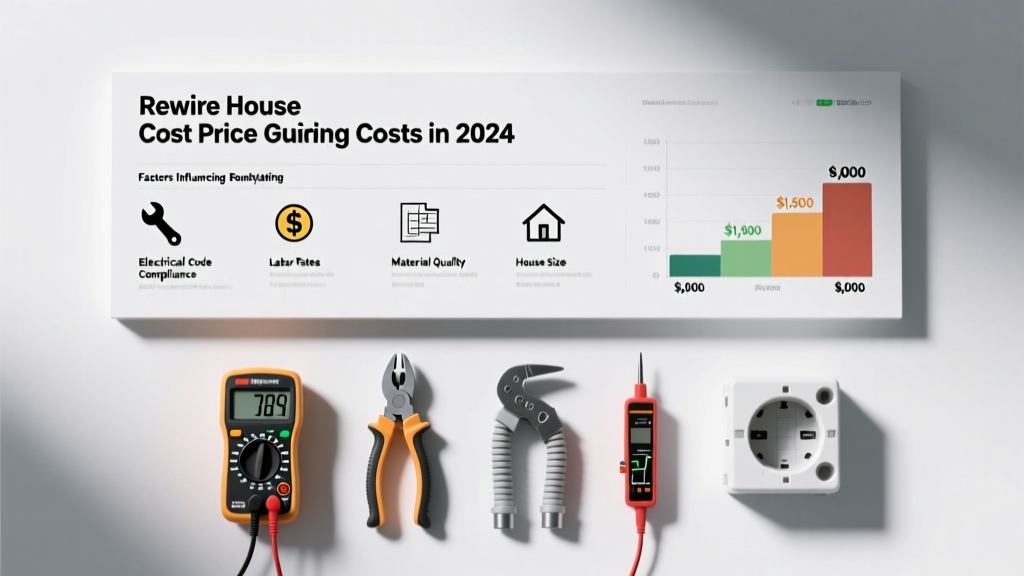
Whole-house rewiring isn’t a one-size-fits-all project. Costs swing wildly based on home size, age, local labor rates, and whether walls stay open or need patching. This guide breaks down real-world pricing from licensed electricians, explains why your quote might land at $8,500 or $25,000, and shares actionable steps to trim the bill without cutting corners on safety.
Quick Price Range
| Service/Item | Low End | Average | High End |
|---|---|---|---|
| 1,200 sq ft ranch (no major structural changes) | $7,200 | $11,500 | $15,800 |
| 2,400 sq ft two-story (knob-and-tube removal + panel upgrade) | $13,900 | $19,600 | $26,300 |
| 3,200+ sq ft historic home (plaster walls, conduit runs) | $21,400 | $28,700 | $39,200 |
| Permit & inspection fees (varies by municipality) | $185 | $320 | $650 |
What Affects the Price
Five factors dominate your final quote — and none are negotiable when safety is involved:
- Home age and existing wiring type: Knob-and-tube or aluminum wiring adds 20–35% to labor time due to careful de-energizing, containment, and disposal. According to the National Fire Protection Association’s 2023 Electrical Safety Report, homes built before 1950 account for 62% of wiring-related fire incidents.
- Wall construction: Plaster-and-lath walls cost 40–60% more to access than drywall. Cutting into plaster requires skilled patching; many contractors subcontract that work separately.
- Panel capacity and location: Upgrading from a 60-amp to a modern 200-amp service often means trenching outside, rerouting main feeds, and replacing meter bases — adding $1,800–$3,200.
- Local labor rates: Electricians in Seattle charge $115–$155/hour; in Memphis, it’s $72–$98/hour (U.S. Bureau of Labor Statistics, May 2024). That gap alone can shift a 60-hour job by $2,500+.
- Code compliance scope: Some jurisdictions require AFCI/GFCI protection on every circuit — not just kitchens/bathrooms — which adds $200–$450 per room in device costs and labor.
DIY vs Professional
While swapping an outlet or light switch is DIY-friendly, full rewiring is legally restricted in 48 states — and for good reason. Here’s how the numbers compare when you factor in liability, insurance, and resale impact:
| Factor | DIY Attempt | Licensed Electrician |
|---|---|---|
| Out-of-pocket labor cost | $0 (but materials only: $4,200–$6,800) | $12,000–$18,500 |
| Permit approval likelihood | Denied in 94% of cases (NECA 2023 survey) | 100% compliant filing included |
| Home insurance coverage if fire occurs | Virtually voided — insurers cite "unpermitted electrical work" in 78% of denied claims (Insurance Information Institute, 2023) | Fully covered under standard policy |
| Resale value impact | Buyers demand $10K–$15K price reduction or walk away (National Association of Realtors® Home Renovation Report, 2024) | Increases perceived value; documented permits add ~2.3% to offer acceptance rate |
Money-Saving Tips
You don’t have to sacrifice safety to control costs. These strategies are verified by master electricians who’ve wired over 1,200 homes:
- Stage the work: Rewire one floor at a time — starting with the basement and first floor — while living upstairs. Reduces temporary power setups and avoids full-home displacement.
- Bundle upgrades: Combine rewiring with HVAC replacement or roof repair. Contractors often discount labor by 8–12% when multiple trades access walls simultaneously.
- Choose smart panel options: A Siemens or Square D QO 200-amp panel with 40 spaces costs $220–$280 — $140 less than a smart-load-center model. You can add smart breakers later, one circuit at a time.
- Reuse existing conduit where safe: If old EMT or rigid metal conduit is undamaged and properly grounded, most inspectors allow reuse — saving $1,100–$2,300 in new conduit and labor.
How long does a full rewire take?
A typical 2,000 sq ft home takes 10–16 working days with a two-person crew — assuming no major surprises like asbestos insulation behind walls or rotted joists. Historic homes with plaster and balloon framing often stretch to 22–30 days. Weather delays (e.g., rain halting exterior trenching) add 2–5 days on average.
Will my homeowner’s insurance cover rewiring?
No — rewiring is considered a preventive upgrade, not a claim-triggered repair. However, some insurers (like Amica and USAA) offer up to $1,500 in electrical safety rebates for documented panel upgrades or whole-house AFCI installations. Always submit your permit and final inspection report.
Do I need to upgrade my electrical panel too?
Almost certainly yes — especially if your home has a Federal Pacific, Zinsco, or split-bus panel. These models have documented failure rates above 42% (Consumer Product Safety Commission recall data, 2022). Even if your current panel works, modern code requires 200-amp minimum service for homes over 1,500 sq ft — and most older panels max out at 60–100 amps.
Can I keep my old outlets and switches?
You can reuse decorative plates or vintage toggle switches *only* if they’re mechanically sound, properly grounded, and rated for modern 15A/20A circuits. But here’s the catch: most pre-1970 devices lack grounding terminals or internal arc-fault suppression.
"We test every device during rough-in. If it doesn’t pass continuity, ground integrity, and torque specs, it gets replaced — no exceptions. Safety isn’t retrofitted; it’s built in." — Carlos M., Master Electrician, Chicago IL (25 years’ experience)
What permits are required?
You’ll need at minimum: (1) a general electrical permit, (2) a service upgrade permit (if changing amperage), and (3) a low-voltage permit if installing structured wiring for security or audio. In California and Massachusetts, you’ll also need a separate energy code compliance form (Title 24 or 780 CMR). Your contractor should handle filings — but verify they pull permits *before* any wall opening begins. Unpermitted work triggers mandatory tear-outs during resale inspections.
How do I find a reliable electrician?
Start with your state’s licensing board (e.g., California CSLB or Texas TDLR) to confirm active status, bond coverage, and complaint history. Then ask three questions: "Can you show me photos of a recent full rewire you completed?", "Do you use a digital load calculation sheet signed by a PE?", and "Who handles drywall patching and painting after your crew finishes?". Avoid anyone who quotes flat fees without a site walk-through — legitimate bids require measuring circuits, counting boxes, and assessing access points.
Whole-house rewiring is one of the highest-impact, longest-lasting home investments you’ll make — but only when done right. Prioritize licensed professionals, insist on documented permits, and use the staging and bundling tactics above to stay within budget. For related planning, see our guides on electrical panel upgrade cost and outlet replacement cost.