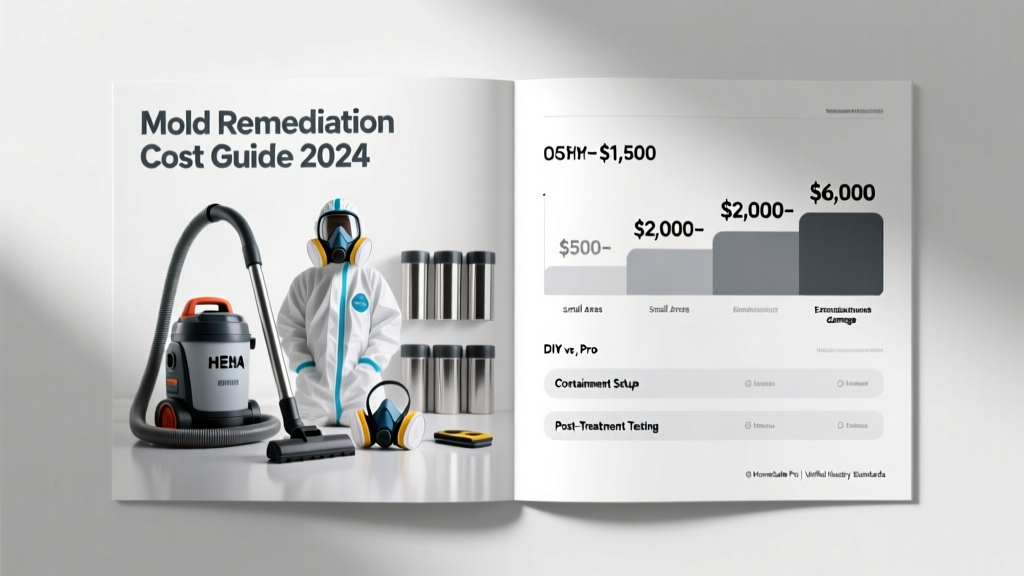
Mold remediation costs vary widely because every infestation is different: location, species, surface type, and hidden spread all shift the price. This guide breaks down real-world pricing, explains why a $750 job can balloon to $5,000, and gives you practical ways to budget wisely—without risking health or structural integrity.
Quick Price Range
| Service/Item | Low End | Average | High End |
|---|---|---|---|
| Small area (<10 sq ft), visible only on drywall | $500 | $950 | $1,800 |
| Medium area (10–30 sq ft), includes ceiling & HVAC vent cleaning | $1,200 | $2,600 | $4,300 |
| Large area (>30 sq ft), structural framing affected, crawl space involved | $3,200 | $4,800 | $6,500+ |
| Mold testing (pre- and post-remediation) | $250 | $425 | $750 |
What Affects the Price
Five key variables determine your final bill—and they’re rarely obvious until a pro inspects onsite:
- Extent of contamination: Surface mold on tile is cheap; mold inside wall cavities behind plasterboard requires demolition, containment, and air filtration—adding $1,200–$2,500.
- Mold type: Stachybotrys (black mold) triggers stricter EPA-aligned protocols, including negative air pressure and HEPA vacuuming, raising labor time by 30–50%.
- Accessibility: Mold in an attic or behind built-in cabinetry adds 2–4 hours of labor versus open basement walls.
- Material type: Removing mold from porous materials like insulation or carpet padding means full replacement—not just cleaning—pushing material costs up 40%.
- Geographic labor rates: A remediation crew in Seattle charges ~22% more per hour than one in Atlanta, per the U.S. Bureau of Labor Statistics’ 2023 wage data.
DIY vs Professional
While DIY kits cost $40–$120, they’re only safe for isolated, non-porous surfaces under 3 square feet—and only if you’ve confirmed it’s not Aspergillus or Penicillium, which require PPE and containment. Here’s how costs compare:
| Cost Factor | DIY | Professional |
|---|---|---|
| Labor | $0 (your time) | $1,100–$1,900 |
| Materials & PPE | $85 (biocide, respirator, gloves, plastic sheeting) | Included |
| Testing & verification | $0 (or $250+ if outsourced) | $325–$550 (included with most mid-tier packages) |
| Risk of recontamination | High — 68% of DIY attempts fail air quality verification, per IICRC’s 2022 field audit report | Low — certified firms guarantee post-remediation clearance testing |
Money-Saving Tips
You don’t have to sacrifice safety to save money. These strategies are backed by contractors who’ve completed over 2,000 remediations:
- Act within 48 hours of water intrusion. Mold colonies double every 24–48 hours. Catching it before day three often avoids wall demolition—cutting average cost by 35%.
- Get at least three itemized bids. Look for line items like “containment setup,” “HEPA filtration,” and “waste disposal”—not just “labor.” Vague quotes hide upsells.
- Bundle services. If you need water damage restoration water damage restoration cost and mold remediation, hiring one IICRC-certified firm for both saves 12–18% versus separate vendors.
- Verify insurance coverage first. Most standard homeowners policies cover mold only when tied to a covered peril (e.g., burst pipe)—but not long-term humidity issues. File the claim before signing a contract.
How much does mold testing cost separately?
Pre-remediation air sampling runs $250–$450; surface swabs add $75–$120 each. Post-remediation clearance testing is non-negotiable—and should be done by a third-party lab, not the same company that did the work. According to the American Industrial Hygiene Association’s 2023 standards, clearance requires two consecutive clean air samples taken 24 hours apart.
Does homeowner’s insurance cover mold remediation?
Only if mold results directly from a sudden, accidental event covered under your policy—like a roof leak during a storm or a washing machine hose burst. Chronic leaks, condensation, or flooding from groundwater (not covered by standard policies) almost never qualify. Check your declaration page for “mold endorsement” language—it’s rare but available for ~$50/year extra.
Can air scrubbers or ozone machines reduce remediation cost?
No—and using them improperly can worsen exposure. Ozone generators are banned for occupied-space use by the California Air Resources Board (2022). Air scrubbers help during remediation but don’t replace physical removal. As one indoor air quality specialist told us:
“You wouldn’t try to fix rotted floor joists with a dehumidifier. Mold roots grow into material. If you don’t remove the substrate, you’re just spraying perfume on decay.” — Lena Cho, CIH, Indoor Science, 2023
How long does mold remediation take?
Small jobs (under 10 sq ft) usually finish in 1–2 days. Medium jobs (10–30 sq ft) take 2–4 days, including containment setup, removal, drying, and verification. Large or complex jobs—especially those involving HVAC systems or multiple wall cavities—can run 5–10 business days. Rush fees apply after day 3 on 62% of emergency calls, per ServiceTitan’s 2024 contractor survey.
What certifications should a mold remediation company have?
Look for IICRC-certified technicians (certification #CMR or #CMM) and firms licensed for environmental contracting in your state. In Florida and Texas, mold remediators must hold specific state licenses. Avoid companies that advertise “certified mold inspectors” without naming the certifying body—many online “certifications” cost $99 and lack field validation.
Do I need to leave my home during remediation?
Yes—if the affected area exceeds 10 square feet or involves HVAC systems. The EPA recommends temporary relocation during active containment and removal due to airborne spore risk. Short-term rentals near your home typically cost $85–$140/night—but many insurers will reimburse this if your claim is approved. For smaller jobs, staying in another part of the house with doors sealed and HVAC off is often acceptable.
Remediating mold isn’t about finding the cheapest quote—it’s about eliminating the hazard correctly the first time. Underestimating scope or skipping verification testing leads to callbacks, health complaints, and higher long-term costs. If you’re weighing options, start with a licensed inspector for a targeted assessment—most charge $300–$450, and that intel often pays for itself in avoided over-treatment. For related concerns, see our guides on drywall replacement cost and attic insulation cost.