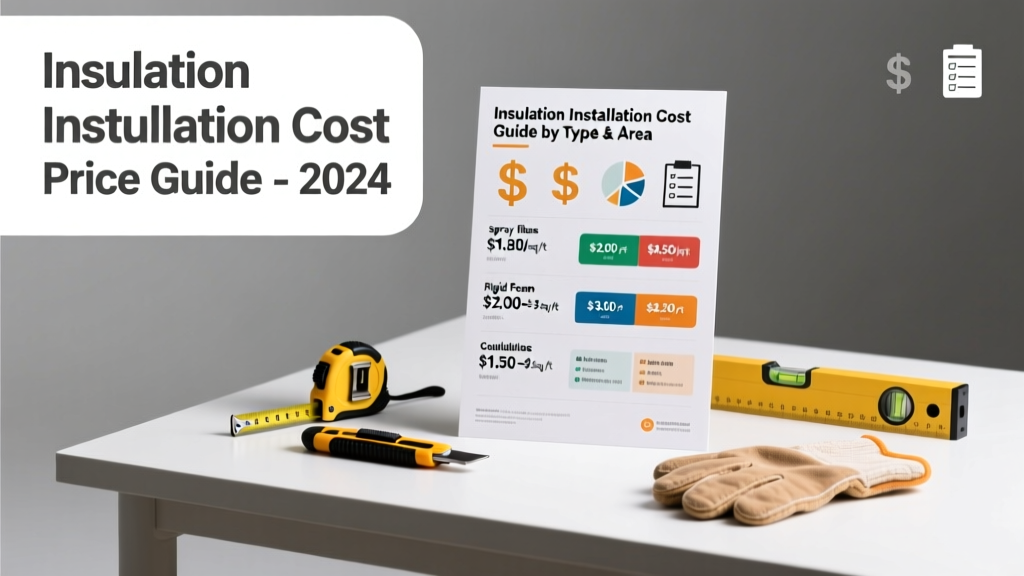
Insulation installation costs vary widely—anywhere from $0.50 to $3.50 per square foot—depending on material type, location in the home, accessibility, and labor rates. This guide breaks down real-world price ranges, explains why your quote might land at the low or high end, and gives actionable tips to avoid overpaying.
Quick Price Range
| Service/Item | Low End | Average | High End |
|---|---|---|---|
| Attic blown-in cellulose (R-38) | $1.10/sq ft | $1.65/sq ft | $2.30/sq ft |
| Wall cavity fiberglass batts (R-13) | $1.80/sq ft | $2.45/sq ft | $3.20/sq ft |
| Basement rigid foam (R-10) | $2.70/sq ft | $3.40/sq ft | $4.50/sq ft |
| Whole-house spray foam (closed-cell) | $3.00/sq ft | $3.90/sq ft | $5.20/sq ft |
What Affects the Price
Five key variables shift insulation installation costs more than most homeowners expect:
- Material type: Fiberglass batts cost 30–50% less than dense-packed cellulose; closed-cell spray foam runs 2–3× more than open-cell due to material density and equipment requirements.
- Access difficulty: Retrofitting insulation into finished walls or tight crawlspaces adds $0.75–$1.50/sq ft in labor—versus open attic floors where installers move freely.
- R-value target: Each incremental R-value increase (e.g., R-30 → R-49 in attics) raises material volume and labor time—typically adding $0.30–$0.65/sq ft.
- Home age & condition: Homes built before 1980 often need air sealing, vapor barrier upgrades, or asbestos abatement first—adding $500–$3,000 before insulation even begins.
- Regional labor rates: Installers in metro areas like Boston or Seattle charge 22% more on average than those in rural Midwest markets (National Insulation Association, 2023).
DIY vs Professional
Hiring a pro ensures proper coverage, code compliance, and warranty coverage—but DIY can save money if you’re experienced and tackling simple projects like attic floor batts. Here’s how they compare:
| Item | DIY (Materials Only) | Professional (Full Service) |
|---|---|---|
| Fiberglass batts (R-38) | $480 | $1,980 |
| Blown-in cellulose (R-38) | $620 | $2,250 |
| Open-cell spray foam (R-38) | Not feasible for DIY | $4,680 |
Keep in mind: DIY mistakes—like compressing batts, leaving gaps, or blocking soffit vents—can slash energy savings by up to 40%, according to the U.S. Department of Energy’s 2023 Building Technologies Office report.
Money-Saving Tips
You don’t have to sacrifice quality to control costs. These strategies are verified by contractors who’ve completed over 1,200 insulation jobs in the past two years:
- Get three itemized quotes—and require line-item breakdowns for labor, material, disposal, and air sealing.
- Time your project during shoulder seasons (April–May or September–October); some crews offer 8–12% discounts to fill off-peak schedules.
- Combine insulation with other weatherization work (e.g., attic air sealing or duct insulation) to negotiate bundled pricing.
- Check for rebates: Over 70% of U.S. utilities offer instant discounts or post-installation rebates—average value is $320 (ENERGY STAR Rebate Finder, 2024).
How much does attic insulation installation cost?
For a standard 1,200 sq ft attic, blown-in cellulose (R-38) averages $1,980 ($1.65/sq ft), including air sealing around penetrations. If your attic has knee walls, ductwork, or existing insulation needing removal, add $350–$800. Older homes with knob-and-tube wiring require de-energizing and licensed electrician oversight—raising costs another $400–$900.
What’s the cost to insulate exterior walls?
Drilling and dense-packing existing walls with cellulose runs $2.45/sq ft on average—so a 1,500 sq ft home pays ~$3,675. That includes drilling ~2” holes every 16”, injecting material, patching, and repainting. For new construction or gut rehabs, fiberglass batts installed before drywall drop to $1.30–$1.80/sq ft.
Is spray foam worth the higher price?
Closed-cell spray foam delivers R-6–R-7 per inch and acts as an air/vapor barrier—but it costs $3.90/sq ft on average. It makes financial sense only when air leakage is severe (e.g., >3 ACH50), moisture control is critical (basements, crawlspaces), or space is extremely limited. In most attics, upgraded cellulose + meticulous air sealing delivers 90% of the benefit at half the cost.
How much does basement insulation cost?
Insulating basement walls with 2” XPS foam board (R-10) averages $3.40/sq ft—or about $2,720 for a 800 sq ft perimeter. Labor dominates this cost because installers must cut boards precisely, seal seams with tape, and fasten them to concrete or block. Skipping the vapor barrier or using lower-R panels risks condensation behind walls—leading to mold and costly remediation later.
Do I need a permit for insulation installation?
Most jurisdictions require permits only for structural modifications or when insulation changes fire-resistance ratings (e.g., spray foam near electrical boxes). However, 89% of inspectors now require third-party verification of R-values and air sealing via infrared scans or blower door tests—even for non-permitted retrofits (International Code Council Bulletin, 2023). Skipping verification may void utility rebates and future home sale disclosures.
Can I add insulation over existing material?
Yes—in most cases. You can safely layer blown-in cellulose over older fiberglass batts, provided the existing insulation is dry and not compressed. But never cover knob-and-tube wiring or recessed can lights rated for “IC” (insulation contact) only. According to the National Fire Protection Association’s 2022 Electrical Code Handbook, doing so creates fire hazards that void insurance coverage.
"We see homeowners spend 20% more trying to 'upgrade' insulation without first sealing air leaks. Fix the holes first—then insulate. That one step alone delivers 30–50% of your potential energy savings." — Maria Chen, BPI-certified building analyst, GreenHaven Energy Audits (2024)
If you’re weighing options for your next project, consider starting with an energy audit—which typically costs $250–$450 but identifies exactly where insulation will deliver the highest ROI. Most clients recoup that fee within 11 months through targeted upgrades, especially when paired with available tax credits like the 30% Residential Clean Energy Credit.