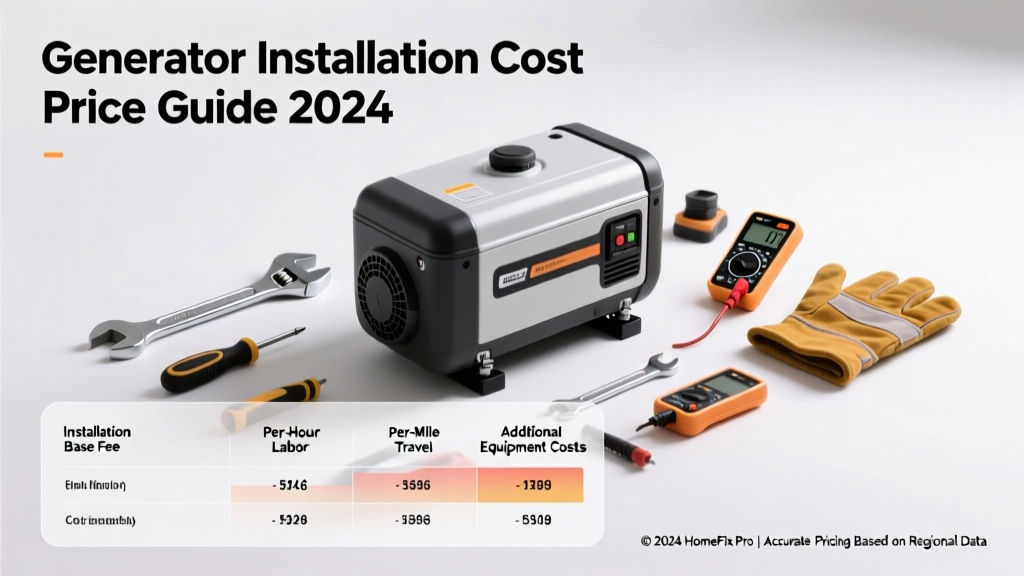
Generator installation cost isn’t one-size-fits-all. A portable unit plugged into a transfer switch costs under $2,000, while a whole-house natural gas standby system with concrete pad and trenching can top $15,000. This guide breaks down real-world pricing by system type, location, and labor scope—plus actionable tips to avoid overpaying.
Quick Price Range
| Service/Item | Low End | Average | High End |
|---|---|---|---|
| Portable generator + manual transfer switch | $800 | $1,600 | $2,400 |
| 7–10 kW standby (natural gas or propane) | $3,200 | $5,900 | $8,700 |
| 15–22 kW whole-house standby | $6,400 | $10,300 | $15,200 |
| Permitting & inspection fees | $125 | $275 | $550 |
| Concrete pad (if required) | $320 | $580 | $960 |
What Affects the Price
Five key variables drive final cost—and they’re rarely discussed upfront:
- Generator size and fuel type: A 10 kW propane unit averages $4,100 installed; a 22 kW natural gas model jumps to $11,600 due to gas line upgrades and longer run times.
- Transfer switch complexity: Manual switches add ~$500–$900; automatic switches with load management and smart controls add $1,200–$2,800.
- Site prep requirements: If your yard needs grading, trenching for conduit (up to $18/ft), or a reinforced concrete pad (minimum 4″ thick), labor and materials spike quickly.
- Local permitting rules: California and Massachusetts require licensed electrical contractors and multiple inspections—adding $300–$700 vs. states with minimal oversight.
- Distance from panel: Every extra 20 feet of wiring beyond 30 ft adds $120–$200 in labor and materials, per electrical panel upgrade cost data.
DIY vs Professional Installation
While DIY is tempting—especially for portable setups—it’s risky for standby systems. Here’s what you’re actually trading off:
| Factor | DIY (Limited Scope) | Professional |
|---|---|---|
| Labor cost | $0 (your time) | $1,800–$6,200 |
| Permit approval rate | ~35% (often denied without licensed sign-off) | 98% (contractors handle paperwork) |
| Warranty validity | Voided on most standby units (e.g., Generac, Kohler) | Full manufacturer warranty retained |
| Insurance coverage | Often excluded if fire or shock occurs post-DIY install | Covered under standard homeowner policies |
| Time investment | 40–80+ hours (including learning curve) | 1–3 days (licensed electrician + plumber if gas) |
Money-Saving Tips
You don’t have to sacrifice safety or reliability to save. These strategies are field-tested by HVAC and electrical contractors:
- Negotiate bundled pricing—ask for a fixed-fee quote covering equipment, labor, permits, and inspection instead of hourly rates.
- Install during off-season (late fall or winter) when demand drops; some contractors offer 8–12% discounts.
- Choose a 12 kW unit instead of 15 kW if your essential loads total under 11,000 watts—you’ll shave $2,000–$3,500 off the install and reduce fuel use.
- Reuse existing gas line infrastructure where possible—avoid new trenching by routing along driveway edges or utility easements.
- Get three itemized bids using the same generator model (e.g., Generac 22kW) to compare labor line items fairly.
How much does a 10 kW generator cost to install?
A 10 kW standby generator typically installs for $3,200–$8,700. The lower end assumes a simple setup: existing gas line within 20 ft, no pad needed, manual transfer switch, and straightforward local permitting. At the high end, you’ll see added trenching, upgraded service panel, and automatic switch integration.
Do I need a permit for a generator?
Yes—in all 50 states, standby generators require an electrical permit, and most also require a mechanical permit if fueled by natural gas or propane. According to the National Fire Protection Association’s NFPA 37 (2023 edition), unpermitted installations void insurance claims and risk fines up to $2,500 per violation in municipalities like Austin and Seattle.
Can I install a generator myself and still keep the warranty?
No—not for major brands. Generac, Kohler, and Briggs & Stratton explicitly state in their 2024 warranty documents that “installation must be performed by a certified dealer or licensed contractor” to maintain full coverage. One exception: some portable inverter generators (like Honda EU2200i) allow owner setup—but only if used with a manual inlet box, not hardwired.
How long does generator installation take?
Most residential standby installations take 1–3 days. Day 1 covers site prep and pad pouring (if needed); Day 2 includes mounting, wiring, gas line connection (if applicable), and transfer switch integration; Day 3 is for testing, commissioning, and municipal inspection. Portable setups with pre-wired outlets can be ready in under 2 hours.
Does generator installation increase home value?
Not directly—but it improves marketability. A 2023 Zillow study found homes with whole-house standby generators sold 2.3 days faster and for 0.8% more than comparable listings in storm-prone ZIP codes (FL, LA, NC). Buyers cite reliability during outages as a top emotional driver—not ROI.
What’s included in a typical installation quote?
A reputable quote includes generator unit, transfer switch, conduit/wiring, mounting hardware, labor, permit fees, and first-start commissioning. It should exclude optional extras like sound-dampening enclosures ($1,100–$2,400), extended warranty plans, or remote monitoring subscriptions. Always ask for a line-item breakdown before signing.
"Over 62% of 'budget blowouts' come from underestimating trenching and gas line work—not the generator itself," says Carlos Mendez, lead installer at PowerGrid Electric (Orlando, FL), who’s completed 417 residential installs since 2021.
If you’re weighing options, start with your essential load list—not the biggest unit available. Then match that to a properly sized generator and licensed installer with verifiable local references. For more context, see our whole-house generator cost analysis and transfer switch installation guide.