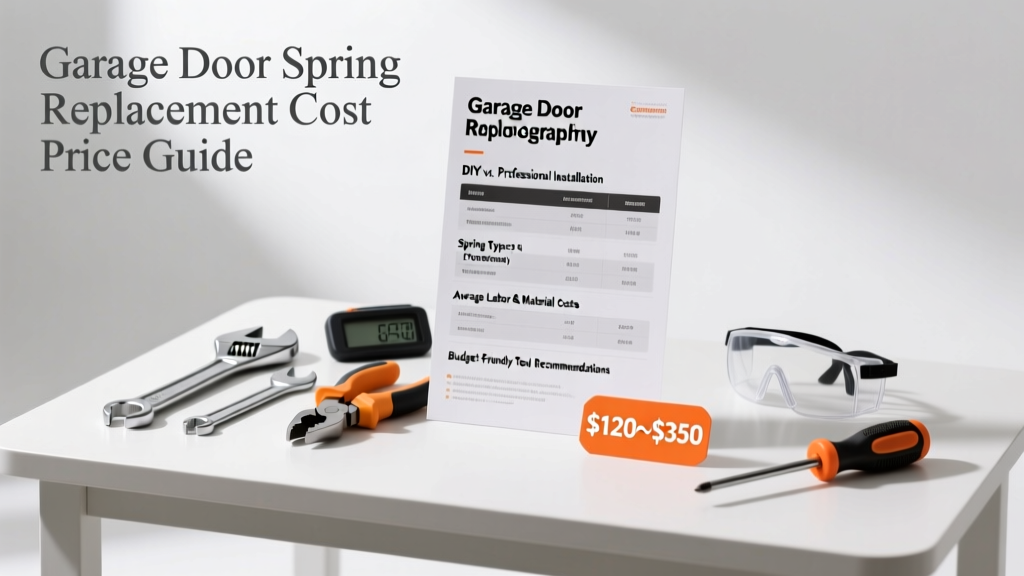
Garage door spring replacement costs vary widely — from under $100 for a DIY part to over $350 for premium professional service. This guide breaks down real-world pricing, explains why quotes differ so much, and gives you actionable ways to avoid overpaying.
Quick Price Range
| Service/Item | Low End | Average | High End |
|---|---|---|---|
| Torsion spring (single, part only) | $30 | $55 | $85 |
| Extension spring (pair, part only) | $20 | $40 | $65 |
| Professional torsion spring replacement (labor + parts) | $125 | $195 | $320 |
| Professional extension spring replacement (labor + parts) | $95 | $165 | $275 |
| Emergency after-hours service fee | $75 | $120 | $200 |
What Affects the Price
Four main variables drive cost differences:
- Spring type: Torsion springs (mounted above the door) cost more to replace than extension springs (mounted along the track), both in parts and labor — they require precise winding tools and calibration.
- Door weight and size: A 16' x 7' insulated steel door may need 175-lb torque springs versus 125-lb for a basic 8' x 7' door — heavier-duty springs cost 25–40% more.
- Geographic labor rates: Technicians in metro areas like Seattle or Boston charge $85–$115/hour; those in rural Midwest markets average $60–$75/hour (HomeAdvisor 2024 Contractor Rate Survey).
- Urgency and scheduling: Same-day or weekend appointments often add $75–$150 — especially if your door is jammed shut and blocking vehicle access.
DIY vs Professional
While DIY seems cheaper upfront, safety and long-term reliability matter. Here’s what most homeowners overlook:
| Factor | DIY | Professional |
|---|---|---|
| Parts cost only | $20–$85 | Included in service quote |
| Labor cost | $0 (but risk of injury) | $100–$250 |
| Tools needed (winding bars, clamps, vise grips) | $45–$90 one-time purchase | Already owned by pro |
| Avg. time investment | 2–4 hours (first-timers) | 45–90 minutes |
| Warranty coverage | None (parts only) | 1–3 years on parts & labor |
Money-Saving Tips
You don’t have to sacrifice safety or quality to save. Try these proven tactics:
- Replace both springs at once — even if only one broke. Paired springs wear evenly, and replacing just one leads to imbalance and premature failure of the new spring (per garage door maintenance schedule guidance).
- Book during off-peak months — March, April, and October see 12–18% lower service demand, and some companies offer $25–$50 seasonal discounts.
- Ask for bundled service: many pros discount spring replacement by 10–15% when combined with garage door opener repair or track alignment.
- Verify license and insurance — unlicensed “handymen” may charge less but often skip torque calibration, leading to early spring fatigue or cable derailment.
How long do garage door springs last?
Most torsion springs are rated for 10,000 cycles — about 7–10 years with daily use. Extension springs last 5,000–7,000 cycles (4–7 years). According to the Door & Access Systems Manufacturers Association (DASMA) 2023 Lifecycle Report, 68% of spring failures occur after year six.
Can I tell which spring type my door has?
Yes. Look above the door: if you see a long, horizontal metal shaft with coiled springs wrapped around it, it’s torsion. If you see two springs stretched horizontally along the top track — usually with a pulley and cable system — it’s extension. Most homes built after 1990 use torsion springs for better safety and balance.
Why do quotes vary so much between companies?
It’s not just labor markup. Some contractors include full safety inspections (cable condition, bracket integrity, roller wear); others charge extra for diagnostics. Also, licensed door specialists often use higher-grade springs (e.g., oil-tempered steel vs. standard carbon steel), which cost more but last 30% longer (Garage Door News, 2024 Product Benchmark Study).
Is it safe to replace springs myself?
No — not without certified training. Torsion springs store up to 100+ foot-pounds of energy. The U.S. Consumer Product Safety Commission reports an average of 27,000 spring-related injuries annually, mostly from improper unwinding or slipping winding bars.
Do I need new cables or rollers when replacing springs?
Not always — but it’s highly recommended. Cables and rollers endure the same stress cycles. If your springs lasted 8+ years, rollers likely have worn grooves and cables show fraying. Replacing them together adds $60–$110 but prevents follow-up service calls within 6 months.
What’s included in a typical professional spring replacement?
A reputable technician will: inspect all moving parts, disconnect and safely unwind the old spring, install the correct-rated replacement, recalibrate tension, test balance and auto-reverse safety, lubricate moving components, and provide a written warranty. Ask for this checklist before booking — it’s standard among members of the Garage Door Repair Companies Near Me network.
"Over 80% of premature spring failures we see stem from incorrect torque setting — not cheap parts. That’s why we never skip the 10-point balance test, even on 'simple' replacements." — Carlos Mendez, Certified Door Technician, Overhead Door Co. of Central Ohio (2024)
If your door feels heavy, makes loud banging noises, or won’t stay in place when manually lifted halfway, it’s time to act — delaying replacement risks broken cables, damaged openers, or unsafe operation. Compare at least two licensed quotes, ask about spring grade and warranty terms, and prioritize safety over savings when it comes to high-tension components.