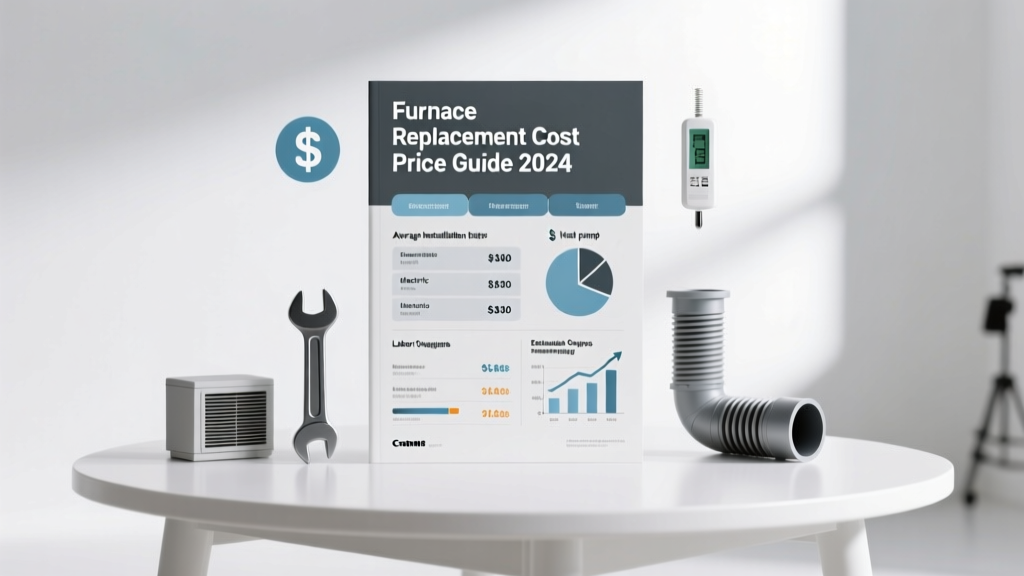
Replacing a furnace isn’t like swapping a lightbulb—it’s a major home system upgrade with wide cost variation. Your final price depends on fuel type, AFUE rating, ductwork condition, regional labor rates, and whether you need electrical or gas line upgrades. This guide breaks down real-world furnace replacement costs using 2024 contractor quotes, manufacturer data, and utility rebate reports—so you can budget confidently and avoid surprise fees.
Quick Price Range
| Service/Item | Low End | Average | High End |
|---|---|---|---|
| Standard 80% AFUE gas furnace (installed) | $2,500 | $3,800 | $5,200 |
| High-efficiency 95%+ AFUE gas furnace (installed) | $4,700 | $6,900 | $12,000 |
| Oil furnace (installed) | $5,100 | $7,300 | $9,800 |
| Electric furnace (installed) | $1,800 | $2,900 | $4,400 |
| Ductwork inspection & minor repair | $250 | $650 | $1,400 |
What Affects the Price
Furnace replacement isn’t one-size-fits-all. Here’s what drives cost differences:
- Fuel type: Natural gas units dominate the market and offer the lowest long-term operating cost—but require a gas line. Oil furnaces cost more to install and maintain; electric models avoid combustion but raise monthly bills in cold climates.
- Efficiency (AFUE): An 80% AFUE furnace may cost $1,500 less upfront than a 96% model—but over 15 years, the high-efficiency unit saves an average of $2,100 in gas, per the U.S. Department of Energy’s Residential HVAC Savings Calculator (2024).
- Size & load calculation: Oversized or undersized units waste energy and wear out faster. A Manual J load calculation—required by most reputable contractors—is $150–$300 but prevents costly callbacks.
- Home accessibility: Attics, crawlspaces, or tight mechanical rooms add $300–$900 in labor time. Replacing a furnace in a finished basement often requires drywall removal and patching.
DIY vs Professional Installation
While some homeowners attempt DIY furnace swaps, it’s strongly discouraged—and prohibited by code in most states without proper licensing. Here’s why:
| Factor | DIY Attempt | Licensed HVAC Pro |
|---|---|---|
| Upfront cost (parts only) | $1,900–$4,300 | Included in quoted price |
| Permits & inspections | Often skipped → failed inspection, fines up to $1,200 | Handled by contractor ($75–$225) |
| Gas line testing & leak certification | Rarely done correctly → risk of CO exposure | Required; includes pressure test & documentation |
| Warranty validity | Voided on all major components | Full 10-year parts + 5-year labor warranty standard |
| Insurance coverage | Excluded if fire or CO incident traced to improper install | Covered under contractor’s liability policy |
Money-Saving Tips
You don’t have to sacrifice quality to save. These strategies are proven to reduce net cost:
- Time your purchase: Order between April and September—off-season demand means 8–12% lower labor rates and better availability for mid-tier models (National Association of Home Builders, 2024 HVAC Contractor Survey).
- Stack incentives: Combine federal tax credits (30% up to $2,000 under the Inflation Reduction Act), local utility rebates (e.g., $750 from PG&E), and manufacturer offers. One homeowner in Ohio saved $3,420 on a 96% AFUE furnace.
- Reuse compatible components: If your existing thermostat, condensate pump, or blower motor meet current specs, ask your contractor to retain them—cuts $200–$600.
- Get 3 itemized bids: Not just totals—demand line-item breakdowns for equipment, labor, disposal, permits, and startup testing. Bid variance often exceeds $1,800.
How much does a furnace replacement cost with installation?
Installation accounts for 40–60% of total cost. For a mid-range 90% AFUE gas furnace, labor alone runs $1,200–$2,600—depending on complexity. That includes removal of the old unit, gas line inspection, venting modifications, electrical upgrades, refrigerant line handling (if paired with AC), and full startup diagnostics. According to the Air Conditioning Contractors of America’s 2024 Labor Rate Benchmark Report, HVAC techs charge $85–$145/hour, and furnace installs take 6–14 hours.
Does furnace size affect replacement cost?
Yes—but not linearly. A 60,000 BTU furnace doesn’t cost 20% more than a 40,000 BTU unit. Instead, oversized units drive up cost through added ductwork adjustments, larger flue pipes, reinforced framing, and higher-capacity electrical circuits. Undersized units may seem cheaper but cause short-cycling, premature failure, and void warranties. Always insist on a Manual J calculation—not just square footage estimates.
Are there hidden costs I should watch for?
Yes. Common surprises include: replacing corroded gas valves ($280–$420), upgrading the main gas line ($1,100–$2,500), installing a new chimney liner ($1,300–$3,200 for masonry chimneys), or adding a smart thermostat with zoning ($350–$900). Ask your contractor to walk through your mechanical room and note every component that may need replacement—not just the furnace itself.
Can I finance my furnace replacement?
Most HVAC companies offer financing—often at 0% APR for 12–84 months—but read the fine print. Deferred interest plans charge retroactive interest if the balance isn’t paid in full by the promo period end. Better options include HELOCs (avg. 8.2% APR) or credit unions offering fixed-rate home improvement loans (5.9–7.4% APR, no balloon payments). Avoid store-branded credit cards unless you’re certain you’ll pay in full before the grace period ends.
How long does furnace replacement take?
A straightforward swap takes one full day (6–10 hours). Complex jobs—like retrofitting a high-efficiency condensing furnace into an older home without PVC venting—can take two to three days. During installation, expect temporary loss of heat and possible dust from drywall or insulation work. Reputable contractors provide a written timeline and cleanup protocol.
What’s the difference between furnace replacement and furnace repair?
Repair makes sense for issues like faulty ignitors ($180–$320), clogged condensate drains ($120–$210), or blower motor capacitors ($95–$165)—especially on units under 10 years old. But replacement is smarter when repairs exceed $1,200, your furnace is over 15 years old, or efficiency has dropped significantly. As HVAC technician Maria Chen of Furnace Repair Cost explains:
"If your furnace needs three or more service calls in one heating season—or if your gas bill jumped 25% year-over-year despite stable usage—I treat that as a red flag for heat exchanger fatigue or internal corrosion. Replacing it then saves more than repairing it later."
Replacing your furnace is a significant investment—but also one with measurable ROI in comfort, safety, and energy savings. Don’t rush the decision. Use this guide to compare apples-to-apples quotes, verify contractor credentials, and apply for every available incentive. For related help, see our guides on furnace repair cost and AC installation cost—since many homes replace both systems together.