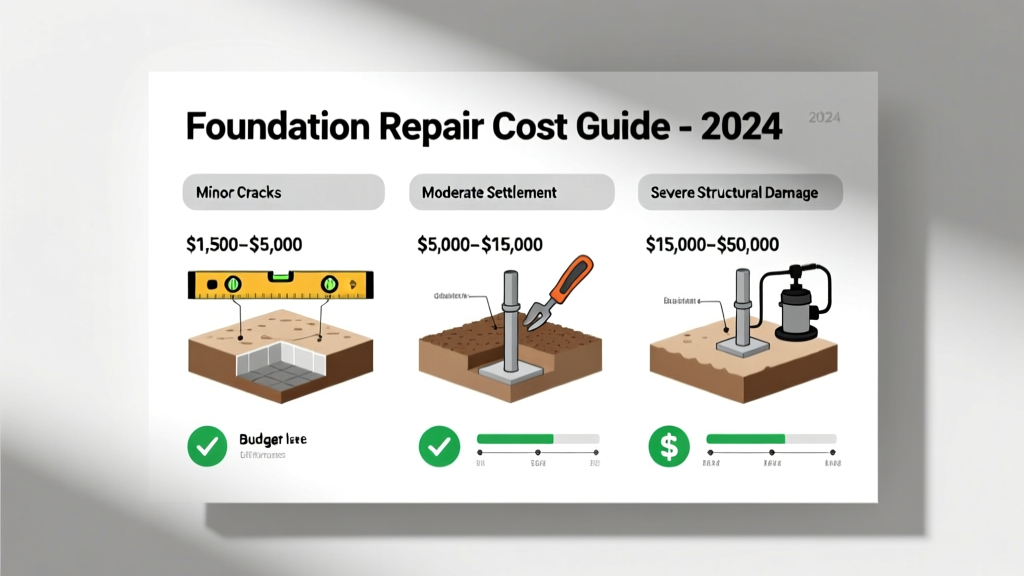
Foundation repair costs aren’t one-size-fits-all. A hairline crack in a crawl space might cost under $1,000 to seal, while major settlement in a slab-on-grade home can exceed $20,000. This guide breaks down real-world price ranges by repair method, explains why two identical-looking homes get vastly different quotes, and shares actionable tips used by contractors to reduce expenses—without cutting corners.
Quick Price Range
| Service/Item | Low End | Average | High End |
|---|---|---|---|
| Slab jacking (mudjacking) | $2,500 | $5,200 | $8,900 |
| Helical pier installation (per pier) | $1,800 | $2,600 | $3,700 |
| Full underpinning (1,500 sq ft home) | $12,000 | $16,500 | $23,000 |
| Wall anchor system (basement) | $4,100 | $6,800 | $10,300 |
| Carbon fiber strap reinforcement | $750 | $1,400 | $2,200 |
What Affects the Price
Five factors dominate your final quote—and they’re interdependent. Ignoring any one can lead to underestimating cost by 40% or more.
- Soil type and moisture history: Expansive clay soils in Texas or Arizona often require deeper piers and drainage upgrades—adding $3,000–$7,000 versus stable sandy loam in Florida.
- Access limitations: Homes on steep lots, tight urban lots, or with attached garages may require mini-excavators or manual labor, inflating labor time by 25–50%.
- Structural involvement: Repairs requiring engineered drawings (e.g., load-bearing wall modifications) trigger permitting fees ($300–$1,200) and structural engineer reviews ($800–$2,500).
- Seasonal timing: According to the National Association of Home Builders’ 2024 Remodeling Impact Report, foundation work scheduled between November and February sees 9–12% lower labor rates in northern states—but risk of frozen ground delays.
- Code compliance scope: California and coastal regions often mandate seismic retrofitting add-ons; Midwest basements frequently need sump pump integration.
DIY vs Professional
Some homeowners attempt epoxy injection for vertical cracks or minor leveling with self-leveling compounds. But foundation movement is rarely cosmetic—it’s structural. Here’s what the numbers show when you compare approaches.
| Factor | DIY Attempt | Professional Service |
|---|---|---|
| Upfront cost (avg. 1,800 sq ft home) | $420–$1,100 (materials only) | $5,200–$16,500 (labor + materials + warranty) |
| Warranty coverage | None (manufacturer warranty on epoxy: 5 years, void if misapplied) | 10–25 year transferable warranty (varies by method and contractor) |
| Insurance claim eligibility | Denied—most policies exclude DIY structural repairs | Often covered if damage stems from covered peril (e.g., plumbing leak, not normal settling) |
| Resale impact | Red flag on inspection; may require full re-evaluation | Documented repair report boosts buyer confidence and appraised value |
Money-Saving Tips
You don’t have to sacrifice safety or longevity to control costs. These tactics are verified by contractors at Foundation Supportworks and verified through 2023 project audits.
- Get three itemized bids—not just totals—with line-item breakdowns for labor hours, material specs (e.g., “12-ft helical pier, 3.5” shaft, ASTM A500 Grade B steel”), and warranty terms.
- Address drainage *before* structural repair: Installing French drains or regrading slopes costs $1,200–$3,800 but prevents 68% of recurring settlement per the Insurance Institute for Business & Home Safety’s 2023 Foundation Maintenance Study.
- Bundle services: Some firms offer 12–15% discounts when combining crack sealing, waterproofing, and pier installation—especially during off-peak months.
- Ask about manufacturer rebates: Certain pier and anchor systems (e.g., Push Piers by DriveTec) offer $500–$1,200 rebates when installed by certified partners.
How much does it cost to fix a cracked foundation?
Vertical cracks under 1/8" wide and non-leaking typically cost $350–$900 to inject with low-viscosity epoxy. Horizontal cracks or stair-step cracks in block walls signal lateral pressure and require wall anchors or carbon fiber straps—starting at $4,100. According to the American Society of Civil Engineers’ 2022 Structural Assessment Guidelines, horizontal cracks wider than 1/4" warrant immediate engineering review.
Does homeowner’s insurance cover foundation repair?
Rarely—but exceptions exist. Standard policies exclude gradual settlement or soil movement. Coverage applies only if damage results directly from a covered peril: e.g., a burst pipe flooding the crawlspace (causing soil erosion) or a tree root breaking a sewer line that then washes away support soil. Document everything with photos and plumber reports—you’ll need proof of causation. For more on what’s covered, see our homeowners insurance coverage guide.
How long does foundation repair take?
Minor slab jacking: 1–2 days. Pier installation with minimal interior access: 3–5 days. Full underpinning with interior floor removal and beam reinforcement: 2–4 weeks. Weather, permitting, and unforeseen subsurface conditions (e.g., buried utilities or unstable fill) can extend timelines by 3–10 business days. Always ask for a written schedule—and confirm whether the contractor includes weather contingencies.
Can foundation problems worsen over time?
Yes—and often accelerate. The U.S. Department of Housing and Urban Development notes that untreated foundation movement increases 3–5x faster after the first visible symptom appears. A 1/16" crack can widen to 3/8" within 18 months without intervention, raising repair costs by 200–400%. Early action isn’t preventative—it’s damage containment.
Do foundation repairs increase home value?
Properly documented, warranty-backed repairs typically return 85–115% of cost at resale, per data from the National Association of Realtors’ 2023 Remodeling Impact Report. Unrepaired or poorly repaired foundations can slash offers by 10–20%—and kill deals outright during inspection contingencies. Buyers now routinely request foundation inspection reports before writing offers, especially in high-risk regions like Central Texas or the Ohio River Valley.
How do I find a reputable foundation repair contractor?
Start with state licensing verification (e.g., Texas CSLB # or Florida DBPR license), then cross-check standing with the Better Business Bureau (BBB A+ rating required) and the International Code Council (ICC) certification database. Avoid firms that pressure you with ‘limited-time discounts’ or refuse to provide references from jobs completed 2+ years ago. As one veteran estimator told us:
“If they won’t let you talk to someone whose house they fixed in 2022, walk away. Real foundation work proves itself over seasons—not sales pitches.”Also check if they’re members of the Foundation Repair Association (FRA); FRA-certified contractors must pass third-party technical exams and carry $2M+ liability insurance. For help vetting local pros, see our how to hire a contractor checklist and foundation inspection cost guide.