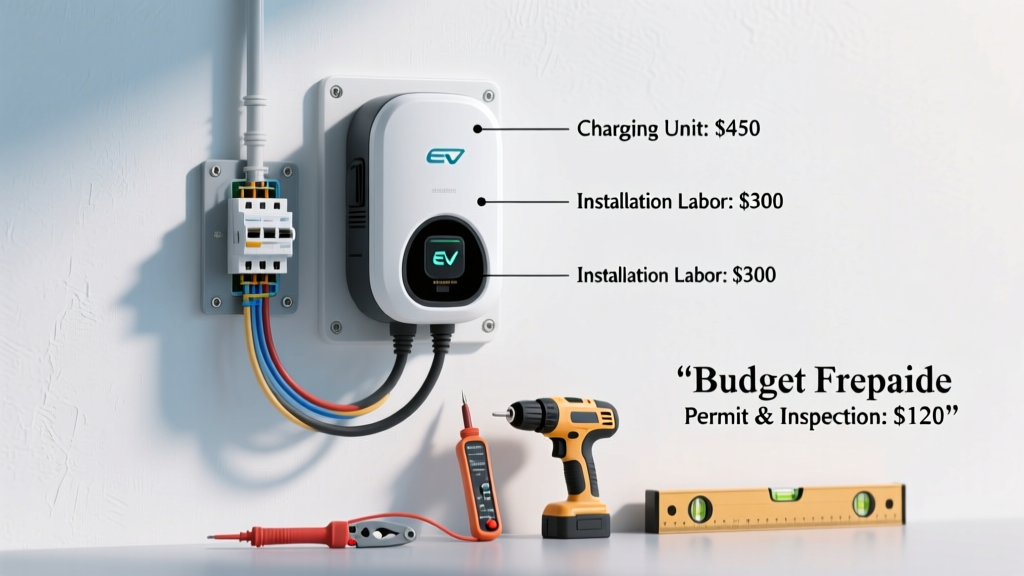
EV charger installation costs vary widely—from $300 to over $3,500—depending on your home’s electrical setup, charger type, and local labor rates. This guide breaks down real-world pricing, explains why one homeowner might pay $599 while another pays $2,850, and gives actionable tips to keep your project on budget.
Quick Price Range
| Service/Item | Low End | Average | High End |
|---|---|---|---|
| Level 2 charger unit only (240V, 32–48A) | $400 | $750 | $1,400 |
| Basic installation (existing 240V circuit, <25 ft run) | $300 | $650 | $950 |
| Full upgrade (new 100A subpanel + 50-ft conduit) | $1,800 | $2,600 | $3,700+ |
| Permitting & inspection fees (varies by jurisdiction) | $0 | $125 | $320 |
What Affects the Price
Four factors drive most of the variation in EV charger installation costs:
- Electrical panel capacity: If your main panel is at or near capacity, adding a 40–50A circuit may require a costly subpanel upgrade—or even a full panel replacement ($1,200–$2,500).
- Wiring distance and pathway: Running new 6/3 NM-B cable through an unfinished basement adds ~$15/ft; drilling through concrete or brick can add $200–$600 per penetration.
- Charger model and features: Wi-Fi-enabled units with load management (e.g., Emporia, JuiceBox) cost $200–$400 more than basic models like the Grizzl-E or Blink HQ 175.
- Local permitting and utility rules: Some cities (e.g., San Francisco, Seattle) require stamped engineering drawings for any new 240V circuit—adding $300–$600 in design fees.
DIY vs Professional Installation
While DIY is technically possible for experienced electricians, most homeowners lack the licensing, tools, or insurance to legally sign off on high-amperage work. Here’s how the numbers compare:
| Cost Component | DIY (if qualified) | Licensed Electrician |
|---|---|---|
| Charger unit | $599 | $599 |
| Labor (8–12 hrs) | $0 | $850–$1,350 |
| Permits & inspections | $125 (self-filed) | $125 (often bundled) |
| Insurance/liability risk | Uninsured — voids home insurance if fire occurs | Covered under contractor’s policy |
| Total estimated out-of-pocket | $724 | $1,574–$2,074 |
Money-Saving Tips
You don’t have to sacrifice safety or code compliance to cut costs. Try these proven strategies:
- Get 3 written quotes—and ask each contractor to itemize labor, materials, permits, and trip fees. According to the National Electrical Contractors Association’s 2023 Contractor Pricing Survey, 68% of homeowners who compared three bids saved at least $420.
- Install during off-peak seasons (late fall or winter). Some contractors offer 10–15% discounts when demand drops.
- Check for rebates before buying: Federal tax credits cover 30% up to $1,000, and utilities like PG&E and ConEdison offer $200–$500 instant rebates.
- Use an existing 240V outlet (e.g., dryer or oven circuit) with a NEMA 14-50 adapter—if your panel has spare capacity and the circuit is properly rated.
Do I need a permit for EV charger installation?
Yes—in nearly all U.S. jurisdictions. The National Electrical Code (NEC 2023) requires permits for any new 240V circuit, including EV chargers. Skipping it risks failed home inspections, insurance claim denials, and fines up to $2,000 in cities like Austin and Portland.
How long does EV charger installation take?
Most standard installations take 4–8 hours on-site. Complex jobs—like running conduit across a garage ceiling or upgrading a 60A panel to 200A—can take 1–3 days. Scheduling lead times average 2–6 weeks, especially in high-demand markets like California and Colorado.
Can my existing panel handle an EV charger?
It depends on your panel’s amperage and available breaker space. A licensed electrician will perform a load calculation per NEC Article 220. According to the U.S. Department of Energy’s 2024 Residential Electrification Report, 37% of homes built before 2000 require panel upgrades before adding EV charging.
Is a Level 2 charger worth the cost over a Level 1?
Absolutely—if you drive daily. A Level 1 (120V) charger adds ~4 miles of range per hour; a 40A Level 2 adds ~25 miles/hour. Over a year, that’s ~8,000 fewer charging hours and less battery degradation. As one master electrician told us:
“I’ve seen more ‘burnt-out’ Level 1 cords than any other EV-related failure—mostly from overheating during overnight use. Level 2 isn’t luxury—it’s longevity.” — Carlos M., NECA-certified contractor, Phoenix, AZ (2024)
Will installing an EV charger increase my home value?
Yes—studies show homes with EV infrastructure sell 5–7% faster and for ~2.7% more. Zillow’s 2023 Home Value Report found EV-ready homes commanded premiums averaging $6,200 in metro areas with strong EV adoption (e.g., Seattle, Denver, Austin).
What’s the difference between hardwired and plug-in EV chargers?
Hardwired units eliminate the NEMA 14-50 outlet, reducing fire risk and improving efficiency—but require more labor. Plug-in models offer flexibility (swap chargers easily) and simplify future upgrades. Most inspectors now prefer hardwired for permanent installations, especially above 40A.
If you’re planning a home electrification project, consider bundling your EV charger install with a solar + storage system or heat pump water heater. Many contractors offer package discounts of 8–12%, and coordinated permitting cuts approval time in half.