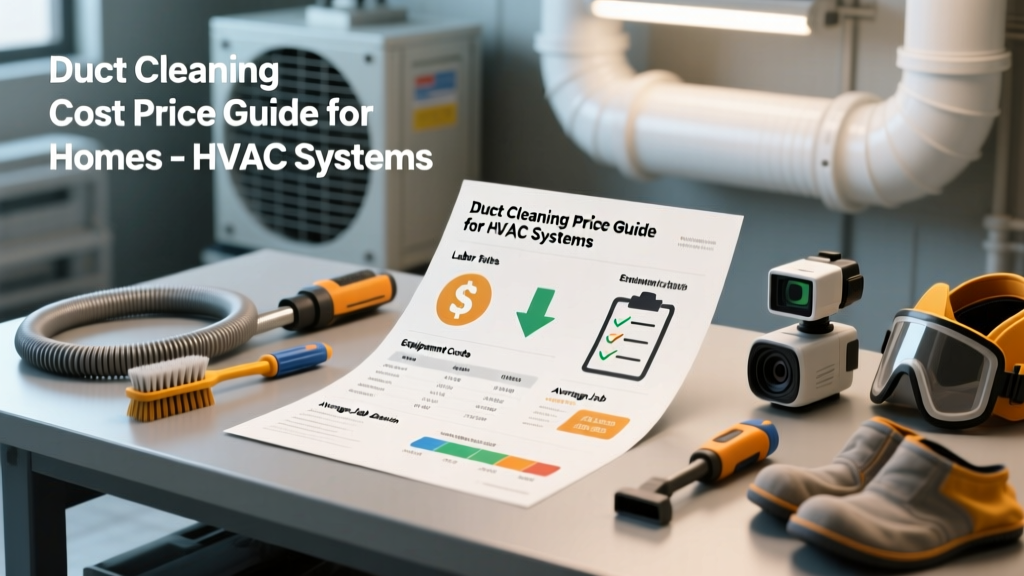
Duct cleaning prices swing wildly—from $300 to over $1,200—because no two homes or HVAC systems are identical. This guide breaks down actual service quotes, explains why a $450 job in a 1,800-sq-ft ranch differs from a $950 job in a dusty 3,200-sq-ft colonial, and shows you where contractors add value (or padding).
Quick Price Range
| Service/Item | Low End | Average | High End |
|---|---|---|---|
| Standard residential duct cleaning (up to 15 registers) | $295 | $475 | $695 |
| Full-system cleaning (ducts + coils + blower + dryer vent) | $595 | $825 | $1,250 |
| Post-renovation debris removal (drywall dust, sawdust) | $395 | $560 | $840 |
| Commercial duct cleaning (per 1,000 sq ft) | $650 | $920 | $1,480 |
What Affects the Price
Four core variables drive most pricing differences:
- Home size and duct complexity: A single-story 1,200-sq-ft condo with 8 registers typically costs 35% less than a 3-story home with 22 registers, dual-zone HVAC, and vertical risers.
- Contamination type: Surface dust is fast and cheap; rodent nesting, mold growth (requiring EPA-registered biocides), or construction debris demands extra labor, PPE, and disposal fees.
- Access limitations: Attic-mounted air handlers, crawl-space ducts, or sealed drywall soffits add $120–$280 in labor time—some firms charge hourly for access prep.
- Geographic labor rates: Median duct cleaning labor in Atlanta is $42/hour; in San Francisco, it’s $78/hour (U.S. Bureau of Labor Statistics, 2023).
DIY vs Professional
While DIY kits sell for $45–$120 online, they only clean accessible vents and short duct sections—not the main trunk lines where 80% of debris accumulates (National Air Duct Cleaners Association, 2022). Here’s the real trade-off:
| Factor | DIY Kit | Professional Service |
|---|---|---|
| Upfront cost | $45–$120 | $295–$1,250 |
| Time investment | 6–10 hours (with frustration) | 3–5 hours (technician on-site) |
| Cleaning depth | Vents + first 2 ft of duct | Entire system, including coils, drain pans, and blower assembly |
| Verification | No before/after photos or video | Most NADCA-certified firms provide inspection video and cleaning report |
Money-Saving Tips
You don’t have to skip duct cleaning—or overpay. Try these proven tactics:
- Bundle with HVAC tune-ups: Many local contractors offer $75–$150 discounts when you pair duct cleaning with seasonal HVAC tune-up.
- Ask for a flat rate—not hourly billing—especially if your home has known access challenges (e.g., tight attic hatches).
- Request a pre-cleaning inspection: Reputable companies like those certified by NADCA will assess contamination level and give a written quote before starting.
- Decline unnecessary add-ons: UV lights, sealants, and antimicrobial sprays rarely improve indoor air quality and inflate bills by $200–$450 without evidence-based ROI.
How often should ducts be cleaned?
The EPA doesn’t recommend routine duct cleaning unless you see visible mold, pest infestation, or excessive debris blowing from vents. Most homes need it only once every 5–8 years—if ever. If your filter hasn’t been changed in 6 months, fix that first—it’s cheaper and more effective than deep cleaning.
Does duct cleaning improve air quality or energy efficiency?
Not measurably, according to a 2021 study published in Indoor Air: researchers found no statistically significant change in PM2.5 levels or HVAC energy use after professional duct cleaning in 42 homes. That said, removing rodent nests or water-damaged insulation does prevent health hazards and airflow blockages.
Are duct cleaning scams common?
Yes—especially door-to-door “limited-time offers” quoting $99 for full-system cleaning. The Better Business Bureau logged 1,200+ duct cleaning complaints in 2023, mostly involving bait-and-switch pricing and unsubstantiated mold claims. Always verify license numbers and ask for proof of NADCA certification.
Can I negotiate the price?
Absolutely—especially off-season (April–September) or for referrals. One contractor in Austin told us,
“We’ll match any written quote from a licensed, insured competitor—but only if it includes itemized line items, not just ‘full system cleaning.’ Vague scopes hide corners we won’t cut.”
What’s included in a legitimate duct cleaning?
A proper job covers: supply and return registers, main trunk lines, air handler interior (blower wheel, evaporator coil, drain pan), and furnace heat exchanger surfaces. It excludes duct sealing (a separate service) and chemical treatments unless specifically requested and justified. Ask for the NADCA ACR standard checklist—it’s free to download and worth comparing against your quote.
Do landlords or insurance companies cover duct cleaning?
Rarely. Landlords aren’t required to clean ducts unless lease terms specify it or local housing codes mandate it (e.g., NYC Local Law 55). Homeowners insurance won’t pay for routine cleaning—but may cover mold remediation linked to a covered water loss, provided you file a claim first and get approval. For rental properties, consider adding duct inspection to your annual maintenance checklist.
If your last duct cleaning was tied to a renovation, flood, or unexplained allergy flare-ups, it’s likely time. But if your filters are clean, airflow feels strong, and no one’s coughing more in winter—you’re probably fine skipping it this year. Focus instead on replacing filters every 60 days and sealing duct leaks with mastic, which delivers faster ROI than cleaning alone.