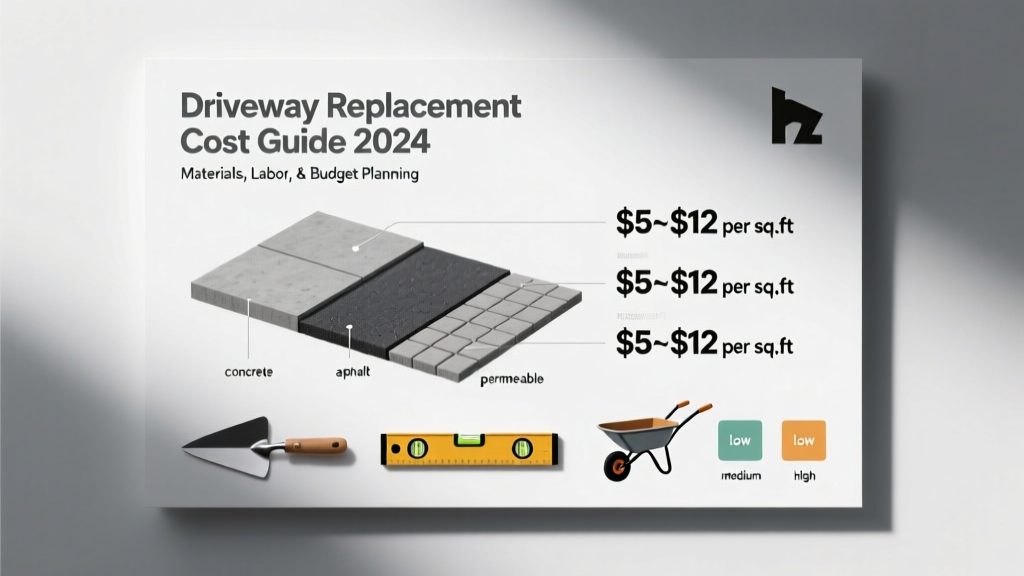
Driveway replacement costs vary widely—from $3,500 for a modest asphalt job to over $25,000 for stamped concrete with custom edging and grading. This guide breaks down actual 2024 pricing across materials, labor, site prep, and regional labor rates—so you can budget accurately before calling a contractor.
Quick Price Range
| Service/Item | Low End | Average | High End |
|---|---|---|---|
| Asphalt (basic, 2” thick, no major grading) | $3.50/sq ft | $5.25/sq ft | $7.80/sq ft |
| Concrete (standard 4” pour, broom finish) | $6.90/sq ft | $9.50/sq ft | $13.40/sq ft |
| Stamped Concrete (patterned, color, sealer) | $12.00/sq ft | $16.50/sq ft | $22.75/sq ft |
| Pavers (interlocking concrete, base included) | $14.50/sq ft | $19.25/sq ft | $27.00/sq ft |
| Crushed Gravel (3” base + 2” top layer) | $1.80/sq ft | $2.60/sq ft | $4.10/sq ft |
What Affects the Price
Four main variables shift your final quote more than material choice alone:
- Site preparation: Removing old pavement, hauling debris, and fixing subsoil drainage can add $1,200–$4,800. The Insurance Institute for Business & Home Safety’s 2023 report found that 68% of failed driveways had underlying compaction or slope issues ignored during initial install.
- Driveway dimensions and slope: Steeper grades require extra grading, retaining walls, or stepped pours—adding up to 22% in labor time. A 12’ x 50’ (600 sq ft) driveway is standard; going beyond 800 sq ft often triggers bulk-rate discounts—but only if soil and access allow.
- Regional labor rates: Contractors in metro areas like Boston or Seattle charge 34–41% more per hour than those in rural Tennessee or Iowa, per the U.S. Bureau of Labor Statistics’ May 2023 wage data.
- Permits and inspections: Required in 31 states for concrete or paver jobs over 500 sq ft. Fees range from $75 (rural county) to $420 (Portland, OR), and delays cost $180–$320/day in idle crew time.
DIY vs Professional
While gravel or simple asphalt patching may be DIY-able, full replacement almost always requires pros—especially for concrete, pavers, or anything needing excavation or compaction. Here’s why:
| Factor | DIY Attempt | Licensed Contractor |
|---|---|---|
| Material cost (asphalt) | $1,650 | $1,920 |
| Rental equipment (roller, plate compactor, etc.) | $320 (3-day rental) | Included in labor |
| Labor time (self) | 120+ hours (weekends + vacation days) | 2–4 days on-site |
| Warranty | None | 2–5 years (material + workmanship) |
| Hidden risk | Cracking within 18 months due to poor compaction or joint sealing | Guaranteed slope, drainage, and curing protocols |
Money-Saving Tips
You don’t need to sacrifice durability to save money—just prioritize smart trade-offs:
- Time your project for fall (September–October): Asphalt plants run at capacity in summer, but off-season demand means 8–12% lower quotes and faster scheduling.
- Reuse existing base where possible: A certified contractor can test your current sub-base with a CBR (California Bearing Ratio) test—if it scores ≥80%, you’ll skip full excavation and save $2,100–$3,400.
- Choose broom-finish concrete instead of stamped: You’ll save $7–$10/sq ft and gain the same longevity—plus easier snow removal in winter climates.
- Get three itemized bids—not just totals. Compare line items for “subgrade prep,” “rebar/mesh,” and “sealing” to spot inflated or omitted costs.
How much does a 2-car driveway replacement cost?
A standard 2-car driveway measures 20’ x 40’ (800 sq ft). At national averages: asphalt runs $4,200–$6,240; concrete $5,520–$10,720; pavers $11,600–$21,600. Add $1,500–$3,000 for demolition and grading if the old surface is cracked or sunken.
Does driveway replacement increase home value?
Yes—but ROI depends on material and neighborhood. According to Remodeling Magazine’s 2023 Cost vs. Value Report, asphalt replacement recoups 62% nationally, while decorative pavers recoup 74% in high-end ZIP codes (e.g., home renovation ROI peaks where curb appeal drives buyer competition).
How long does driveway replacement take?
Most residential jobs wrap in 3–6 days: Day 1–2 for demo and grading; Day 3 for base lay and compaction; Day 4 for pour or paving; Days 5–6 for curing, sealing, and cleanup. Concrete needs 7 days before vehicle use; asphalt, 48–72 hours. Rain or frost delays add 2–5 days—always confirm weather contingencies in your contract.
Can I replace just part of my driveway?
Yes—if damage is localized (e.g., one corner heaved by tree roots). Partial replacement costs 40–60% of full replacement but risks mismatched color, texture, or settling. For concrete, cold joints weaken structural integrity over time. Asphalt patches often fade differently. We recommend full replacement if >30% is compromised—or if your driveway is over 15 years old (asphalt driveway lifespan rarely exceeds 20 years without major rehab).
What’s the cheapest durable option?
Crushed gravel is lowest upfront ($1,080–$2,460 for 600 sq ft), but requires annual regrading and edge maintenance. For true durability with low lifetime cost, 4” reinforced concrete is the best value: $5,700–$8,040 installed, lasting 30+ years with basic sealing every 5 years. As
“A properly compacted, well-drained concrete driveway outperforms all alternatives on 20-year cost-per-use—especially when factoring in snow plow damage and resurfacing cycles.” — Dr. Lena Cho, Civil Engineering Dept., Purdue University, 2022
Do I need a permit for driveway replacement?
It depends on your municipality—but yes, if you’re changing material type, altering slope, adding curbing, or working near a public right-of-way. Most cities require permits for concrete or paver installs over 500 sq ft. Skip it, and you risk fines up to $2,500 or being forced to tear out and redo work. Check with your local building department before signing any contract—many contractors will handle this for you (for a $125–$300 fee).
Replacing your driveway is a significant investment—but one with measurable safety, functionality, and resale benefits. Focus on proven materials, verified contractors with insurance and references, and timing that avoids peak-season markups. And if you’re weighing options, compare not just first cost but also concrete vs asphalt driveway longevity and climate suitability before committing.