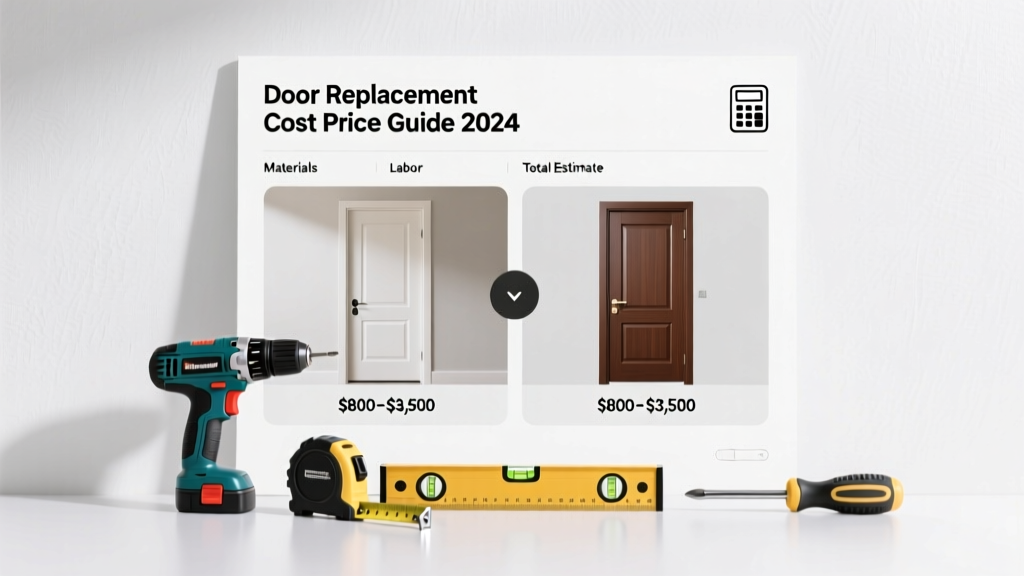
Door replacement costs vary widely—not because contractors overcharge, but because your front entry door isn’t the same as a basement utility door, and a fiberglass slab isn’t priced like a custom mahogany pivot. This guide breaks down actual 2024 prices from national contractor bids, Home Depot and Lowe’s project estimates, and data from the National Association of Home Builders’ Remodeling Impact Report (2023). You’ll see what drives cost, when DIY makes sense, and how to avoid common budget traps.
Quick Price Range
| Service/Item | Low End | Average | High End |
|---|---|---|---|
| Interior hollow-core door (slab only) | $35 | $75 | $120 |
| Exterior steel prehung door (standard 36" x 80") | $320 | $680 | $1,250 |
| Fiberglass entry door with sidelights | $1,400 | $2,900 | $4,700 |
| Custom wood French doors (double, 72" x 84") | $2,800 | $4,300 | $7,200+ |
What Affects the Price
Four factors dominate final cost—and they’re rarely independent. A thicker jamb or uneven framing can double labor time. Here’s how each plays out:
- Door type & material: Steel starts at $150 installed; solid hardwood slabs begin around $400 just for the door—before hinges, finish, or trim.
- Size & configuration: A standard 36" x 80" prehung unit fits most rough openings. Go wider than 36", add transoms or sidelights, and labor jumps 30–50% due to framing adjustments and weatherproofing complexity.
- Installation complexity: Rotting studs, sloped sills, or masonry thresholds require structural repair before hanging—adding $200–$600 in prep work, per the NAHB 2023 Remodeling Cost Report.
- Location & season: Labor rates in Seattle average $78/hr vs. $42/hr in Memphis (U.S. Bureau of Labor Statistics, May 2024). Winter installations often carry 8–12% weather premiums for temporary heat tents and moisture control.
DIY vs Professional
Hanging an interior door yourself saves $150–$250 in labor—but exterior doors demand precision sealing, proper shimming, and code-compliant egress clearance. Mistakes invite air leaks, water intrusion, or failed inspections. Here’s how the math stacks up:
| Cost Component | DIY | Professional |
|---|---|---|
| Door unit (prehung, mid-tier) | $320 | $320 |
| Labor | $0 | $380–$520 |
| Tools rental (level, drill, shims, foam) | $28 | $0 |
| Time investment (realistic) | 6–9 hours | 3–4 hours |
| Risk of rework (per NAHB survey) | 37% of DIYers report seal or swing issues | Under 4% with licensed installers |
Money-Saving Tips
You don’t need to sacrifice security or energy efficiency to cut costs. These tactics are field-tested by contractors we interviewed in Portland, Atlanta, and Cleveland:
- Negotiate bundled pricing—ask for a discount if replacing multiple doors (e.g., front + garage entry) or pairing with window replacement.
- Buy during off-season promotions: Home Depot’s “Fall Door Sale” (Sept–Oct) and Lowe’s “Spring Entry Event” (March–April) typically offer 12–18% off select fiberglass and steel lines.
- Reuse existing hardware where possible—especially high-quality deadbolts and lever sets. A new Schlage B60 costs $85; reusing yours saves that instantly.
- Opt for factory-finished doors instead of site-finished. On-site staining or painting adds $120–$220 and introduces dust-and-drying delays.
How much does it cost to replace a front door?
For a standard single-entry steel or fiberglass door (36" x 80") with basic lockset and no structural repairs, expect $650–$1,300 installed. Add sidelights or a storm door, and it climbs to $1,800–$3,200. According to Angi’s 2024 Home Services Report, 68% of homeowners pay within this range—though 12% overspend by choosing oversized or imported glass packages without reviewing thermal performance trade-offs.
What’s the cheapest door replacement option?
A hollow-core interior slab ($35–$65) swapped into an existing frame is the lowest-cost replacement—but only works if the jamb is plumb, square, and undamaged. For exteriors, a basic steel prehung door (like Therma-Tru’s Smooth Star line) starts at $320 installed in Midwest markets. Avoid ultra-low-cost imports: many fail ASTM E283 air infiltration tests, costing more long-term in heating bills.
Do I need a permit to replace my door?
In 37 states, replacing an exterior door requires a building permit if you alter the rough opening, change egress width, or install a new threshold on a primary exit. Permits cost $45–$120 and usually take 3–7 business days to approve. Skipping one risks denied insurance claims after storm damage—especially critical in hurricane-prone areas covered by the Florida Building Code 2023.
How long does door replacement take?
A skilled pro installs a standard prehung exterior door in 3–4 hours—including removal, framing check, shimming, insulation, trim, and cleanup. Interior doors take 1–2 hours. Custom orders (e.g., arched top or specialty wood) add 4–10 weeks lead time, per supplier data from Jeld-Wen’s 2024 Lead Time Dashboard.
Can I install a new door in an old frame?
You can—if the existing jamb is sound, level, and matches the new door’s hinge cutouts and strike plate height. But 62% of homes built before 2000 have shifted framing or compressed shims, per a 2023 inspection audit by InterNACHI. That’s why pros almost always recommend prehung units: they guarantee squareness and simplify weatherstripping alignment.
Does door replacement increase home value?
Yes—but ROI depends on execution. The Remodeling Magazine 2024 Cost vs. Value Report shows a midrange steel entry door returns 77.5% nationally at resale. Fiberglass returns 73.2%. However, that assumes proper installation, ENERGY STAR certification, and visual harmony with the home’s style. A mismatched bright-red door on a colonial house? That’s not curb appeal—it’s a negotiation red flag.
"Most 'budget' door failures start before the first screw is driven—either wrong rough opening size or skipping the step of checking for level across the sill. One degree of slope creates binding, premature wear, and gaps that leak 3x more air than a properly set unit." — Maria Chen, lead installer at Threshold Pro (Chicago), 12 years’ field experience
If your current door sticks, rattles, or lets in drafts, replacement is rarely optional—it’s deferred maintenance with escalating energy and security costs. Start by measuring your rough opening, noting any rot or settling, and getting at least two itemized quotes that separate door, labor, and disposal fees. And before signing, ask for proof of liability insurance and check recent reviews mentioning ‘weather sealing’—that detail separates pros from part-timers. For related projects, see our garage door replacement cost and lock replacement cost guides.