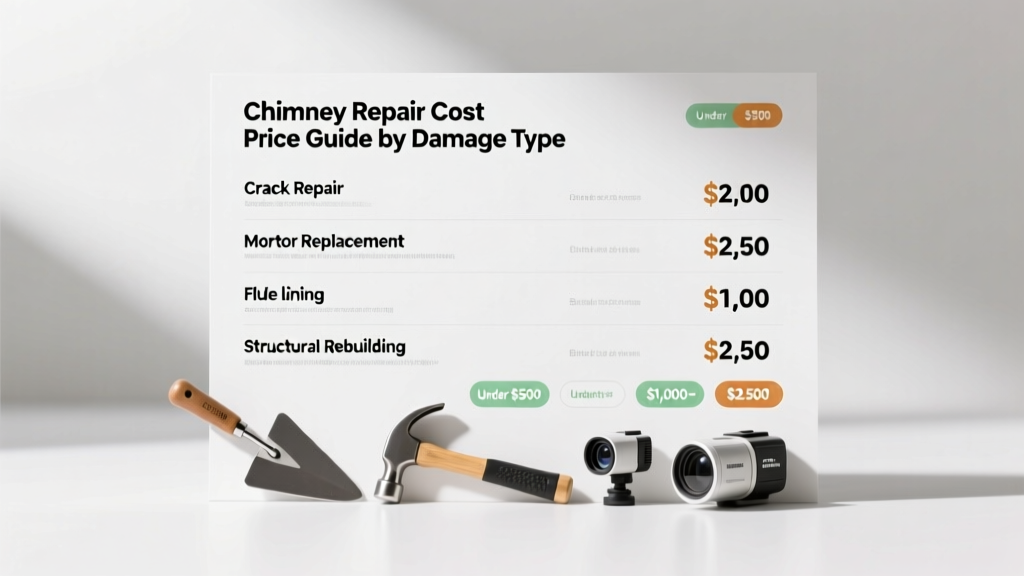
Chimney repair costs swing wildly—not because contractors overcharge, but because a hairline mortar joint crack costs less than half a day’s labor, while a collapsed flue liner or leaning chimney demands structural engineering. This guide breaks down real-world prices from licensed masons and chimney sweeps, explains why your quote might differ from your neighbor’s, and shows where you can save without risking fire or carbon monoxide exposure.
Quick Price Range
| Service/Item | Low End | Average | High End |
|---|---|---|---|
| Mortar repointing (10 ft section) | $150 | $375 | $650 |
| Chimney cap replacement | $120 | $280 | $490 |
| Flue liner patch or relining (stainless steel) | $1,200 | $2,900 | $5,600 |
| Chimney crown repair | $220 | $520 | $980 |
| Full chimney rebuild (30 ft masonry) | $6,200 | $9,400 | $12,000+ |
What Affects the Price
Five key variables determine your final bill—some controllable, others not:
- Damage severity: Surface-level spalling bricks cost ~$18–$25 per brick to replace; full brick replacement with structural reinforcement adds $85–$140 per unit.
- Chimney height & accessibility: Scaffolding for a 35-ft chimney adds $450–$1,100; roof pitch over 8:12 often triggers a 15–20% labor surcharge.
- Material match: Matching historic tuckpointing mortar or salvaged clay flue tiles can increase labor time by 30–50% and raise material costs 2–3×.
- Code compliance: Post-2021 IRC requires stainless-steel liners for wood-burning inserts—even if your existing clay liner looks intact. That upgrade alone adds $1,200–$3,500.
- Geographic labor rates: Masons in metro Boston average $95/hr vs. $62/hr in rural Tennessee (National Association of Home Builders, 2024 Wage Survey).
DIY vs Professional
Some repairs tempt homeowners—especially repointing or cap installation—but missteps risk fire code violations, voided insurance claims, or carbon monoxide leaks. Here’s what’s realistically DIY-able versus when to call a pro:
| Task | DIY Cost | Pro Cost | Risk if Done Improperly |
|---|---|---|---|
| Clean creosote buildup (Level 1) | $45 (brush kit) | $125–$220 | Ignition risk; violates NFPA 211 standard if unverified |
| Install basic chimney cap | $75–$140 (cap + sealant) | $220–$490 | Improper fit → water intrusion → freeze-thaw damage within 1 season |
| Repoint mortar joints | $60 (mortar + tools) | $375–$650 | Wrong mortar mix → efflorescence, cracking, or brick spalling in 2–3 years |
| Replace cracked flue tile | Not recommended | $1,800–$4,200 | Gas leak path; failed inspection; potential CO poisoning |
Money-Saving Tips
You don’t need to sacrifice safety to control costs. These tactics are proven to lower bills without cutting corners:
- Bundle services: Schedule chimney sweeping and minor repointing together—many sweep companies offer 10–15% off combo packages.
- Time it right: Book repairs in late spring or early fall. Winter demand spikes labor costs 12–18%; summer heat slows mortar curing, risking rework.
- Get three itemized quotes: Not just totals—ask for line items like “scaffolding,” “debris removal,” and “flue inspection.” One contractor quoted $2,100 for liner relining included $380 for “structural assessment”—which wasn’t needed for a Level 1 inspection (CSIA-certified inspectors charge $125–$175 separately).
- Repair early: A $220 crown crack grows into $1,400+ masonry deterioration within 18 months due to water infiltration (Chimney Safety Institute of America, 2023 Field Audit).
How much does a chimney crown repair cost?
Crown repairs range from $220 for a small surface crack sealed with elastomeric coating to $980 for full demolition and reinforced concrete replacement. The price jumps sharply if water damage has compromised the underlying chimney structure—requiring brick replacement or flashing reintegration.
What’s the average cost to reline a chimney flue?
Stainless-steel flexible liner installation runs $1,200–$5,600, depending on chimney height, diameter, and whether insulation is added (required for gas inserts). Rigid liners cost 25–40% more but last 30+ years vs. 15–20 for flexible. According to the Chimney Safety Institute of America’s 2024 Relining Benchmark Report, 68% of failed liners were installed without proper insulation or support brackets.
Is chimney waterproofing worth the cost?
Yes—if done correctly. A quality silane-siloxane sealer costs $2.50–$4.20/sq ft applied by a certified technician. It extends mortar life by 5–7 years and prevents freeze-thaw spalling. Skip the big-box store sprays: they clog pores and trap moisture, accelerating decay. For context, the U.S. Department of Energy estimates that untreated masonry chimneys lose 22% more heat year-over-year due to micro-crack moisture absorption.
Why does mortar repointing cost so much?
It’s not the mortar—it’s the labor. Repointing requires removing old mortar to ¾” depth, dampening bricks, applying new Type N or Type O mortar (not cement-based), tooling joints, and curing for 72 hours. Skilled masons charge $65–$95/hr, and a 10-ft section takes 6–9 hours. Rush jobs using premixed cement mortar fail within 2 seasons—costing more long-term.
Do I need a permit for chimney repair?
In 37 states and most municipalities, yes—for any structural change (crown rebuild, liner install, height modification) or work affecting fire separation. Permits cost $50–$220 and require inspections. Skipping one may void your homeowner’s insurance if a fire traces back to unpermitted work. Check your local building department—many offer free pre-submission reviews to avoid plan rejection delays.
Can I repair chimney flashing myself?
Minor aluminum flashing touch-ups (e.g., resealing a loose edge) are feasible with roofing cement and 24-gauge aluminum. But full replacement—especially step-flashing integration with shingles—requires precise layering and slope alignment. A misaligned flashing seam causes leaks that mimic chimney crown failure, leading to $3,000+ drywall and framing repairs. Licensed roofers charge $280–$620 for complete chimney flashing replacement, including tear-out and underlayment integration.
"Mortar that looks 'fine' at eye level often hides 2–3 inches of decay behind the surface. A CSIA-certified Level 2 inspection—including borescope imaging—is non-negotiable before quoting major repairs." — Mike Torres, CSIA Master Chimney Sweep (2024)
Chimney repair isn’t about choosing the cheapest bid—it’s about matching the solution to the root cause, meeting code, and preserving your home’s thermal envelope and safety. Start with a certified inspection, prioritize water intrusion fixes first (they cause 83% of long-term masonry failure), and always verify contractor licensing through your state’s chimney sweep certification database. If your quote includes vague line items like 'miscellaneous materials' or 'site prep,' ask for clarification—transparency separates pros from red flags.