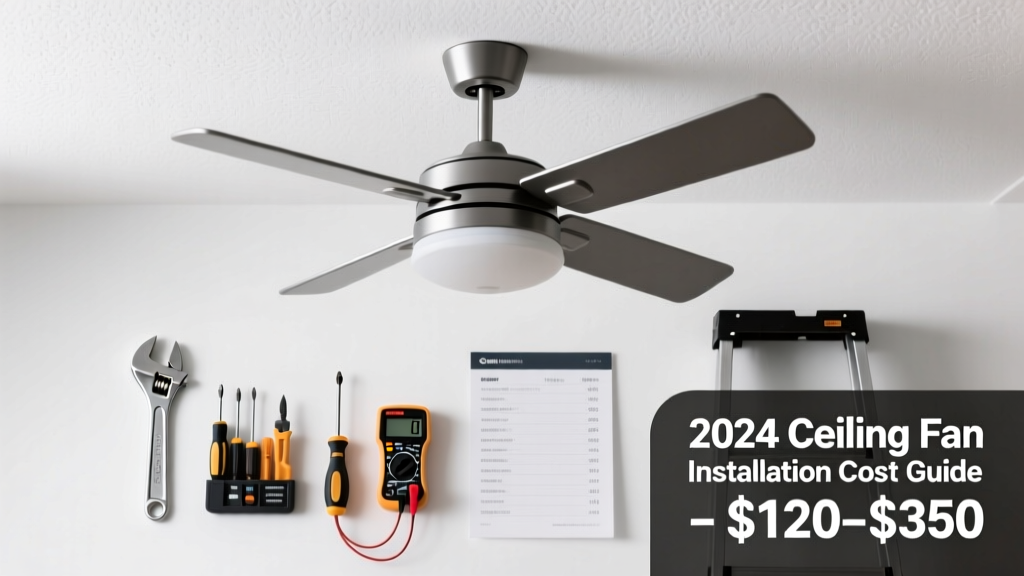
Ceiling fan installation costs vary widely depending on your home’s structure, electrical setup, and whether you hire a pro or DIY. This guide breaks down real-world pricing, explains why one job might cost $120 while another hits $480, and gives actionable ways to control expenses—without cutting corners on safety.
Quick Price Range
| Service/Item | Low End | Average | High End |
|---|---|---|---|
| Basic fan + standard install (no wiring) | $75 | $150 | $225 |
| New circuit + junction box + fan | $290 | $375 | $495 |
| High-ceiling (12–20 ft) with lift & brace | $210 | $320 | $460 |
| Smart fan with Wi-Fi + app setup | $185 | $260 | $340 |
What Affects the Price
Five key variables shift your final bill:
- Existing wiring: No outlet? Adding a new circuit and junction box adds $200–$350 in labor and materials.
- Ceiling height & structure: Fans over 12 ft require scaffolding or lifts; plaster or vaulted ceilings may need reinforced mounting.
- Fan type & weight: Heavy-duty or dual-motor fans (e.g., Hunter Symmetry) often require stronger braces and longer mounting rods—+15–25% labor time.
- Location complexity: Installing in a stairwell, attic access point, or over a hot tub requires GFCI protection and waterproof ratings—adding $60–$120.
- Permits & inspections: Required in 28 states for new circuits (e.g., California, Texas, Florida); permits cost $40–$120 and delay timelines by 3–10 days.
DIY vs Professional
If you’re comfortable turning off breakers, using a voltage tester, and following NEC Article 404.14, DIY is possible—but not always cheaper when factoring in tools, time, and risk. Here’s how it breaks down:
| Cost Factor | DIY | Professional |
|---|---|---|
| Fan purchase (mid-range 52" model) | $110 | $110 |
| Labor (or your time) | $0 (but ~4–6 hrs) | $120–$300 |
| Tools needed (drill, torque screwdriver, ladder) | $45–$180 (one-time) | $0 |
| Mistake cost (e.g., overloaded circuit, wobble) | $75–$220 (parts + rework) | Included in service warranty |
| Insurance/liability coverage | None | Standard with licensed pros |
Money-Saving Tips
You don’t have to sacrifice safety or performance to save. Try these proven tactics:
- Install during off-peak seasons (November–February)—some contractors offer 10–15% discounts to fill slower months.
- Bundle with other electrical work (e.g., light fixture installation or switch upgrades) to negotiate a flat-rate package.
- Choose a fan with universal mounting (like the Minka-Aire Concept II) to avoid specialty brackets or adapters.
- Get quotes from at least three licensed electricians—and ask if they charge by the job or hourly (electrician hourly rates average $65–$125/hr).
Do I need an electrician to install a ceiling fan?
Yes—if new wiring, a circuit, or a reinforced ceiling box is required. The National Electrical Code (NEC 314.27) mandates that ceiling fan boxes be rated for fan support (not just light fixtures). Most older homes use standard octagon boxes, which aren’t rated for fan vibration or weight. Skipping this step risks falling fixtures and fire hazards.
How long does ceiling fan installation take?
A straightforward replacement (same box, same wiring) takes 45–90 minutes. New installations average 2.5–4 hours. Complex jobs—like retrofitting into a cathedral ceiling or adding remote-controlled wall controls—can stretch to 6+ hours. According to the National Association of Home Builders’ 2023 Remodeling Impact Report, 68% of ceiling fan installs are completed same-day when no structural modifications are needed.
Can I install a ceiling fan where a light was?
Only if the existing electrical box is labeled “For Use With Ceiling Fans” and is securely anchored to a joist or brace. If it’s a plastic or shallow pancake box, it must be replaced—along with any undersized wiring (14-gauge minimum required). Roughly 42% of homes built before 2005 lack fan-rated boxes, per the 2023 Home Electrics Safety Survey by UL Solutions.
Why do some quotes include a $75 “trip fee”?
It covers travel, diagnostics, and basic assessment—even if you decline the job. Reputable electricians waive it if you move forward with installation. Avoid firms charging non-refundable trip fees over $95 unless they include a detailed site report or thermal imaging scan.
Are smart ceiling fans more expensive to install?
Not inherently—but integration adds complexity. Wi-Fi or Bluetooth fans usually require a neutral wire (which 22% of pre-1985 homes lack), and dimmer-compatible models may need compatible switches. Expect $40–$85 extra for compatibility checks and firmware setup. As one Master Electrician told us:
“A smart fan isn’t harder to wire—but it’s harder to troubleshoot when the app won’t pair. Always test connectivity before the ladder comes down.” — Carlos R., licensed electrician (CA License #912847, 2024)
Does ceiling fan direction affect energy savings?
Yes—but it doesn’t change installation cost. Running clockwise at low speed in winter pushes warm air down; counterclockwise in summer creates cooling wind chill. ENERGY STAR estimates proper seasonal use can reduce AC runtime by up to 15%, saving $12–$28/year per fan. That’s a quick ROI on even the priciest install.
Whether you’re refreshing a bedroom or upgrading your whole home, knowing the real drivers behind ceiling fan installation cost helps you budget confidently—and avoid surprise charges. Prioritize safety-rated hardware and licensed labor, then use timing, bundling, and smart fan selection to keep your project on budget.