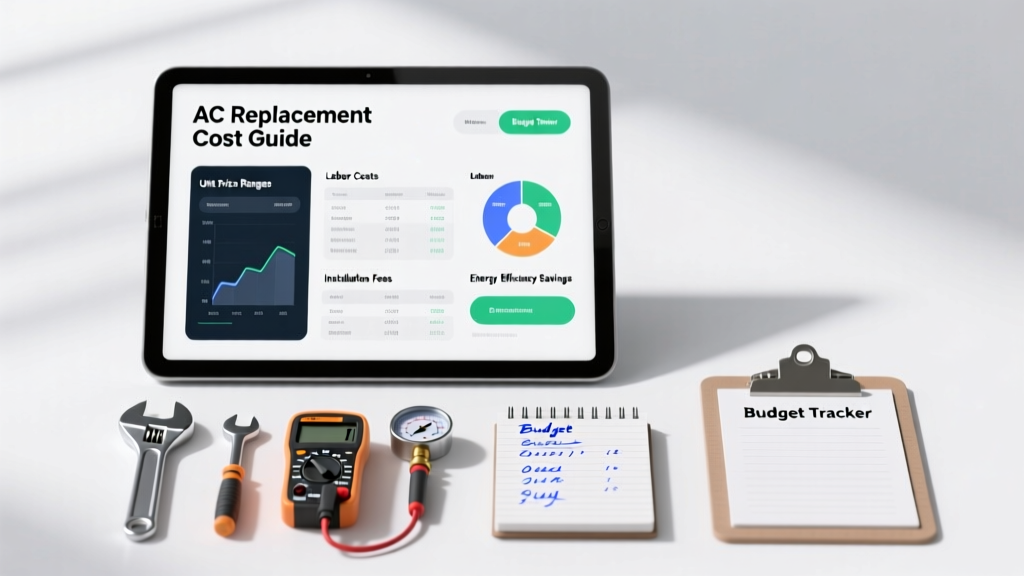
Replacing a central air conditioning system isn’t like swapping a lightbulb—it’s a major home investment with wide price swings. Your final cost depends on equipment specs, labor rates in your region, ductwork condition, and even local permitting rules. This guide breaks down real-world pricing, explains why two identical homes might pay $3,800 versus $12,500, and shares actionable ways to trim the bill—without cutting corners on safety or performance.
Quick Price Range
| Service/Item | Low End | Average | High End |
|---|---|---|---|
| New condenser + air handler | $3,200 | $6,800 | $11,500 |
| Labor (8–12 hrs) | $1,100 | $2,400 | $4,200 |
| Ductwork repair/replacement | $0 | $1,600 | $5,300 |
| Permitting & inspections | $75 | $225 | $480 |
| Disposal of old unit | $75 | $150 | $300 |
What Affects the Price
Five key variables move the needle on your final quote:
- SEER rating: Upgrading from a 10-SEER to a 16-SEER unit adds $1,200–$2,600—but cuts cooling costs by up to 37%, per the U.S. Department of Energy’s 2023 SEER analysis.
- Unit size (tons): Oversizing leads to short cycling; undersizing strains the system. A load calculation (Manual J) is required by code in most states—and skipping it can void warranties.
- Brand & features: Carrier and Trane premium models include variable-speed compressors and smart diagnostics; Lennox and Goodman offer strong mid-tier value. Brand alone can shift equipment cost by $1,800+.
- Home accessibility: Attic-mounted air handlers or crawl-space condensers add $300–$900 in labor due to rigging, lift rentals, or confined-space safety protocols.
- Regional labor rates: HVAC techs in Boston charge 2.3× more per hour than those in Memphis, according to the Bureau of Labor Statistics’ 2024 wage survey.
DIY vs Professional Installation
While DIY AC replacement sounds tempting—especially with YouTube tutorials—it’s unsafe, illegal in 48 states without EPA Section 608 certification, and voids manufacturer warranties. Here’s why hiring pros pays off long-term:
| Factor | DIY Attempt | Licensed Contractor |
|---|---|---|
| Equipment cost only | $2,900 | $2,900 |
| Refrigerant handling & evacuation | Not permitted (EPA violation) | Included ($320–$580) |
| Warranty coverage | None (parts-only, if any) | 10-year parts + 5-year labor standard |
| Code compliance & permits | Failed inspection = $1,200 rework | Handled in-house, no delays |
| Total realistic cost | $4,100+ + fines + failure risk | $6,200–$8,400 (fully covered) |
Money-Saving Tips
You don’t have to sacrifice quality to save. These strategies are proven to reduce total cost by 12–22%:
- Get at least three written quotes—each must itemize labor, equipment, and disposal. Watch for line items like "trip fee" or "refrigerant recovery" that inflate bills.
- Time your purchase during spring (March–May). Contractors have lighter schedules and often run promotions before peak summer demand hits.
- Ask about utility rebates: Programs like Mass Save (MA) and SoCalGas offer $500–$1,200 for ENERGY STAR® units meeting regional efficiency thresholds.
- Reuse existing copper lines if they’re clean, dry, and properly sized—cuts $280–$450. But never reuse R-22 lines with R-410A systems; moisture contamination causes compressor failure.
- Bundle with furnace replacement: Many contractors discount $600–$900 when replacing both systems simultaneously.
How much does a 3-ton AC unit cost installed?
A 3-ton system—the most common residential size—averages $6,200 installed in the Midwest, but climbs to $9,400 in coastal California due to higher labor, permit, and seismic bracing requirements. According to the ACCA’s 2023 Residential HVAC Cost Report, 68% of homeowners paid between $5,900 and $8,100 for this size.
Does AC replacement include ductwork?
No—it’s almost always quoted separately. If your ducts leak >20% (common in homes over 15 years old), upgrading them adds value: The U.S. EPA estimates duct sealing alone improves system efficiency by 15–20%. Skipping duct work on an old system can slash your new AC’s lifespan by 3–5 years.
Can I finance my AC replacement?
Yes—and wisely. Look for 0% APR offers lasting 12–60 months through contractor partnerships (e.g., Wells Fargo Home Projects card) or utility programs. Avoid rent-to-own or high-interest “instant approval” loans: Those average 29.9% APR and double total cost. Credit unions often offer fixed-rate HVAC loans at 7.5–10.5%.
How long does AC replacement take?
Most full-system replacements wrap up in one day—8 to 10 hours—if ducts and electrical panels are ready. Add 1–3 days if ducts need lining, the main disconnect requires upgrading, or city inspections delay sign-off. Rain or extreme heat may push timelines by 24 hours.
What’s included in a standard AC replacement?
A true standard replacement includes: removal/disposal of old condenser and air handler; installation of new matched components; refrigerant charging and evacuation; electrical connections; thermostat compatibility check; and startup verification. It does not include duct cleaning, extended warranty upgrades, or smart thermostat bundles—those are add-ons.
Is it cheaper to replace just the outdoor unit?
Rarely—and usually unwise. Mismatched indoor/outdoor units cause inefficiency, noise, and premature failure. AHRI certifies only matched systems. Replacing only the condenser saves ~$1,400 upfront but risks $2,800+ in repairs within 2 years. As HVAC contractor Maria Chen told us:
"I’ve seen five 'condenser-only' jobs this year end in full system replacement before the warranty expired—because the old coil couldn’t handle the new refrigerant flow."
If your air handler is under 8 years old and matches the new condenser’s refrigerant type and airflow specs, partial replacement *might* work—but only after a certified technician performs a full compatibility assessment. Don’t guess. Your comfort and utility bills depend on it.