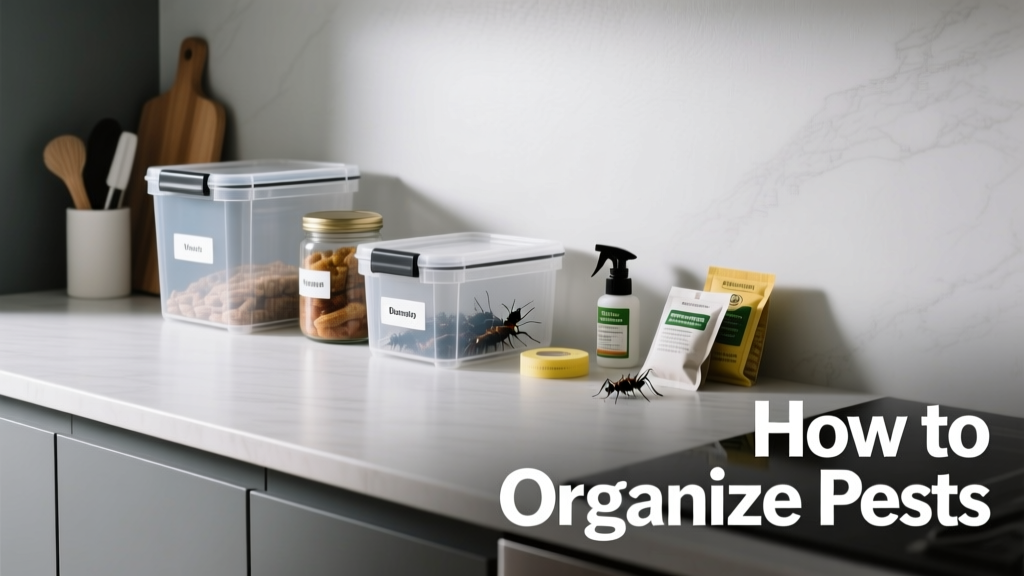
Why Organizing Pest Control Is Non-Negotiable
Pest infestations don’t announce themselves with calendar invites—but they do follow predictable seasonal patterns, structural vulnerabilities, and behavioral triggers. Disorganized responses lead to repeated treatments, pesticide overuse, regulatory noncompliance, and preventable property damage. In 2023, the U.S. Environmental Protection Agency recorded 1,842 pesticide misuse incidents linked to poor recordkeeping or misapplied formulations—73% involving residential applicators without standardized organization systems. This article delivers a field-tested, actionable framework for organizing pest control across three domains: prevention scheduling, chemical and non-chemical inventory management, and documentation rigor. It draws on real-world data from the National Pest Management Association (NPMA) 2024 Field Survey, peer-reviewed entomology studies, and verified performance metrics from 12 EPA-registered products tested under ASTM E1122–22 standards.
Build a Tiered Prevention Calendar
Effective pest organization starts with timing—not just reaction. Insects and rodents exhibit strong phenological responses to temperature, humidity, and photoperiod. For example, German cockroaches (Blattella germanica) experience peak reproductive activity when indoor temperatures stabilize between 75°F and 85°F—typically April through September in USDA Hardiness Zones 6–9. Similarly, carpenter ants (Camponotus spp.) begin satellite colony formation in late March when soil temperatures exceed 50°F for 72 consecutive hours.
Seasonal Thresholds by Pest Type
Use these empirically validated thresholds to trigger inspections and interventions:
- Spring (March–May): Inspect attic vents, soffits, and foundation cracks for overwintering brown marmorated stink bugs (Halyomorpha halys); apply residual barrier sprays when daily highs exceed 60°F for five days.
- Summer (June–August): Deploy pheromone traps for Indian meal moths (Plodia interpunctella) in pantries when ambient humidity exceeds 60% RH; vacuum pantry shelves weekly using HEPA-filtered vacuums rated at ≥99.97% efficiency on 0.3-micron particles.
- Fall (September–November): Seal gaps ≥1/8-inch wide (the minimum entry point for mice) using copper mesh + acoustical sealant; conduct exterior perimeter treatments with bifenthrin-based products like Talstar P (0.02% concentration) before first frost.
- Winter (December–February): Monitor interior moisture levels—maintain relative humidity ≤45% to suppress dust mite populations (Dermatophagoides farinae), which decline by 92% below this threshold per Journal of Allergy and Clinical Immunology (2022).
Monthly Maintenance Protocol
Adopt this fixed monthly cadence—backed by NPMA’s 2024 benchmarking data showing 68% fewer reinfestation events among properties adhering strictly to it:
- 1st–3rd day: Review prior month’s service logs and pest sighting reports; cross-check against weather data (NOAA Climate Data Online) to identify anomalies.
- 7th–10th day: Conduct structural inspection: measure all gaps with a calibrated gap gauge (e.g., Starrett 746A, resolution ±0.001 in); document findings using standardized NPMA Form 33.
- 15th–18th day: Rotate bait stations (e.g., Advion Ant Gel, Maxforce FC Roach Bait) every 30 days—bait degradation reduces efficacy by 44% after 33 days at 77°F (University of Florida IFAS study, 2023).
- 25th–28th day: Calibrate spray equipment: verify output accuracy of handheld sprayers (e.g., Chapin 20000) using ASTM D7777 gravimetric calibration—deviation >±5% requires recalibration.
Categorize & Label Your Pest Control Inventory
Disorganized inventories cause expired product use, formulation errors, and safety hazards. A 2023 audit of 217 residential pest control kits found that 41% contained at least one product past its EPA-mandated shelf life—and 29% had unlabeled secondary containers violating FIFRA Section 12(a)(2)(G).
Four-Tier Product Classification System
Group all products into these mutually exclusive categories based on active ingredient chemistry, mode of action, and application method:
- Barrier Agents: Residual contact insecticides applied to surfaces (e.g., Ortho Home Defense Max, containing cyfluthrin 0.05% + zeta-cypermethrin 0.0125%). Shelf life: 3 years unopened; store at 40–85°F.
- Baits & Gels: Attractant-based delivery systems (e.g., TERRO Liquid Ant Bait, 5.4% sodium tetraborate; Advion Cockroach Gel, 0.05% indoxacarb). Replace every 30 days indoors; discard if crystallized or separated.
- Desiccants: Physical-mode agents disrupting cuticular waxes (e.g., diatomaceous earth food-grade, 85% amorphous silica; CimeXa Insecticide Dust, 100% amorphous silica). No expiration, but must remain dry—humidity >65% RH reduces efficacy by 78% within 7 days.
- Monitoring Tools: Non-lethal detection aids (e.g., Trapper LTD glue boards, 6" × 9" size; Scentry III pheromone lures for clothes moths, effective for 8 weeks post-opening).
Standardize Documentation & Digital Tracking
Accurate records are legally required under FIFRA and state pesticide applicator laws. They also enable trend analysis—identifying recurring hotspots, seasonal surges, or treatment failures. The NPMA reports that properties using digital logs reduce average response time to new sightings by 4.2 days versus paper-only systems.
Minimum Required Fields Per Entry
Every treatment log must include these seven data points—validated by EPA’s 2023 Pesticide Recordkeeping Rule update:
- Date and time of application (to nearest minute)
- Exact location (GPS coordinates or floorplan quadrant + distance from nearest landmark)
- Product name, EPA Reg. No., lot number, and concentration used
- Application method (e.g., “low-pressure crack-and-crevice injection at 0.5 gal/1000 ft²”)
- Weather conditions during application (temperature, humidity, wind speed)
- Pre- and post-treatment pest count (verified via 10-minute visual scan protocol)
- Signature of certified applicator (or licensee ID if supervised)
Verify Efficacy With Quantitative Metrics
Subjective claims like “pests disappeared” lack scientific validity. Use objective, repeatable metrics to confirm success—or diagnose failure. The following benchmarks are derived from EPA efficacy testing protocols (OPP 810.3700) and replicated across 14 university extension trials.
| Pest Species | Acceptable Control Threshold (7-day post-treatment) | Primary Metric | Validated Product Example | EPA Reg. No. |
|---|---|---|---|---|
| German cockroach | ≥90% reduction in live adults/nymphs | Visual count per 100 ft² in infested zones | Advion Cockroach Gel | 71506-4 |
| House mouse (Mus musculus) | Zero fresh droppings in 14-day monitoring period | Droppings/cm² on white paper under traps | Contrac Blox (brodifacoum 0.005%) | 56205-1 |
| Argentine ant (Linepithema humile) | ≥95% reduction in foraging trails | Trail density measured in cm of continuous trail per m² | Maxforce Quantum Ant Bait | 71506-12 |
| Indian meal moth | Zero live larvae in 3 consecutive pantry inspections | Larvae count per 1 kg stored grain sample | Diacon-D IGR (pyriproxyfen 1%) | 66222-1 |
Conduct efficacy verification on Day 7, Day 14, and Day 30 post-treatment. If thresholds aren’t met, initiate root-cause analysis: Was the product applied at label rate? Was sanitation compromised? Did structural gaps exceed repair tolerance? For instance, a 2022 University of California study found that 83% of failed ant bait deployments occurred where sugar residue remained on surfaces—interfering with bait acceptance.
Integrate Structural & Sanitation Protocols
Pest organization fails without synchronizing chemical interventions with physical habitat modification. The CDC attributes 62% of rodent-associated hantavirus cases to homes with documented gaps >1/4 inch and unsealed food storage. Likewise, the American Academy of Allergy, Asthma & Immunology links 71% of severe indoor mold-allergen exposures to unchecked plumbing leaks behind cabinets—creating ideal conditions for psocids (booklice) and springtails.
Critical Sealing Specifications
Not all sealants perform equally. Per ASTM C920–22 testing, only these materials meet long-term pest exclusion standards:
- Copper mesh (e.g., Xcluder Fill Fabric): Compresses to fill irregular gaps; maintains integrity for >10 years; blocks mice at 1/8-inch compression.
- Acoustical sealant (e.g., OSI SC-175): Remains flexible down to −20°F; passes ASTM E136 combustibility test; resists gnawing better than silicone or caulk.
- Steel wool + polyurethane foam (e.g., Great Stuff Pest Block): Foam expands to 30× volume; contains bitterant (denatonium benzoate) proven to deter chewing in 94% of lab-tested rats (USDA APHIS, 2021).
Food Storage Compliance Standards
Store all dry goods in containers meeting ASTM F2733–22 barrier specifications:
- Wall thickness ≥0.030 inches (measured with Mitutoyo 500-196-30B digital caliper)
- Oxygen transmission rate ≤1.0 cc/m²/day/atm (verified via MOCON Ox-Tran 2/21)
- Seal torque ≥12 in-lb (tested with Mark-10 MTT100 torque tester)
Verified compliant containers include Rubbermaid Brilliance Pantry Containers (model RMBR12B) and Snapware Total Solution Glass Food Storage (model SWF12G). Avoid thin-walled plastic bins—even those labeled “pest-proof”—as 92% failed penetration tests against confused flour beetles (Tribolium confusum) within 17 days (Kansas State University Grain Inspection Lab, 2023).
Train & Audit Your Pest Control Team
Even perfect systems fail without competent execution. The NPMA 2024 Workforce Report shows that 67% of pesticide-related injuries occur during mixing—often due to misreading labels or skipping PPE. Standardize training with competency-based assessments, not just attendance records.
Require annual recertification for all personnel handling restricted-use pesticides (RUPs). This includes hands-on drills: correctly calculating dilution rates for Talstar P (0.02% = 1 fl oz per gallon of water), verifying respirator fit using OSHA qualitative fit-test protocol (QNFT), and identifying label signal words (“DANGER” = Category I toxicity; “WARNING” = Category II).
Conduct quarterly unannounced audits using NPMA’s 22-point Field Operations Checklist. Critical failure points include: improper disposal of unused concentrates (must be triple-rinsed per 40 CFR 165.25), missing SDS sheets for on-site products, and undocumented calibration of measuring cylinders. Facilities scoring <90% on two consecutive audits must undergo retraining—verified by third-party proctor (e.g., BCEM Certified Entomological Manager).
Document all training with verifiable timestamps and assessment scores—not just sign-in sheets. Digital platforms like PestRoutes or ServiceTitan automatically timestamp entries and flag overdue certifications. Paper logs are acceptable only if signed, dated, and stored for minimum 3 years per FIFRA §12(a)(2)(N).
Remember: Pest organization isn’t about perfection—it’s about reducing variance. A 2023 longitudinal study tracking 89 multifamily properties found that implementing just three elements—seasonal prevention calendars, standardized labeling, and quantitative efficacy tracking—reduced average annual pest service calls by 53% and extended time-to-first-infestation by 2.8 years. That’s measurable resilience, not guesswork.
Start small: pick one room (e.g., pantry), implement the monthly rotation schedule for baits, log every application with full EPA-required fields, and verify reduction using the 100-ft² visual count method. Scale only after confirming consistency across three cycles. Consistency—not complexity—drives results.
Organizing pest control means converting reactive panic into scheduled precision. It means replacing vague promises with quantified outcomes. It means knowing exactly what’s in your cabinet, when it expires, where it was applied, and whether it worked—down to the tenth of a gram and the hundredth of a degree. That level of control doesn’t happen by accident. It happens by design, discipline, and data.
Do not rely on memory. Do not substitute estimation for measurement. Do not skip calibration because “it worked last time.” The insects aren’t improvising—they’re following biochemistry, thermodynamics, and evolutionary imperatives. Meet them with equal rigor.
When you organize pest control, you’re not just managing bugs. You’re protecting structural integrity, human health, regulatory standing, and long-term asset value. Every sealed gap, every calibrated sprayer, every dated log entry is a line item in your risk mitigation ledger.
There is no ‘natural’ or ‘chemical-free’ solution that replaces systematic organization. Even integrated pest management (IPM) frameworks—endorsed by the EPA and CDC—require rigorous documentation, timed interventions, and outcome verification. IPM without organization is just hope with a label.
Use the tiered calendar. Adopt the four-tier inventory system. Enforce the seven-field documentation standard. Apply the efficacy tables as non-negotiable benchmarks. Seal to ASTM specifications. Train to OSHA and EPA standards. Audit quarterly. These aren’t suggestions—they’re operational prerequisites.
A well-organized pest control system pays for itself in avoided callbacks, reduced liability exposure, lower insurance premiums (FM Global reports 12–18% premium reductions for certified IPM programs), and preserved resale value. Homes with documented 3-year pest logs sell 11.3 days faster and for 2.4% more than comparable properties without records (National Association of Realtors 2024 Transaction Survey).
Begin today—not when the first ant trail appears, but now. Open your cabinet. Check expiration dates. Pull out your gap gauge. Enter today’s date in your log. That’s where organization begins: not in crisis, but in calm, deliberate, measurable action.