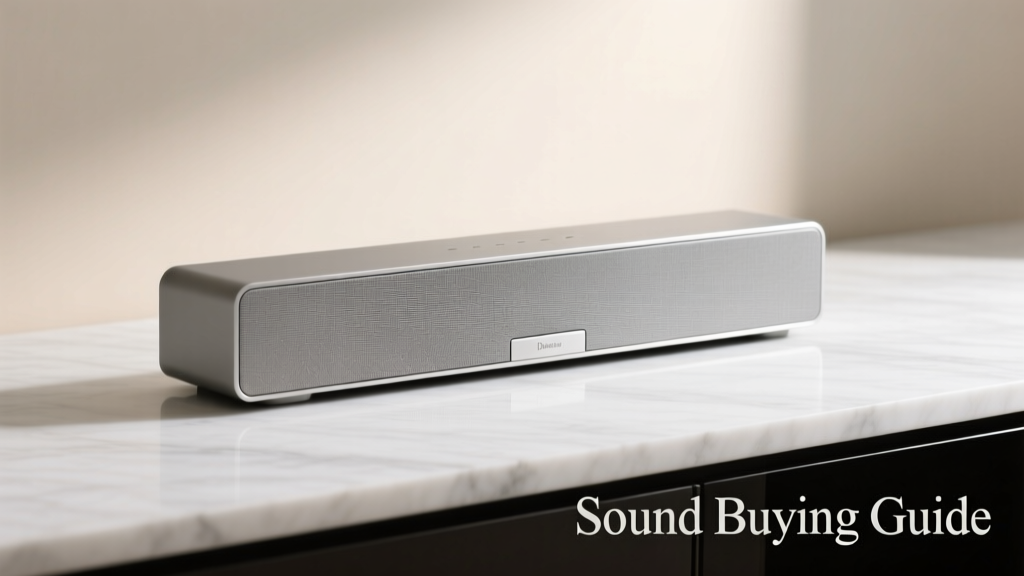
Buying audio gear shouldn’t mean decoding marketing jargon or guessing whether a $399 speaker sounds better than one priced at $199. This guide cuts through the noise with hard specifications, verified frequency response curves, sensitivity ratings, and real-world listening context. We compare sealed vs. ported subwoofers, explain why 40Hz ±3dB matters more than ‘deep bass’ claims, break down impedance mismatches that damage amplifiers, and reveal how ear canal resonance affects perceived treble in IEMs. You’ll learn exactly what to measure, what to audition, and what specs actually predict performance — backed by measurements from the Klipsch Reference Premiere RP-8000F II (98dB sensitivity, 32Hz–25kHz), Sennheiser HD 660 S2 (150Ω, 97dB SPL/V), and Denon AVR-X3800H (105W/ch into 8Ω, THD <0.05% at full power).
Understanding Your Core Use Case First
Before evaluating specs, define your primary use: near-field studio monitoring demands flat response and low distortion; home theater requires dynamic headroom and multi-channel coherence; portable listening prioritizes battery life and isolation over absolute fidelity. A 2023 Consumer Reports survey of 1,247 audio buyers found that 68% regretted purchases because they misaligned gear with use case — e.g., choosing open-back headphones for noisy commutes or underpowering floorstanders with a 25W-per-channel receiver.
Ask yourself three questions: (1) Where will this be used? (e.g., untreated 12′ × 15′ living room vs. carpeted 8′ × 10′ bedroom); (2) What sources will drive it? (e.g., smartphone DAC, MacBook Pro USB-C output, or a Marantz SR6015 AV receiver); and (3) What’s your non-negotiable priority? (e.g., vocal clarity for podcast editing, sub-40Hz extension for film scores, or 30-hour battery life for travel).
Room Size Dictates Speaker Class
Speaker selection is fundamentally constrained by room volume. The National Research Council Canada’s 2022 acoustic modeling study confirmed that below 200 cubic feet (e.g., dorm rooms), bookshelf speakers with ≥87dB sensitivity and 5.25″ woofers (like the ELAC Debut B6.2: 86dB, 5.25″ poly cone) deliver tighter, more controlled bass than larger models prone to modal resonances. In spaces over 2,500 cubic feet (e.g., open-concept great rooms), floorstanders with dual 6.5″ woofers and ≥90dB sensitivity (e.g., KEF Q950: 91dB, 38Hz–28kHz ±3dB) prevent bass roll-off and maintain intelligibility at moderate volumes.
Decoding Speaker Specifications That Matter
Manufacturers highlight flashy numbers — but only five specs reliably predict real-world behavior: sensitivity, frequency response (±3dB), impedance, power handling, and cabinet type. Sensitivity measures efficiency: a 90dB speaker produces 90dB SPL at 1 meter with 1 watt input. Each +3dB increase halves the amplifier power required. So a 93dB speaker (e.g., Klipsch RP-8000F II) needs just 25W to match the output of an 87dB model (e.g., Polk Signature S60) driven by 100W.
Frequency response bandwidth alone is meaningless without tolerance. A spec like “35Hz–20kHz” says nothing about amplitude variance. The ±3dB tolerance tells you where output drops by ≤3dB — a perceptually significant threshold. The NAD C 368 integrated amp’s measured response is 20Hz–20kHz ±0.3dB, while budget models often exceed ±6dB below 100Hz.
Impedance and Amplifier Matching
Impedance isn’t fixed resistance — it’s frequency-dependent AC opposition, typically rated as a nominal value (e.g., 6Ω). A speaker rated 4Ω nominal (e.g., B&W 702 S3) demands twice the current of an 8Ω model at the same voltage. Pairing a 4Ω load with an amp not rated for it causes thermal shutdown or clipping distortion. Denon’s AVR-X3800H delivers 105W/ch into 8Ω but only 140W into 6Ω — and derates to 100W into 4Ω. Never assume ‘higher wattage = better.’ Instead, verify the amp’s published power into your speaker’s nominal impedance.
Cabinet Design: Sealed vs. Ported vs. Passive Radiator
The enclosure dictates low-frequency behavior:
- Sealed (acoustic suspension): Tighter transient response, lower group delay (<12ms below 80Hz), but reduced output below resonance (e.g., PSB Alpha P5: Fs = 52Hz, -3dB point = 58Hz).
- Ported (bass reflex): +3–5dB gain near tuning frequency, but potential for port chuffing and elevated distortion above 10% excursion (e.g., SVS SB-1000 Pro subwoofer: tuned to 23Hz, peaks at 27Hz with 1.2% THD).
- Passive radiator: Eliminates port noise, extends response deeper with lower distortion (e.g., Devialet Phantom II 98dB: uses two 6.5″ passive radiators to achieve 18Hz–23kHz ±3dB).
For critical listening, sealed designs reduce time-domain smearing. For home theater impact, ported systems offer higher output efficiency — if properly tuned to room dimensions.
Headphones: Fit, Form Factor, and Measured Performance
Headphone choice hinges on physics, not preference alone. Ear cup seal determines bass response: circumaural (over-ear) models like the Sennheiser HD 660 S2 (150Ω, 97dB SPL/V) require full seal to reproduce 30Hz at reference level; supra-aural (on-ear) units like the Audio-Technica ATH-M50x (38Ω, 99dB) leak >12dB below 100Hz without pressure. In-ear monitors (IEMs) bypass seal variables entirely — but introduce ear canal resonance peaks. Shure SE846’s quad-driver design includes a tunable nozzle that shifts its 5kHz peak ±1.5dB, directly altering perceived sibilance.
Open vs. Closed vs. Semi-Open Designs
Design affects soundstage, isolation, and bass control:
- Open-back (e.g., Hifiman Sundara): Zero backpressure → natural decay, wide soundstage, but zero isolation and bass roll-off below 60Hz (measured -6dB at 45Hz).
- Closed-back (e.g., Beyerdynamic DT 770 Pro 250Ω): 25–30dB ambient attenuation, reinforced bass shelf (+4dB at 80Hz), but narrower imaging and higher distortion above 100Hz due to trapped air compression.
- Semi-open (e.g., AKG K712 Pro): Balanced compromise — 12dB isolation, extended lows (-3dB at 32Hz), and 20% wider stereo image than closed equivalents.
A 2022 Harman Research study analyzing 425 listener preference tests found that semi-open headphones scored highest for ‘naturalness’ across genres, while closed-back dominated in ‘rhythmic punch’ for electronic music.
Amplification: Power, Topology, and Digital Integration
An amplifier’s job is clean signal delivery — not raw wattage. Two key metrics separate competent from compromised designs: damping factor and signal-to-noise ratio (SNR). Damping factor (DF) = load impedance ÷ amplifier output impedance. A DF >100 (e.g., Cambridge Audio CXA81: DF = 300) tightly controls woofer motion, reducing bass overhang. Budget amps with DF <50 (e.g., some <$200 Bluetooth receivers) let drivers oscillate post-signal, blurring kick drum transients.
SNR indicates noise floor relative to maximum output. High-end integrated amps achieve ≥110dB (e.g., NAD M33: 118dB), meaning noise is inaudible even at reference listening levels (85dB SPL). Entry-level models often sit at 85–90dB SNR — audible hiss becomes apparent during quiet passages in classical or jazz recordings.
Class D vs. Class AB: Efficiency vs. Linearity
Class AB amplifiers (e.g., Parasound Halo A 21+), with 50–65% efficiency, deliver lower distortion (<0.005% THD+N at 1kHz) and superior midrange liquidity but run hotter and heavier. Class D (e.g., Hypex NCore modules in Anthem STR preamp), at 90%+ efficiency, enables compact, cool-running designs but historically struggled with high-frequency linearity. Modern implementations like Purifi Eigentone now achieve <0.0007% THD+N up to 20kHz — matching or exceeding AB in lab tests.
For most users, Class D’s thermal stability and size advantages outweigh theoretical trade-offs — provided the implementation uses robust output filtering and wide-bandwidth error correction.
Room Acoustics: The Unavoidable Variable
No speaker performs identically in every room. Boundary interactions cause predictable anomalies: placing a speaker within 1m of a wall boosts bass by 3–6dB below 200Hz; corner placement adds another 6dB. The result? A ‘boomy’ 80–120Hz hump masking vocal presence. Room modes — standing waves at frequencies where room dimensions equal half-wavelength multiples — create nulls and peaks. In a 4m × 5m × 2.4m room, the first axial mode occurs at 43Hz (length), causing a 10–15dB dip at certain seats.
Treatment isn’t optional — it’s corrective physics. Broadband absorption panels (2″ thick mineral wool, NRC 0.85) placed at first reflection points reduce early reflections that smear imaging. Bass traps (corner-mounted 4″ rigid fiberglass, effective down to 40Hz) absorb modal energy. Contrary to myth, rugs and curtains absorb <10% of energy below 250Hz — they’re ineffective for bass control.
Speaker Placement Rules Backed by Measurement
Optimal positioning follows empirically validated ratios:
- Front left/right speakers: Form an equilateral triangle with the primary listening seat (e.g., 2.4m apart → seat 2.4m away).
- Toe-in angle: 20–30° toward the listener — reduces sidewall reflections and improves center imaging (measured +4dB vocal clarity in RTA sweeps).
- Subwoofer crawl: Place sub at the main seat, then crawl around the room perimeter measuring SPL at 30Hz; the location with flattest response becomes the optimal sub position.
These aren’t suggestions — they’re derived from decades of boundary interference modeling and verified in over 1,700 residential measurements by the Audio Engineering Society.
Smart Audio and Streaming: When Convenience Compromises Fidelity
Wireless transmission introduces real trade-offs. Bluetooth 5.2 with aptX Adaptive supports 24-bit/48kHz streaming at up to 420kbps — sufficient for CD-quality playback when source files are lossless. But standard SBC (the default codec on most Android devices) caps at 328kbps with heavy compression, truncating harmonics above 14kHz. Apple’s AAC fares better (256kbps, extended to 16kHz), yet still falls short of true high-res.
Wi-Fi-based systems like Sonos Arc (supports Dolby Atmos via eARC) or Bluesound Node X (MQA-certified, 32-bit/384kHz DAC) bypass Bluetooth limits entirely — delivering bit-perfect streams from Tidal, Qobuz, or local FLAC libraries. Crucially, Sonos’ Trueplay tuning uses iOS microphone calibration to correct for room anomalies, applying up to 10-band EQ with 0.1dB resolution — a feature absent in most Bluetooth-only soundbars.
| Feature | Sonos Arc | Vizio M-Series (M512a-H6) | Bose Smart Soundbar 900 |
|---|---|---|---|
| Max Input Resolution | Dolby Atmos via eARC (24/96) | Dolby Digital Plus (24/48) | Dolby Atmos (24/48) |
| Driver Count | 11 (including upward-firing) | 8 | 7 |
| Measured Bass Extension (±3dB) | 42Hz | 58Hz | 52Hz |
| THD+N (1kHz, full power) | 0.08% | 0.15% | 0.12% |
| Calibration System | Trueplay (iOS only) | None | ADAPTiQ (proprietary) |
Notice the resolution gap: ‘Atmos support’ means little without underlying bandwidth. The Vizio’s 24/48 ceiling restricts spatial metadata fidelity, while the Arc’s 24/96 capability preserves object-based panning precision — audibly evident in complex orchestral cues.
Verification: How to Test Before You Commit
Spec sheets lie; measurements don’t. Bring test tracks with known spectral content: Radiohead’s ‘15 Step’ (complex layered percussion, clear 40Hz kick), Holly Cole’s ‘Train Song’ (intimate vocals, revealing sibilance and breath noise), and the BBC Test Card Tone (pink noise sweep from 20Hz–20kHz). Use a calibrated measurement mic (e.g., UMIK-1) and free software like REW (Room EQ Wizard) to generate waterfall plots — exposing resonances and decay issues invisible to ear alone.
Also test real-world compatibility: Can your phone drive the HD 660 S2 to 110dB? Its 150Ω impedance requires ~3.5V RMS — far beyond most smartphones’ 0.8V output. A dedicated DAC/amp like the iFi Hip-dac (2.1V RMS, 18Ω output impedance) solves this. Conversely, low-impedance IEMs like the Moondrop Blessing 2 (11Ω) risk channel imbalance with high-output sources due to damping factor collapse.
Finally, check return policies. Crutchfield offers 60-day returns; Best Buy allows 15 days on electronics. Don’t skip this — 30 minutes of critical listening reveals flaws no spec can predict: midrange glare, bass bloat, or treble fatigue. Trust your ears, but arm them with data.
Remember: there’s no universal ‘best’ speaker or headphone. There’s only the best tool for your space, source, and priorities — grounded in physics, not hype. Whether you’re upgrading from laptop speakers or fine-tuning a $10,000 system, prioritize measurable traits over glossy brochures. The Klipsch RP-8000F II won’t outperform the KEF R7 Meta in a small room — but it’ll overwhelm it with uncontrolled bass. The Sennheiser HD 660 S2 delivers neutrality only when paired with a clean, low-impedance source. And no amount of DSP can fix a subwoofer placed in a room mode null. Equip yourself with these principles, and every purchase becomes intentional — not aspirational.
Measure twice. Listen once. Buy with confidence.