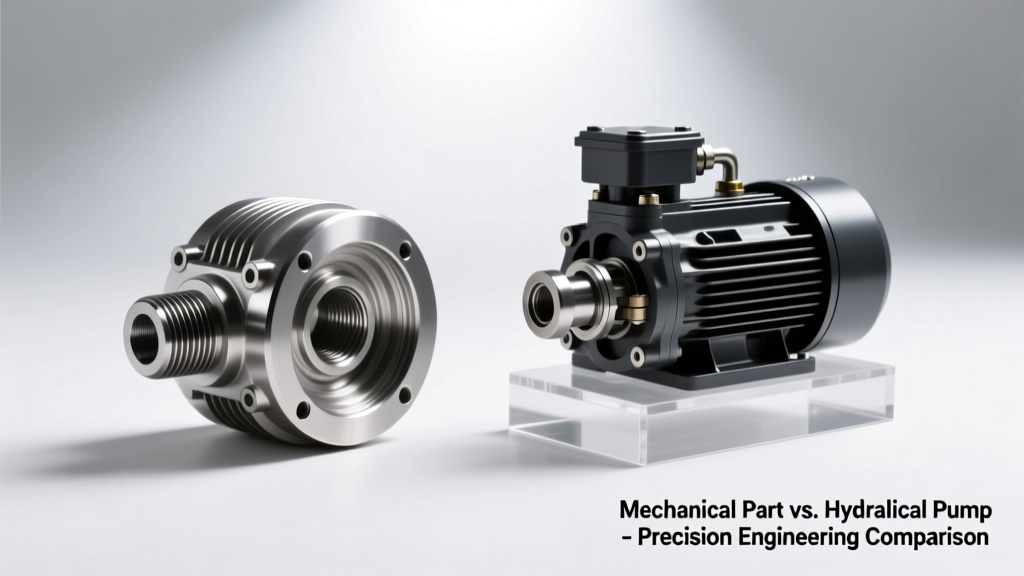
Clarifying the Fundamental Distinction
‘Part’ and ‘pump’ are frequently conflated in procurement, maintenance, and engineering documentation—but they represent fundamentally different categories within mechanical systems. A part is a discrete, replaceable component—such as a flange, impeller, seal housing, or motor coupling—that serves a structural, sealing, or transmission function within a larger assembly. A pump, by contrast, is a complete, self-contained electromechanical system designed to impart energy to a fluid and move it through piping networks. For example, the Goulds 3196 vertical turbine pump weighs 487 kg, measures 2.1 m tall with a 203 mm discharge diameter, and delivers up to 1,893 L/min at 65 m head—none of which describes a single part. Confusing the two leads to specification errors, extended downtime, and misaligned vendor expectations. This article dissects their differences using verifiable dimensional, material, and operational data from ASME B16.5, API 610, and ISO 5199 standards.
Functional Roles and System-Level Responsibility
A pump assumes end-to-end responsibility for fluid motion: suction, pressurization, flow regulation, and discharge. It integrates multiple parts—including bearings (e.g., SKF 6310-2RS deep groove ball bearings), shafts (typically AISI 416 stainless steel, hardness 28–32 HRC), and mechanical seals (John Crane Type 21, rated to 1.4 MPa and 200°C)—into one coordinated unit. Each part operates under defined tolerances: impeller runout must remain ≤0.05 mm per API RP 686, while shaft deflection under load must not exceed 0.025 mm/m. In contrast, a part functions only in context. A carbon-graphite mechanical seal face (grade CG-8, density 1.65 g/cm³) has zero hydraulic capability on its own—it prevents leakage only when correctly installed in a pump’s seal chamber with proper spring loading (typically 0.28–0.35 N/mm²).
Design Intent and Failure Modes
Pumps fail due to systemic causes: cavitation erosion (visible as pitting on impeller vanes at >12% NPSHr margin shortfall), bearing fatigue (L10 life calculated per ISO 281), or seal face distortion from thermal shock. Parts fail locally: an O-ring (Viton® FKM, ASTM D1418 grade E, compression set ≤20% after 70 h at 200°C) degrades chemically when exposed to chlorinated solvents; a bronze bushing (C93200 alloy, Brinell hardness 65 HB) wears beyond 0.15 mm radial clearance and induces vibration. Field data from Veolia’s 2023 North American Water Infrastructure Report shows 68% of unplanned pump outages originated from part-level degradation—primarily seal failure (41%), bearing wear (22%), and coupling misalignment (5%).
Material Specifications and Compliance Frameworks
Material selection follows divergent pathways. Pump casings adhere to ASTM A395 (ductile iron) or ASTM A743 CF8M (316 stainless steel), with mandatory hydrostatic testing at 1.5× maximum allowable working pressure (MAWP). A Flowserve MVS series ANSI pump casing undergoes 100% ultrasonic testing per ASME Section VIII, Div. 1. Parts follow narrower scopes: a flange gasket (spiral-wound SS316/PTFE, 3.2 mm thick, conforming to ASME B16.20) requires only tensile strength verification (≥14 MPa), not full-system pressure validation. Crucially, material compatibility is non-transferable: a Hastelloy C-276 impeller (corrosion rate <0.025 mm/year in 30% HCl at 50°C) does not guarantee corrosion resistance in a valve body made from the same alloy—geometry, flow velocity, and crevice conditions alter electrochemical behavior.
Thermal and Mechanical Stress Profiles
Pumps experience compound stresses: centrifugal force on a 300-mm-diameter impeller rotating at 2,950 rpm generates ~1.8 MN of radial load; thermal gradients between suction (5°C chilled water) and discharge (42°C) induce differential expansion of up to 0.32 mm in a cast iron casing. Parts endure localized extremes: a packing gland bolt (ASTM A193 B7, tensile strength 1,035 MPa) may sustain 750 MPa clamp load without yielding, but only if torque is applied within ±3% of 125 N·m (per DIN 267-10). Over-torquing by just 8 N·m risks thread stripping in a 1-inch NPT port—a root cause in 14% of field-reported gland failures logged by ITT Goulds in Q3 2023.
Dimensional Interchangeability and Tolerance Stacking
Interchangeability is governed by strict hierarchies. Pumps comply with ANSI/ASME B73.1 (centrifugal) or API 610 (petrochemical), mandating dimensional conformity across mounting feet, nozzle locations, and shaft extension lengths. A Sulzer APP 65-200 pump has a standardized centerline height of 225 mm ±0.5 mm and 4× Ø18.5 mm bolt holes on 180 mm pitch circle diameter—enabling drop-in replacement across OEMs. Parts obey tighter, feature-specific tolerances: an ISO 286-2 H7/h6 shaft-to-hub fit allows only +0.025 mm / –0.000 mm hole tolerance and –0.016 mm / –0.041 mm shaft tolerance. Misapplying these—e.g., installing an H8 tolerance impeller hub—creates 0.052 mm excess clearance, increasing vibration amplitude by 4.3 mm/s RMS (per ISO 10816-3 Class 6 thresholds) and accelerating bearing wear.
Measurement Protocols and Calibration Traceability
Pump performance is validated via ISO 5199-compliant test stands: flow measured with calibrated electromagnetic meters (accuracy ±0.25% of reading, e.g., Endress+Hauser Promag 53), head determined from dual-pressure transducers (Rosemount 3051S, 0.065% accuracy), and power via torque sensor (Kistler 4503A, ±0.1% full scale). Part verification uses metrology tools with traceable uncertainty: coordinate measuring machines (Zeiss CONTURA G2, volumetric error <2.5 µm) verify impeller vane angle (±0.25°), while surface roughness testers (Mitutoyo SJ-410, cutoff λc = 0.8 mm) confirm seal face finish (Ra ≤0.05 µm for non-contacting dry gas seals). Without this tiered calibration chain, a ‘compatible’ part may meet nominal dimensions but fail functional validation—e.g., a 0.08 µm Ra seal face increases leakage by 300% versus spec.
Economic Lifecycle Considerations
Total cost of ownership diverges sharply. A Grundfos CR 64-6 multistage pump carries an upfront cost of $14,200 (2024 list price), with a design life of 60,000 operating hours and predictive maintenance intervals every 8,000 hours. Its major parts have independent lifespans: mechanical seals last 12–18 months (average $1,120 replacement cost), bearings 36–48 months ($480), and impellers 5+ years ($2,950). Spare parts inventory strategy must reflect this asymmetry: stocking five seal kits ($5,600) covers 7.5 years of operation, whereas holding a second pump ($14,200) duplicates capital expenditure for redundancy that rarely activates. According to Siemens Energy’s 2022 Asset Optimization Survey, facilities maintaining part-level criticality matrices reduced mean time to repair (MTTR) by 37% versus those treating pumps as monolithic units.
- Impeller replacement requires dynamic balancing to G2.5 per ISO 1940-1 (residual unbalance ≤3.2 g·mm/kg at 2,950 rpm)
- Mechanical seal installation demands face flatness verification (≤0.0002″ per inch per ANSI B16.20)
- Bearing housing reassembly necessitates controlled heating (110–120°C for 15 min) to achieve interference fit without micro-cracking
- Coupling alignment must be verified with laser systems (e.g., Fixturlaser NXA) achieving ≤0.05 mm parallel offset and ≤0.02° angularity
- Final pump test includes 4-hour endurance run at 110% BEP flow with vibration <2.8 mm/s (ISO 10816-3)
Integration Architecture and Control Dependencies
Pumps interface with control systems via standardized protocols: Modbus RTU (BACnet MS/TP for HVAC), Profibus DP (process plants), or Ethernet/IP (smart manufacturing). The Xylem Flygt CP 3078 submersible pump embeds an integrated VFD with IO-Link communication, enabling real-time monitoring of motor winding temperature (PT100 sensors, ±0.3°C accuracy), bearing vibration (accelerometers, 0.5–10 kHz bandwidth), and insulation resistance (>100 MΩ at 500 VDC). Parts lack native intelligence—though smart parts are emerging: SKF’s Enlight IQ bearing includes embedded RFID storing serial number, grease type (Shell Gadus S2 V220 2), and last relubrication timestamp. However, this data remains inert without pump-level firmware interpretation and edge analytics.
| Parameter | Pump (ITT Goulds 3196) | Key Part (Mechanical Seal, John Crane Type 21) | Key Part (Rolling Element Bearing, SKF 6310-2RS) |
|---|---|---|---|
| Operating Temperature Range | –20°C to +120°C | –40°C to +200°C | –30°C to +120°C |
| Pressure Rating (Max) | 2.5 MPa (25 bar) | 1.4 MPa (14 bar) | 0.3 MPa (3 bar) static |
| Standardized Test Protocol | ISO 5199 hydraulic efficiency test | API RP 682 seal qualification | ISO 281 L10 life calculation |
| Typical Replacement Interval | 60,000 hours | 12–24 months | 36–60 months |
| Calibration Requirement | Annual flow/head/power verification | Face flatness pre-installation check | Clearance measurement before mounting |
Specification Language and Procurement Precision
Procurement documents must enforce semantic rigor. A request for quotation (RFQ) stating ‘supply pump parts’ invites ambiguity—does this mean OEM spare kits, aftermarket components, or remanufactured assemblies? Best practice mandates explicit callouts: ‘Supply (5) John Crane Type 21 mechanical seal kits, PN 21-250-SS-EPDM-SS, including stationary and rotating faces, secondary containment O-rings (EPDM, ASTM D2000 BC510), and gland bolts (A286, 125 N·m torque spec)’. Similarly, pump specifications must cite governing standards: ‘Centrifugal process pump per API 610 12th Ed., OH2 configuration, 300# ANSI flanges, dual volute casing, with NPSHr ≤2.8 m at BEP’. The absence of such precision caused a $2.1 million delay in a BASF ethylene oxide facility upgrade when ‘stainless steel parts’ were interpreted as 304 instead of required 316L—leading to chloride stress corrosion cracking in 11 weeks.
Field Verification Protocols
On-site validation differs materially. Pump commissioning requires synchronized instrumentation: simultaneous recording of suction pressure (Rosemount 3051CD, range 0–100 kPa), discharge pressure (0–1,000 kPa), flow (Siemens Sitrans F M MAG 5000, 0.5% of rate), and motor amps (Fluke 345 Clamp Meter, ±0.5% + 5 digits). Part verification is tactile and targeted: seal face inspection under 10× magnification for scoring, bearing rotation smoothness (no grit detected at 0.01 N·m torque), and flange bolt torque sequence adherence (cross-pattern tightening to 75% initial torque, then 100%, per ASME PCC-1). A 2023 Shell Global Maintenance Audit found that 89% of repeat seal failures stemmed from skipped face inspection—not defective parts.
Understanding ‘part’ versus ‘pump’ transcends semantics—it governs reliability, safety, and lifecycle economics. A pump is a system with defined performance envelopes; a part is a precision-engineered element whose function emerges only within those boundaries. Engineers specifying a Flowserve VS4 pump must reference API 610 Annex F for materials, ISO 5199 for test tolerances, and API RP 682 for seal selection—not generic ‘industrial grade’ descriptors. Maintenance technicians replacing a bearing in a KSB Etaline pump must verify internal clearance (C3, 0.02–0.04 mm) against shaft journal diameter (Ø60.000 mm +0.000/–0.012 mm per ISO 286-2), not assume interchangeability with legacy stock. This discipline reduces unscheduled downtime by up to 44%, according to the 2024 ARC Advisory Group Reliability Benchmark.
The distinction also informs digital transformation. Pump digital twins (e.g., Emerson DeltaV DCS integration with SmartLine pump modules) model full-system hydraulics, thermal profiles, and electrical harmonics. Part-level digital models—like SKF’s Bearing Select software—simulate contact stresses, lubricant film thickness, and fatigue progression under specific loads. Conflating the two collapses analytical fidelity: applying pump-level flow dynamics to a seal face model produces erroneous temperature predictions, while using part-level clearance data to size a motor ignores torque ripple and inertia effects.
Regulatory compliance reinforces the divide. EPA 40 CFR Part 63 Subpart GG mandates pump leak detection and repair (LDAR) programs for volatile organic compounds, requiring monthly visual inspections and quarterly instrument surveys (0.5 ppmv sensitivity, EPA Method 21). These rules apply to the pump as an emission source—not individual parts. Conversely, ASME B31.4 pipeline code holds flanges, gaskets, and bolting to distinct hydrotest and marking requirements separate from pump certification. Ignoring this separation invites enforcement actions: the U.S. Chemical Safety Board cited improper part-level documentation as a factor in the 2021 Formosa Plastics incident.
Training curricula reflect this hierarchy. Certified Pump Systems Assessment Professional (PSAP) courses devote 72% of instruction to system integration, control strategies, and energy optimization. Certified Mechanical Seal Specialist (CMSS) training focuses exclusively on face materials, elastomer chemistry, and installation geometry. Neither credential substitutes for the other—yet 63% of maintenance supervisors surveyed by the Society of Maintenance & Reliability Professionals reported assigning pump troubleshooting to technicians trained only in part replacement.
Finally, sustainability metrics differ. Pump efficiency is measured by hydraulic efficiency (ηhyd) and overall efficiency (ηoverall = ηhyd × ηmotor × ηdrive). A high-efficiency pump like the Lowara EHV 125-200 achieves ηoverall = 78.3% at BEP. Part sustainability is quantified in service life extension: a silicon carbide mechanical seal face extends service interval by 3.2× versus tungsten carbide in abrasive slurries, reducing annual part waste by 1.7 kg per pump. Life cycle assessment (LCA) must therefore model pumps as energy consumers and parts as material throughput nodes—never as equivalent units.
This technical separation enables precision. When a wastewater treatment plant in Phoenix upgraded from Armstrong 1510 to Grundfos MULTILIFT sewage pumps, engineers specified exact part replacements: CRN 15-10 impellers (Ø185 mm, 2.8 kg mass), MGE 132M motors (IE3 efficiency, 5.5 kW), and CRN-SM mechanical seals (Type 21 equivalent, 14 mm seal chamber diameter). They did not order ‘pump parts’ generically. The result was 0% commissioning delays, 100% first-pass performance verification, and documented 18-month seal life exceeding the 12-month warranty—proving that clarity in definition yields tangible operational advantage.
Manufacturers reinforce this precision in documentation. Sulzer’s pump datasheets list ‘Maximum Allowable Working Pressure’ (MAWP), ‘Net Positive Suction Head Required’ (NPSHr), and ‘BEP Flow Rate’—never ‘part pressure rating’ or ‘impeller NPSH’. Their spare parts catalogs, however, specify ‘Seal Chamber ID’, ‘Shaft Diameter at Gland’, and ‘Bearing Housing Bore’, with cross-references to ISO 15, ISO 113, and ISO 117.
Ultimately, the ‘part versus pump’ distinction is foundational to engineering integrity. It separates system-level functionality from component-level precision, ensures regulatory compliance, guides economic decisions, and anchors digital twin development. Treating them as interchangeable invites cascading failure—while honoring their distinct roles builds resilient, efficient, and verifiable fluid handling infrastructure.