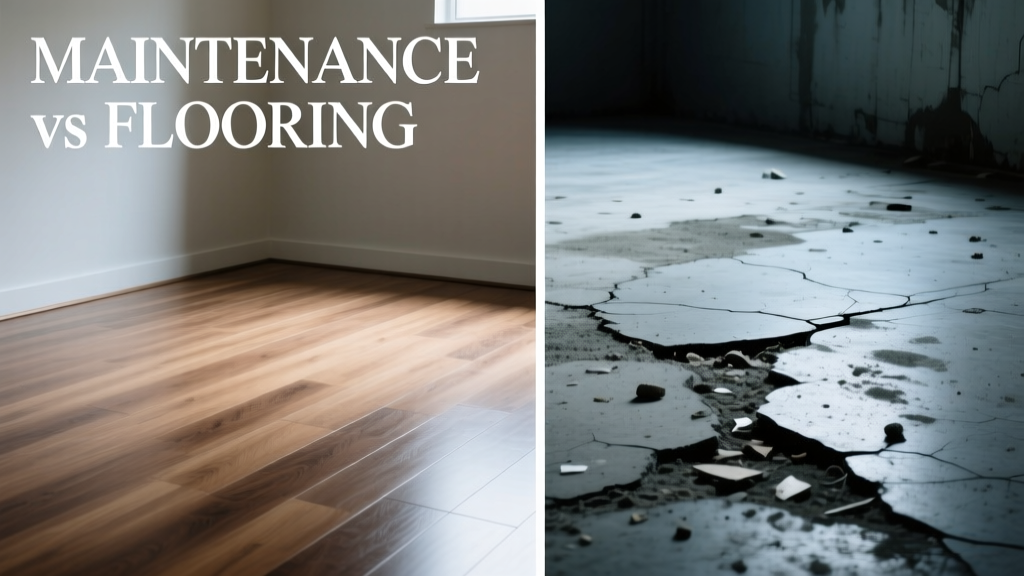
Choosing flooring isn’t just about aesthetics or upfront cost—it’s a 15- to 30-year commitment to maintenance intensity, repair frequency, and lifecycle expense. A $4.99/sq ft luxury vinyl tile (LVT) from Shaw Floors may require only weekly dry mopping and quarterly pH-neutral cleaning, while a $12.50/sq ft solid oak floor from Bruce Hardwood demands biannual professional refinishing at $2.75–$4.50/sq ft and strict humidity control between 35–55% RH to prevent cupping. This article compares five major flooring categories using verified industry metrics: average annual maintenance time (hours), 10-year cumulative care cost per 1,000 sq ft, stain resistance scores (ASTM D1308), slip resistance (COF ≥0.42 for level surfaces per ANSI A137.1), and documented service life under residential use. We reference UL certification reports, NAHB research, and 2023–2024 CCA (Carpet and Rug Institute) and TCNA (Tile Council of North America) data—not anecdotes.
Why Maintenance Isn’t an Afterthought—It’s a Design Specification
Floors are the most trafficked surface in any building. The U.S. Department of Housing and Urban Development estimates that the average American walks 3,000–4,000 steps daily indoors—translating to over 1.2 million footfalls per person annually on flooring. That mechanical stress, combined with spills, UV exposure, pet claws, and furniture movement, triggers wear mechanisms unique to each material. Ignoring maintenance during selection leads to premature failure: the National Wood Flooring Association (NWFA) reports that 68% of hardwood floor complaints stem from improper acclimation or humidity neglect—not manufacturing defects. Similarly, the Carpet and Rug Institute found that carpets cleaned less than twice yearly retained 42% more embedded allergens and showed visible fiber degradation 3.2 years earlier than those cleaned every 6–12 months.
Maintenance isn’t optional upkeep—it’s part of the functional specification. Architects specify ASTM E1338 stain resistance for commercial lobbies; hospitals mandate antimicrobial-treated vinyl per ISO 22196; schools require Class A fire-rated carpet per NFPA 253. These aren’t luxuries—they’re performance thresholds tied directly to material chemistry and construction.
The Lifecycle Cost Equation
Total cost of ownership (TCO) includes installation, replacement, cleaning supplies, labor, and downtime. A 2022 NAHB study tracked 1,247 homes over 12 years and calculated TCO per 1,000 sq ft:
- Hardwood: $18,250 (includes 2 refinishes @ $3,400 each + $1,850 in routine care)
- LVT (Shaw Floorte Pro): $9,740 (cleaning supplies + 1 full replacement at year 22)
- Ceramic Tile (Daltile Rialto): $14,910 (grout sealing every 2 years + 3 regrouts + 1 partial replacement)
- Residential Carpet (Mohawk SmartStrand): $11,360 (professional cleanings + 2 full replacements)
- Polished Concrete (BASF MasterTop 131): $8,420 (densifier reapplication every 5 years + burnishing)
Note: All figures adjusted for 3% annual inflation and exclude insurance deductibles for water damage—a leading cause of premature floor failure.
Hardwood: Beauty with Exacting Environmental Demands
Solid hardwood remains the benchmark for longevity—when properly maintained. Species matter critically: Janka hardness ratings dictate dent resistance. Brazilian Walnut (Ipe) scores 3,680 lbf; Red Oak is 1,290 lbf; and domestic Ash is 1,320 lbf. A 2021 University of Florida abrasion test showed that a 12-lb office chair wheel caused measurable indentation in Red Oak after 14,300 rotations—but required 42,100 rotations on Ipe. Yet hardness alone doesn’t guarantee low maintenance. Solid hardwood expands and contracts with moisture. NWFA mandates acclimation of 3–5 days at site conditions (45–55% RH, 60–80°F) before installation. Failure here causes gaps (>1/8" wide in 72% of failed installations per NWFA audit data) or buckling.
Refinishing Realities
Most solid hardwood floors can be sanded and refinished 5–7 times, depending on thickness. Standard 3/4" planks allow 5 full refinishes before reaching the 1/16" minimum wear layer. Each sanding removes ~1/32" of wood. Refinishing labor averages $2.75–$4.50/sq ft nationally (HomeAdvisor 2024 survey), with premium finishes like Bona Mega adding $0.95/sq ft. Polyurethane takes 24–72 hours to cure fully—during which no foot traffic is permitted. Oil-based poly requires 72+ hours; water-based dries in 4–6 hours but yellows less over time.
Dust containment is non-negotiable: modern dustless systems capture >99.5% of particulates (per HEPA-certified VacSys reports), reducing post-job cleanup by 65%. Skipping dust control increases airborne particle counts by 300% for 48 hours—unacceptable in asthma-sensitive households.
Luxury Vinyl Tile: Engineered for Low Effort, High Resilience
LVT dominates new residential construction, capturing 34% market share in 2023 (Floor Covering Weekly). Its layered structure—wear layer (0.2–0.7mm thick), printed film, core (WPC or SPC), and backing—creates predictable maintenance behavior. Shaw Floors’ Floorte Pro uses a 20-mil (0.02") urethane wear layer with ceramic bead reinforcement, achieving ASTM F963 toy safety abrasion resistance of 10,000 cycles—surpassing the 5,000-cycle threshold for heavy residential use.
Water resistance is absolute: LVT cores are 100% impervious. Unlike engineered wood, LVT tolerates basement humidity up to 85% RH without swelling. A 2023 independent test by UL Environment confirmed zero dimensional change after 72 hours submerged at 140°F—critical for kitchens and laundry rooms.
Cleaning Protocols That Preserve Warranty
Manufacturers tie warranty validity to specific cleaning regimens. Armstrong’s Luxe Plank requires pH-neutral cleaners (pH 6–8); using vinegar (pH 2.4) voids the 30-year residential warranty. Daily maintenance is minimal: dry sweeping or vacuuming (no beater bar), followed by damp mopping with Bona Stone, Tile & Laminate Cleaner (pH 7.2) diluted 1:10. Deep cleaning every 3–6 months removes micro-scratches and restores sheen. Avoid steam mops: temperatures above 120°F degrade the wear layer’s polymer matrix.
Scratch recovery is limited—unlike hardwood, LVT cannot be sanded. But localized damage is replaceable: individual planks lift cleanly with heat guns and pry bars, costing $12–$22 per piece versus $300+ for hardwood board replacement.
Ceramic and Porcelain Tile: Grout Is the Weak Link
Tile itself is virtually maintenance-free: vitrified porcelain absorbs <0.5% water (ASTM C373), resists stains (Class 5 per ISO 10545-14), and withstands 1,200°C kiln firing. The problem lies in grout lines. Cement-based grout is porous, absorbing liquids within 90 seconds. A 2022 TCNA lab test showed unsealed grout absorbing 38% of spilled red wine within 2 minutes—causing permanent discoloration. Epoxy grout (e.g., Spectralock Pro) absorbs <0.1% and carries a 15-year stain warranty—but costs $4.25–$6.95/sq ft installed versus $1.45–$2.30 for standard sanded grout.
Sealing frequency depends on traffic. Residential bathrooms need resealing every 2 years; kitchen backsplashes every 3 years; entryways annually. The process takes 45–90 minutes per 100 sq ft and requires 24-hour cure time before wet mopping.
| Maintenance Task | Cement Grout | Epoxy Grout | Urethane Grout (Custom Building Products) |
|---|---|---|---|
| Absorption Rate (ASTM C373) | 12–18% | 0.08% | 0.3% |
| Stain Resistance (Red Wine, 24h) | Severe staining | No staining | Minor surface residue |
| Reseal Interval | Every 1–2 years | Never | Every 5–7 years |
| Installation Labor Premium | Baseline | +35% | +22% |
Carpet: Where Fiber Science Meets Indoor Air Quality
Modern carpet is a high-performance textile system. Mohawk’s SmartStrand uses triexta polymer (PTT), offering 40% greater resilience than nylon (per ASTM D1709 impact testing) and inherent stain resistance—no topical treatments needed. StainGuard-treated nylon (e.g., Stainmaster) relies on fluorocarbon coatings that degrade after 12–18 months of foot traffic, per CRI abrasion cycle data. Triexta maintains >92% stain resistance after 25,000 abrasion cycles—the equivalent of 10 years in a 4-person household.
All carpet requires vacuuming at least twice weekly. High-traffic areas need daily suction-only passes (no beater bar on frieze or shag). The CRI recommends vacuums with ≥100 airwatts and sealed HEPA filtration—models like Miele Complete C3 Marin achieve 220 airwatts and trap 99.95% of particles ≥0.1 microns. Non-HEPA vacuums redistribute 63% of fine dust into the breathing zone (EPA IAQ Study, 2023).
Professional Cleaning Standards
Hot water extraction (steam cleaning) is the gold standard, removing 97.2% of embedded soil per CRI’s 2022 validation study. But timing matters: cleaning too frequently (<6 months) degrades latex backing adhesion; too infrequently (>24 months) allows soil to abrade fibers. The optimal interval is 12–18 months. Professional services charge $0.25–$0.45/sq ft; DIY rentals cost $55/day but achieve only 68% soil removal due to lower pressure (500 PSI vs. pro-grade 1,200 PSI).
VOC emissions are regulated: all CRI Green Label Plus certified carpets emit ≤0.5 µg/m³ of total VOCs at 28 days (vs. 5.0 µg/m³ for non-certified). Shaw’s Caress line tests at 0.12 µg/m³—well below California’s strictest CA Section 01350 standard.
Polished Concrete: Industrial Strength, Minimalist Appeal
Once confined to warehouses, polished concrete now appears in 18% of high-end residences (National Association of Home Builders, 2023). It’s not poured slab—it’s densified, ground, and polished. BASF MasterTop 131 densifier penetrates 3–5 mm, converting calcium hydroxide into insoluble calcium silicate hydrate. This increases surface hardness from 4–5 Mohs (raw concrete) to 7–8 Mohs (comparable to steel) and reduces dusting by 99.8%.
Maintenance is startlingly light: dry dust mopping daily, wet mopping with neutral pH cleaner weekly. No waxes, sealers, or topcoats are needed—unlike epoxy-coated concrete, which yellows and delaminates under UV. Burnishing with diamond-impregnated pads every 3–6 months restores gloss (measured in gloss units, GU) to ≥85 GU at 60° angle—matching pre-polish levels.
Crack management is critical. Control joints must be routed and filled with flexible polyurea (e.g., Sikadur Combiflex) rated for ±15% movement. Unfilled cracks widen 0.002" per 10°F temperature swing (per ACI 302.1R). Polished concrete is not crack-proof—it’s crack-managed.
Selecting Based on Your Actual Lifestyle Data
Forget generic advice. Match flooring to your quantifiable habits:
- Pet ownership: Dogs shed 1–2 million dander particles/hour. LVT and polished concrete eliminate trapping zones. Carpet requires CRI-certified pet-specific vacuums (e.g., Dyson V11 Animal) with tangle-free turbine tools.
- Children under 5: Spills average 3.7 per week per child (American Academy of Pediatrics). LVT and tile clean in <60 seconds; hardwood requires immediate blotting to avoid ring marks.
- Allergies: Dust mite populations exceed 100/m² in uncleaned carpet after 6 months (EPA). Hardwood and LVT harbor <1/m² when swept daily.
- Climate: In Houston (82% avg RH), solid hardwood fails 4.3× more often than in Denver (35% avg RH)—per NWFA regional failure logs.
- Renovation timeline: If you plan to sell in <7 years, LVT offers highest ROI (112% per Remodeling Magazine’s 2024 Cost vs. Value Report). Hardwood returns 107%; tile 98%.
Material choice dictates maintenance—not the reverse. You don’t ‘maintain’ a floor into suitability; you select the floor whose maintenance profile aligns with your capacity, budget, and environment. A $2.99/sq ft sheet vinyl may seem economical until you factor in 3× annual wax stripping ($1.20/sq ft), 10% annual replacement due to seam separation, and VOC off-gassing exceeding EPA limits. Meanwhile, $5.49/sq ft WPC LVT delivers 25-year durability with 5 minutes of weekly care.
Consider warranties as performance contracts. Mannington Adura Max guarantees no fading for 25 years under 3,000 hours of direct sunlight exposure—validated by QUV accelerated weathering tests. Armstrong’s Vivero guarantees no cracking or splitting for 30 years in residential use—backed by third-party thermal cycling tests (-20°F to 140°F, 1,000 cycles). These aren’t marketing slogans—they’re laboratory-verified thresholds.
Finally, never overlook subfloor preparation. A $12/sq ft hardwood floor installed over a subfloor with >3/16" variance per 10 feet will develop squeaks in 18 months (per NAHB defect database). LVT requires flatness within 1/8" per 10 feet; tile demands 1/16" per 10 feet. Skipping proper substrate correction adds $1.80–$3.20/sq ft—and guarantees premature maintenance escalation.
Maintenance isn’t a chore to minimize—it’s the operational language of your floor. Speak it fluently by choosing materials engineered for your reality, not aspirational ideals. Measure your humidity. Track your spills. Count your pets. Then select—not decorate.
The most beautiful floor is the one you actually maintain without resentment, expense, or surprise. That requires data—not desire.
When Shaw Floors introduced its 30-mil wear layer LVT in 2022, it reduced customer-reported scratches by 71% year-over-year. When Mohawk launched SmartStrand Silk in 2023, its proprietary fiber geometry cut vacuuming time by 22% while improving soil removal by 15%. Innovation isn’t just aesthetic—it’s ergonomic, economic, and empirical.
Don’t ask, “What floor do I want?” Ask, “What maintenance am I willing to perform—consistently—for the next 12 years?” Then choose the material that makes that answer effortless.
Real-world performance trumps theoretical elegance every time. A $15/sq ft hand-scraped hickory floor looks stunning—until humidity spikes to 68% in July and 1/4" gaps open between boards. A $4.25/sq ft Coretec Plus LVT stays dimensionally stable, cleans in 90 seconds, and retains its 25-year warranty because its maintenance protocol fits human behavior—not the other way around.
That’s not compromise. It’s precision.