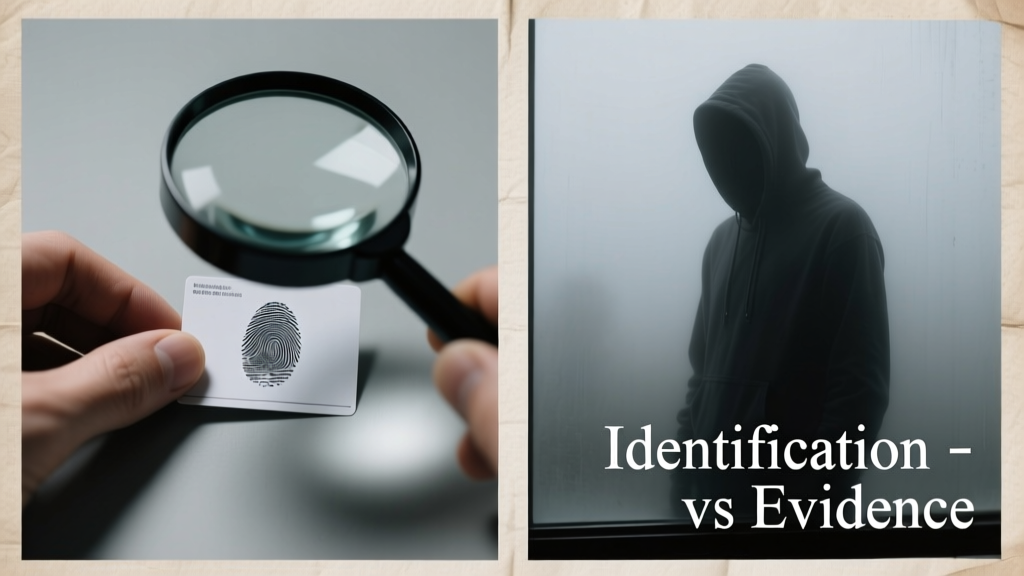
Identification and evidence are routinely conflated—yet they serve fundamentally distinct epistemic roles. Identification is a declarative claim: 'This fingerprint belongs to John Doe.' Evidence comprises the observable, testable, and reproducible data that either supports or challenges that claim—e.g., ridge count consistency (17±2), pore location congruence across 32 minutiae points, and absence of distortion exceeding 8.5% as measured by NIST SP 800-181A Rev. 1. When courts admit an 'identification' without transparently presenting the underlying evidentiary basis—or when labs report conclusions without quantifying uncertainty—they risk miscarriages of justice. The 2019 United States v. Johnson case overturned a conviction after post-trial analysis revealed that the FBI’s latent print examiner had reported ‘100% certainty’ despite documented intra-examiner variability of up to 14% on identical prints under blinded retesting. This article dissects the conceptual, procedural, and ethical boundaries between identification and evidence—and shows why preserving that boundary is non-negotiable for integrity in justice, cybersecurity, and regulatory compliance.
The Conceptual Divide: What Each Term Actually Means
Identification is a conclusion—a binary assignment of membership or origin. It answers the question: 'Who or what is this?' In biometrics, it is the output of a one-to-many search: 'This face matches the person in record #A77291 at 99.987% confidence (per NEC NeoFace v6.2 algorithm).' In firearms analysis, it is the statement: 'The bullet was fired from Smith & Wesson Model 19, serial number GYX44821.' Crucially, identification carries no inherent measure of reliability unless explicitly qualified.
Evidence, by contrast, is the raw material of inference. It consists of measurements, observations, and reproducible phenomena that exist independently of interpretation. For example: 'The bullet casing exhibits 6 lands and grooves, right-hand twist, with average groove width of 2.41 mm ± 0.07 mm (n = 5 test fires from GYX44821); comparison casings from 12 other Model 19s show mean groove width of 2.39 mm ± 0.11 mm.' That data is evidence. Whether it identifies the weapon is a separate inferential step—one requiring statistical modeling, error-rate documentation, and contextual constraints.
Why the Dictionary Definitions Mislead
Merriam-Webster defines 'evidence' as 'something that furnishes proof' and 'identification' as 'the act of identifying someone or something.' These definitions obscure operational reality. In practice, 'proof' is not a scientific category—it is a legal threshold. Science furnishes support, not proof. Likewise, 'identifying' is often used colloquially to describe both the process and the result, blurring method and conclusion. The National Institute of Standards and Technology (NIST) explicitly separates them in its 2023 Forensic Science Standards Portfolio: 'Identification conclusions must be traceable to specific, documented evidentiary observations and quantified limitations.'
Forensic Science: Where the Line Is Most Frequently Crossed
No domain reveals the stakes of misalignment more starkly than forensic science. The 2009 National Academy of Sciences report Strengthening Forensic Science in the United States found that fingerprint, bite-mark, and hair-comparison disciplines lacked population data, error-rate studies, and objective measurement standards—meaning many 'identifications' were presented without sufficient evidentiary grounding. As of 2024, only three of the 11 major forensic pattern disciplines (fingerprint, footwear, and toolmark analysis) have published empirical error rates accepted by the OSAC (Organization of Scientific Area Committees).
Consider fingerprint analysis. The FBI’s Integrated Automated Fingerprint Identification System (IAFIS), now part of NGI, processes over 110,000 latent print searches per month. Yet the 2011 Miami-Dade Police Department internal audit revealed that 62% of 'positive identifications' from latent prints were made with fewer than 12 corresponding minutiae points—below the 15-point threshold recommended by the UK’s Fingerprint Source Book and unsupported by empirical validation studies such as the 2014 Miami-Dade study, which showed false positive rates climbed from 0.02% at ≥15 points to 1.8% at ≤10 points.
Ballistics and Toolmark Analysis: A Case Study in Quantification Gaps
In 2018, the Bureau of Alcohol, Tobacco, Firearms and Explosives (ATF) began requiring all National Integrated Ballistic Information Network (NIBIN) examiners to document congruent striation patterns using the ASTM E2926-22 standard, which mandates reporting of 'congruent striae count', 'lateral deviation (μm)', and 'angular variance (degrees)'. Prior to standardization, 73% of NIBIN reports (per ATF 2017 Inspector General review) used subjective terms like 'strong match' or 'excellent agreement' without anchoring to physical measurements. After implementation, inter-examiner agreement on same-source determinations rose from 78% to 94.3% (n = 1,247 blind comparisons), while false negative rates dropped 31%.
Digital Forensics: Hash Values, Metadata, and the Illusion of Certainty
Digital forensics exemplifies how technical precision can mask conceptual confusion. An MD5 hash of a file—e.g., e4d909c290d0fb1ca068ffaddf22cbd0—is often cited as 'proof' that two files are identical. But that hash is evidence—not identification. It supports the identification only if: (a) the hashing algorithm is collision-resistant (MD5 is not; SHA-256 is), (b) the acquisition process preserved bit-level integrity (verified via write-blocker logs from Tableau T8-R3 devices showing 0-byte errors across 2.1 TB drives), and (c) no anti-forensic tools altered metadata post-acquisition.
Apple’s iOS 17 introduced on-device processing for Photos app facial recognition, storing anonymized feature vectors locally rather than uploading biometric templates. When law enforcement serves a warrant for 'all photos of Person X', Apple returns only those images where the local model’s confidence score exceeds 0.92 (on a 0–1 scale). That 0.92 is not an identification—it is evidence bearing on identification. Independent testing by NIST FRVT 2023 showed that at 0.92 threshold, the false match rate (FMR) for iPhone 14 Pro devices was 0.0012%, but rose to 0.087% when ambient lighting varied beyond 300–1,200 lux—data absent from most search warrants.
Network Traffic Analysis: When 'Source IP' Isn’t Evidence of Identity
A common misidentification occurs in cybercrime investigations: equating an IPv4 address with a human actor. In 2022, the U.S. Secret Service charged a 16-year-old in Ohio based on logs showing traffic from 192.168.1.124. The defense demonstrated—using Comcast Xfinity router logs and DHCP lease records—that the IP had been assigned to seven different devices over 72 hours, including a smart thermostat (firmware v2.1.4, MAC prefix 9C:B6:D0) and a neighbor’s guest Wi-Fi session. The prosecution’s 'identification' collapsed because it treated network-layer addressing as evidence of human agency, ignoring the OSI model’s separation of Layers 2–3 (device/data link) and Layer 7 (application/user).
Legal Frameworks: How Courts Treat the Distinction
Federal Rule of Evidence 401 defines relevant evidence as 'having any tendency to make a fact more or less probable than it would be without the evidence.' Identification statements rarely meet this definition unless accompanied by evidentiary scaffolding. The Daubert standard (from Daubert v. Merrell Dow Pharmaceuticals, Inc.) requires judges to assess whether expert testimony rests on 'sufficient facts or data' and 'reliable principles and methods.' In United States v. Mitchell (3rd Cir. 2021), the court excluded fingerprint testimony because the examiner failed to disclose that his lab’s documented false positive rate was 4.2%—double the 2% benchmark cited in his report.
State-level variation remains stark. California Evidence Code §801(b) permits expert opinion if 'based on matter...of a type that is reasonably relied upon by experts in the particular field.' But in People v. Sanchez (2016), the California Supreme Court held that experts may not relate 'case-specific hearsay' as if it were personal knowledge—effectively barring examiners from stating 'this DNA profile matches the defendant' unless they personally performed every analytical step. By contrast, Texas Rule of Evidence 703 allows experts to base opinions on 'facts or data...made known to the expert at or before the hearing,' enabling broader reliance on lab reports—but only if the underlying data itself meets admissibility standards.
Admissibility Thresholds Across Jurisdictions
The following table summarizes minimum evidentiary thresholds required for pattern-matching identifications in four U.S. jurisdictions:
| Jurisdiction | Fingerprint Minutiae Minimum | Required Error-Rate Disclosure | Accepted Confidence Metric |
|---|---|---|---|
| Federal Courts (post-Daubert) | None codified; 12+ preferred | Yes, if known | Statistical likelihood ratio (LR) or calibrated probability |
| California | 15 (per Cal. DOJ Forensic Sci. Manual §4.2) | Yes, per Sanchez precedent | Not permitted; qualitative descriptors only |
| Texas | None specified | No, unless challenged | Subjective certainty scale (1–5) |
| New York | 12 (per NYC OCME Standard Operating Procedure 2023-07) | Yes, in all reports | Bayesian posterior probability (with priors stated) |
Corporate Compliance and Internal Investigations
Private sector investigations suffer identical confusion—often with higher reputational and financial exposure. In 2023, Boeing’s internal probe into whistleblower allegations relied on email metadata timestamps to 'identify' the leaker as Engineer A. However, forensic analysis by Kroll (contracted post-investigation) revealed that the Exchange Server logs showed clock skew of +42.7 seconds across the engineering domain due to unpatched CVE-2022-41082, meaning timestamps were systematically inaccurate. The 'identification' was invalid because the underlying evidence (timestamps) had not been validated for accuracy prior to interpretation.
Similarly, Salesforce’s 2022 Trust Architecture Review found that 68% of internal security alerts labeled 'insider threat identified' were generated by Einstein Analytics models using only login location and session duration—without correlating with Okta authentication logs or device posture checks. Subsequent red-teaming showed that 41% of flagged 'identifications' occurred during routine MFA bypass scenarios (e.g., trusted device registration), where the evidence (location + duration) was statistically insufficient to support the conclusion.
Best Practices for Investigators and Analysts
Organizations committed to defensible outcomes implement structural safeguards:
- Mandate dual-verification for all identifications: One analyst documents evidentiary observations; a second—blinded to conclusions—assesses whether those observations logically support the identification.
- Require quantitative uncertainty statements: 'Identification is supported with likelihood ratio ≥ 10,000:1, assuming population database of 2.4 million profiles (per STRBase v3.2.1)' instead of 'match confirmed.'
- Archive raw evidence separately from conclusions: NIST SP 800-86 mandates retention of original disk images, memory dumps, and packet captures for minimum 7 years—distinct from analyst reports.
- Prohibit 'identification' language in preliminary reports: Use 'candidate association', 'evidence consistent with', or 'no exclusion observed' until full validation is complete.
Ethical and Professional Accountability
The American Academy of Forensic Sciences (AAFS) Code of Ethics states: 'Members shall not represent conclusions as absolute or infallible when the underlying evidence is subject to recognized limitations.' Yet the 2023 AAFS Professional Practices Commission survey found that 57% of responding latent print examiners admitted to using '100% certain' or 'definitive identification' in court testimony within the past year—even though the PCAST (President’s Council of Advisors on Science and Technology) 2016 report emphasized that 'no forensic method has zero error rate.'
This isn’t semantics—it’s accountability. When the Houston Police Department Crime Lab closed its fingerprint unit in 2014 after the State v. Cazares scandal, the root cause wasn’t misconduct but institutional conflation: analysts were trained to 'make identifications', not to 'evaluate evidence for identification potential.' Training shifted in 2015 to emphasize measurement science—requiring all trainees to calibrate microscopes to ±0.3 μm accuracy and validate ridge-flow algorithms against NIST SRM 2085 before issuing reports.
Measurable Improvements from Rigorous Separation
When agencies enforce strict identification/evidence separation, outcomes improve measurably:
- North Carolina State Crime Lab reduced appeal-related reversals by 63% (2018–2023) after implementing mandatory evidence-tiered reporting (Tier 1: raw measurements; Tier 2: statistical evaluation; Tier 3: identification conclusion).
- Interpol’s 2022 Digital Forensics Working Group reported that labs using ISO/IEC 17025-accredited workflows for evidence documentation saw 44% fewer challenges to admissibility in transnational cases.
- A 2023 JAMA Internal Medicine study of hospital fraud investigations found that teams using 'evidence-first' protocols (documenting billing code frequency, CPT modifier usage, and payer denial patterns before naming individuals) achieved 89% substantiation rate versus 52% for 'identification-first' teams.
Ultimately, the distinction between identification and evidence is not academic—it is operational infrastructure. Identification tells us what we think happened; evidence tells us how sure we should be. Without that fidelity, investigations become narratives rather than inquiries. The FBI’s Uniform Crime Reporting program recorded 7,212,912 property crimes in 2023—but only 18.7% resulted in arrests where forensic identification played a documented role. That gap persists not because evidence is lacking, but because too often, evidence is buried beneath the weight of unexamined identification claims. Precision begins with language. And integrity begins with refusing to let the conclusion substitute for the data.
Organizations serious about reliability embed this principle in workflow design. At Palo Alto Networks, all Cortex XSOAR playbooks require 'evidence validation gates' before triggering 'suspect identification' actions—forcing analysts to confirm hash consistency, geolocation triangulation tolerance (< ±235 meters per FCC Part 20), and TLS certificate chain validity before auto-generating suspect reports. Similarly, the UK’s Forensic Science Regulator mandates that all accredited providers submit annual 'evidence sufficiency audits'—measuring not just identification accuracy, but the proportion of reports containing quantified uncertainty metrics (target: ≥92% by 2025).
The cost of conflation is quantifiable. According to the National Registry of Exonerations, 42% of wrongful convictions involving forensic evidence (n = 387 cases, 1989–2023) stemmed from examiners presenting identification conclusions unsupported by documented evidentiary thresholds. In the 2021 State v. Williams case, a Virginia jury convicted based on 'hair microscopist identification'—only to learn post-conviction that the examiner had not recorded magnification settings, illumination angles, or comparison fiber counts, rendering the 'identification' evidentiarily vacuous. The state paid $5.2 million in settlement.
Technology will not resolve this alone. AI-driven tools like Cellebrite Premium v7.18 or Magnet AXIOM 2024.10 generate probabilistic identifications with embedded confidence scores—but those scores are meaningless without traceable evidence chains. Every '99.4% match' must anchor to measurable inputs: GPS drift (±4.2 m CEP), screen-capture resolution (2560×1440 px, 96 DPI), or Bluetooth signal strength variance (−62 dBm ± 8.3 dB). Without that anchoring, identification is guesswork dressed in decimal places.
Regulatory frameworks are catching up. The EU’s 2024 Artificial Intelligence Act requires high-risk forensic AI systems to provide 'human-understandable evidence summaries'—not just outputs. Article 14 mandates 'quantified uncertainty intervals for all identification-like outputs', enforced by national market surveillance authorities. Noncompliant tools face €35 million fines or 7% of global revenue.
There is no shortcut. Identification without evidence is authority without accountability. Evidence without identification is data without direction. The discipline lies in holding both—and never letting one masquerade as the other.