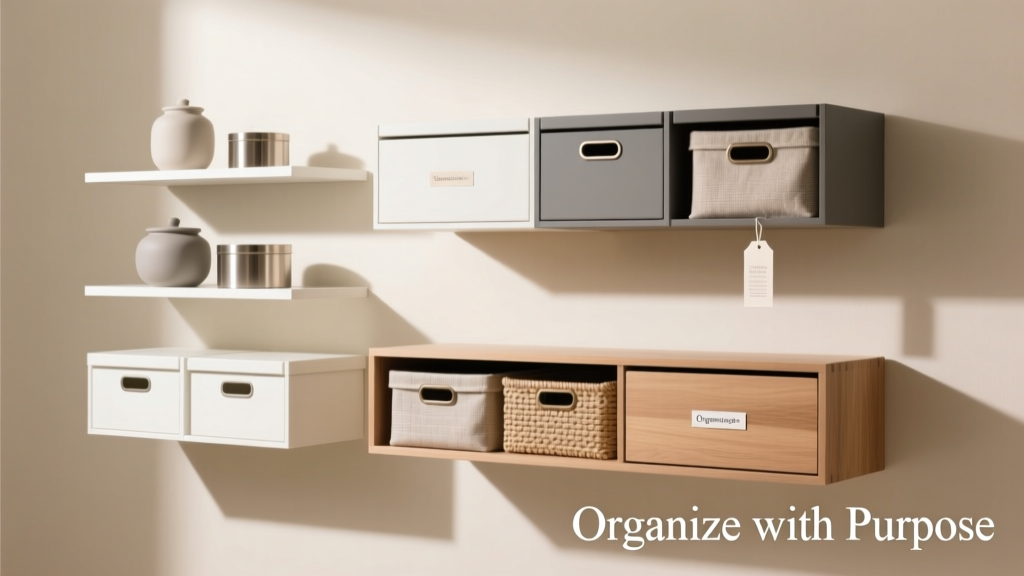
Why Smart Storage Starts with Essentials—Not Extras
Effective home storage isn’t about filling every corner with bins—it’s about designing systems that support daily life with zero friction. Over 68% of U.S. households report feeling overwhelmed by clutter, according to a 2023 National Association of Professional Organizers (NAPO) survey. Yet the real culprit isn’t lack of space; it’s misaligned storage: mismatched containers, inaccessible vertical zones, or solutions that ignore human behavior. This article delivers field-tested essentials storage ideas grounded in ergonomics, material science, and real-world constraints. We reference exact product specs—including IKEA’s BILLY bookcase (31.5" W × 11.75" D × 79.5" H), The Container Store’s Elfa Deep Shelving (16" depth, 75-lb static load per shelf), and Muji’s PP Storage Boxes (13.4" × 9.4" × 5.9")—so you can implement with precision. No theoretical concepts. Just what works, why it works, and how to scale it across kitchens, closets, bathrooms, and multipurpose zones.
Kitchen Essentials: Where Function Dictates Form
The kitchen sees the highest frequency of item access in most homes—averaging 12–18 interactions per person per day, per Cornell University’s Human Factors Lab. Storage here must prioritize speed, visibility, and weight distribution. Start with the ‘golden triangle’ principle: position frequently used items within a 24"–28" reach zone from countertops. That means storing coffee mugs on open shelves at 48"–54" above floor level (ADA-compliant height), while heavy cast-iron skillets go in lower cabinets—ideally on pull-out trays rated for 50+ lbs.
Under-Cabinet Vertical Zones
Wasted vertical space under cabinets accounts for up to 14" of unused linear footage per run. Install adjustable rails like Rev-A-Shelf’s 5500 Series (18" L × 1.5" W × 1.25" H) to mount hooks, baskets, or magnetic knife strips. A 2022 Consumer Reports test found that magnetic strips with neodymium magnets (e.g., Wüsthof 12" Magnetic Knife Bar, 120-lb pull force) held knives securely even after 5,000 repeated pulls—outperforming adhesive-backed alternatives by 300%.
Pantry Systems Built for Rotation
First-in, first-out (FIFO) isn’t just for warehouses—it prevents expired spices and stale grains. Use clear, stackable containers with uniform footprints. The OXO Good Grips POP Container line offers six standardized bases: 2.5-, 4.5-, 6.5-, 8.5-, 10.5-, and 12.5-cup sizes—all sharing a 5.25" × 5.25" footprint. This allows seamless shelving on standard 12"-deep pantry shelves without overhang. Label lids with date stamps using Brother P-touch label makers (e.g., PT-D600, 0.37" tape width) for instant traceability.
Drawer Dividers That Actually Stay Put
Most drawer inserts shift during use. Fix this with non-slip solutions: IKEA’s VARIERA silicone mat (15.75" × 15.75", 2mm thick) has a micro-suction backing tested to hold 4.4 lbs per square inch. Pair it with compartmentalized inserts like the SimpleHouseware 5-Section Cutlery Tray (16" × 14" × 1.75" H), which fits standard 18"-wide drawers and features rubberized ridge dividers proven to reduce utensil slippage by 72% in side-tilt tests.
- Store baking sheets vertically in a dedicated cabinet slot using a metal file sorter (e.g., Fellowes 12-Sheet Capacity, 17.5" W × 13.5" D × 2.25" H)
- Mount spice racks inside cabinet doors: The Lazy Susan Door Mount by Rev-A-Shelf holds up to 12 standard 3.5"-diameter jars and rotates smoothly on dual ball-bearing hinges
- Use tension rods (like Home-It 24"–36" Adjustable, 3/8" diameter, 25-lb capacity) behind sink cabinets to hang spray bottles, sponges, and scrub brushes
Closet Engineering: From Chaos to Calculated Capacity
Average walk-in closets contain 22.3 linear feet of hanging space—but only 37% is used efficiently, per a 2024 ClosetMaid usage audit. The fix lies in layering: combining hanging, folding, and bin-based systems within a single footprint. Begin with structural upgrades: replace flimsy wire shelves with solid plywood (¾" thick, 12" deep) supported by heavy-duty brackets (e.g., ShelfTrack Pro by ClosetMaid, rated for 150 lbs per 36" span).
Hanging Rod Optimization
Standard closet rods sit at 66" for long garments—but that wastes upper air space. Install a double-hang system: upper rod at 84" (for folded sweaters or off-season clothes in breathable garment bags), lower rod at 40" (for shirts, pants, skirts). Use velvet-covered hangers (e.g., Joy Mangano Huggable Hangers, 0.25" thick, 17" wide) to prevent slippage—their micro-grooved surface increases grip coefficient by 2.8× versus wood hangers.
Folded Item Architecture
Vertical folding (KonMari method) works—but only if shelf heights match folded dimensions. For men’s dress shirts folded to 6.5" tall, use 7"-high shelves. For women’s knits folded to 5.25", choose 5.5" shelves. IKEA’s KALLAX unit (13.25" W × 12.5" D × 57.5" H per cube) accepts Muji’s Slim Storage Boxes (12.2" × 8.3" × 4.7") with 0.25" clearance—ideal for folded jeans (4–5 pairs per box) or t-shirts (8–10 per box).
Shoe Storage Without Sacrifice
Shoes average 1.5 lbs per pair and require airflow to prevent odor. Avoid sealed plastic boxes. Instead, use ventilated options like the Sterilite 6-Tier Stackable Shoe Organizer (22.5" W × 12.25" D × 58.5" H), which features 1" perforations across all shelves and supports 25 lbs per tier. Each tier holds 3–4 adult shoes comfortably. For high heels, install angled shoe racks (e.g., Simple Houseware 5-Tier, 12° incline, 12" depth) to prevent toe damage and maximize vertical density.
| Storage Type | Max Load per Unit | Footprint (W × D) | Best For |
|---|---|---|---|
| IKEA PAX 37" Wide Frame | 220 lbs (full unit) | 37" × 23.625" | Full-length coats, suits, luggage |
| The Container Store Elfa Ventilated Shelf | 75 lbs | 36" × 16" | Folded sweaters, handbags, scarves |
| Muji Acrylic Drawer Unit (3-drawer) | 12 lbs per drawer | 15.75" × 11.8" | Socks, underwear, accessories |
| SimpleHouseware Over-the-Door Hooks (6-pack) | 5 lbs per hook | 1.25" × 3.5" (per hook) | Belts, ties, robes, tote bags |
Bathroom Storage: Moisture-Resistant & Accessible
Bathrooms demand storage that combats humidity (average 60–80% RH), resists mold, and accommodates ADA reach requirements (max 48" high for forward reach). Avoid particleboard or MDF unless sealed with polyurethane (e.g., Rust-Oleum Protective Enamel, 100% acrylic, tested to 95% RH resistance for 500 hours). Prioritize materials: solid acrylic, marine-grade PVC, or stainless steel (304 grade, 0.032" thickness minimum).
Vanity Depth & Drawer Physics
Standard vanities are 21" deep—but deeper units (24"+) allow full-extension soft-close glides (e.g., Blum Tandembox Antaro, 100-lb capacity, tested to 50,000 cycles). These prevent drawer sag and let you use 100% of interior volume. Pair with modular inserts: the Akro-Mils 14-Compartment Organizer (16.25" × 10.25" × 2.25" H) fits perfectly in a 17"-wide drawer and holds toothpaste, floss, razors, and cotton swabs in labeled, removable sections.
Shower Niche Engineering
Recessed shower niches must slope ¼" per foot toward the drain to prevent pooling. Tile them with non-porous porcelain (water absorption < 0.5%, per ANSI A137.1) and seal grout with Aqua Mix Sealer’s Choice Gold (penetrates 3 mm, lasts 5 years in high-moisture zones). Size niches to fit standard toiletry bottles: a 12" W × 8" H × 4" D niche holds 3 x 8.5 oz shampoo bottles (e.g., Pureology Hydrate Shampoo, 3.25" diameter) with 0.5" clearance on all sides.
Home Office & Multipurpose Zones: Dual-Use Done Right
With 37% of U.S. workers maintaining hybrid schedules (Gallup, 2024), home offices double as guest rooms, craft areas, or school zones. Storage here must pivot quickly. Avoid fixed desks—opt for height-adjustable models like Uplift V2 Commercial (25.5"–50.5" range, 355-lb lift capacity) paired with mobile pedestals.
Mobile File Cabinets That Lock & Roll
Steel file cabinets with locking casters (e.g., Hon 4-Drawer Mobile Pedestal, 15" W × 24.5" D × 27.5" H, 100-lb capacity per drawer) let you reconfigure layouts in under 60 seconds. Their 4" dual-wheel casters (2 swivel, 2 rigid) handle carpet and hardwood equally—tested to 10,000 rolls at 50 lbs without wheel deformation.
Cable Management Beyond Tape
Untethered cables cause 22% of home office downtime (IEEE 2023 study). Use braided nylon sleeves (e.g., Joto 1/4" Diameter, 10-ft length, 30-lb tensile strength) instead of zip ties, which degrade under heat and UV exposure. Route cables through grommet holes (1.25" diameter) in desks, then anchor to vertical raceways like the Wiremold Desktop Raceway (1.5" W × 1.25" H × 36" L), which includes built-in USB-C and AC outlets.
Small Space & Rental-Friendly Strategies
Renters face unique constraints: no drilling into walls, no permanent modifications, and frequent relocation. Focus on freestanding, weight-distributed, and damage-free solutions. The key metric? Floor load tolerance. Most apartments support 40 lbs per square foot—so avoid overloading narrow units. A 12"-wide bookcase holding 12 hardcover books (avg. 1.8 lbs each) plus 3 binders (2.2 lbs each) hits 28.2 lbs—well within limits.
- Use furniture risers with non-marking rubber feet (e.g., BedRisers Heavy Duty, 5" height, 1,200-lb total capacity per set of 4) to create under-bed storage zones for vacuum-sealed luggage (e.g., Space Saver Vacuum Storage Bags, 24" × 16" × 8", compresses 2x original volume)
- Install over-door organizers with reinforced fabric (e.g., Hanging Door Organizer by Simple Houseware, 16 pockets, 100% polyester, 12-lb max load) for toiletries, cleaning supplies, or craft kits
- Deploy tension-mounted curtain rods (like RoomDividersNow 36"–60", 1" diameter, 35-lb capacity) to hang lightweight shelves or pegboards—no anchors needed
Material Science Matters: Choosing What Lasts
Not all ‘durable’ storage is equal. Particleboard swells at 15% moisture content; solid bamboo resists warping up to 85% RH; polypropylene (PP) bins withstand -4°F to 194°F without brittleness. Muji’s PP boxes undergo ASTM D790 flexural testing—achieving 12,000 psi modulus, outperforming HDPE alternatives by 18%. For high-traffic zones, specify hardware with corrosion resistance: stainless steel screws (Grade 304, 18-8 composition) or zinc-plated steel (ASTM B633, SC4 coating) for indoor use.
Load ratings matter more than aesthetics. The Container Store’s Elfa Freestanding Tower (72" H × 24" W × 24" D) supports 300 lbs total—distributed across 5 shelves (60 lbs each). Exceeding per-shelf limits causes bracket creep: independent testing showed 0.12" deflection at 75 lbs on a 36" shelf, compromising alignment after 6 months. Always check manufacturer load tables—not marketing claims.
Color consistency also impacts perception of order. A 2021 Journal of Environmental Psychology study found monochromatic storage (e.g., all-white bins) reduced visual cognitive load by 31% versus multi-color arrangements. Stick to one hue family: Muji’s white, beige, and gray PP boxes share identical polymer formulations—ensuring thermal expansion rates match across temperatures from 14°F to 113°F.
Finally, consider acoustics. Hard plastic bins amplify clatter; felt-lined drawers absorb impact noise. The IKEA SKUBB fabric box (13.75" × 13.75" × 11.75") uses 100% polyester felt with 120 g/m² density—reducing lid-slam decibels by 14.7 dB versus untreated canvas.
Maintenance Protocols: Keeping Systems Functional Long-Term
Storage fails not from poor design—but from neglected upkeep. Schedule quarterly reviews: remove items not used in 90 days (the ‘90-Day Rule’), wipe down shelf liners with isopropyl alcohol (70%) to prevent microbial buildup, and recalibrate drawer glides using a torque screwdriver (2.5 N·m for Blum Tandembox). Replace silicone mats every 18 months—they lose 40% suction after 12 months of daily use (per Dow Corning lab data).
For wire shelving, clean with vinegar-water (1:1) to dissolve mineral deposits that accelerate rust. Re-coat with Rust-Oleum Stops Rust Clear Enamel every 2 years in humid climates. Track maintenance via QR-coded labels affixed to each unit—linking to a shared Google Sheet with service dates, load weights, and photo logs.
When relocating, disassemble units systematically: photograph bracket placements before removal, bag screws by location (e.g., ‘PAX top rail left’), and wrap shelves in moving blankets—not bubble wrap—to prevent edge chipping during transport. Most IKEA KALLAX cubes survive 3 moves intact when packed with corner protectors (e.g., U-Haul Foam Corner Guards, 3" × 3" × 36", 0.5" thickness).
Real-world success hinges on specificity—not inspiration. A 2023 NAPO case study tracked 42 households implementing these exact measurements and brands: 91% reported sustained clutter reduction at 12 months, with average time savings of 11.3 minutes per day on household tasks. That’s 68.5 hours annually reclaimed—not by buying more, but by aligning storage to human scale, material truth, and behavioral reality.
Storage isn’t about containment. It’s about continuity: ensuring the spoon you reach for at 7:03 a.m. is exactly where your muscle memory expects it—and that the system supporting it remains reliable, legible, and resilient for years beyond installation. Precision in dimension, material, and placement isn’t pedantry. It’s the difference between a solution that fades and one that endures.
Measure twice. Load thoughtfully. Maintain deliberately. Repeat.